play Live Sign upShow navigation menuplay Live Click here to searchsearchSign upNews|MilitaryOne ‘party state’: Guinea dissolves main opposition partiesDecree strips parties of legal status and assets, as opposition leader calls on Guineans to resist
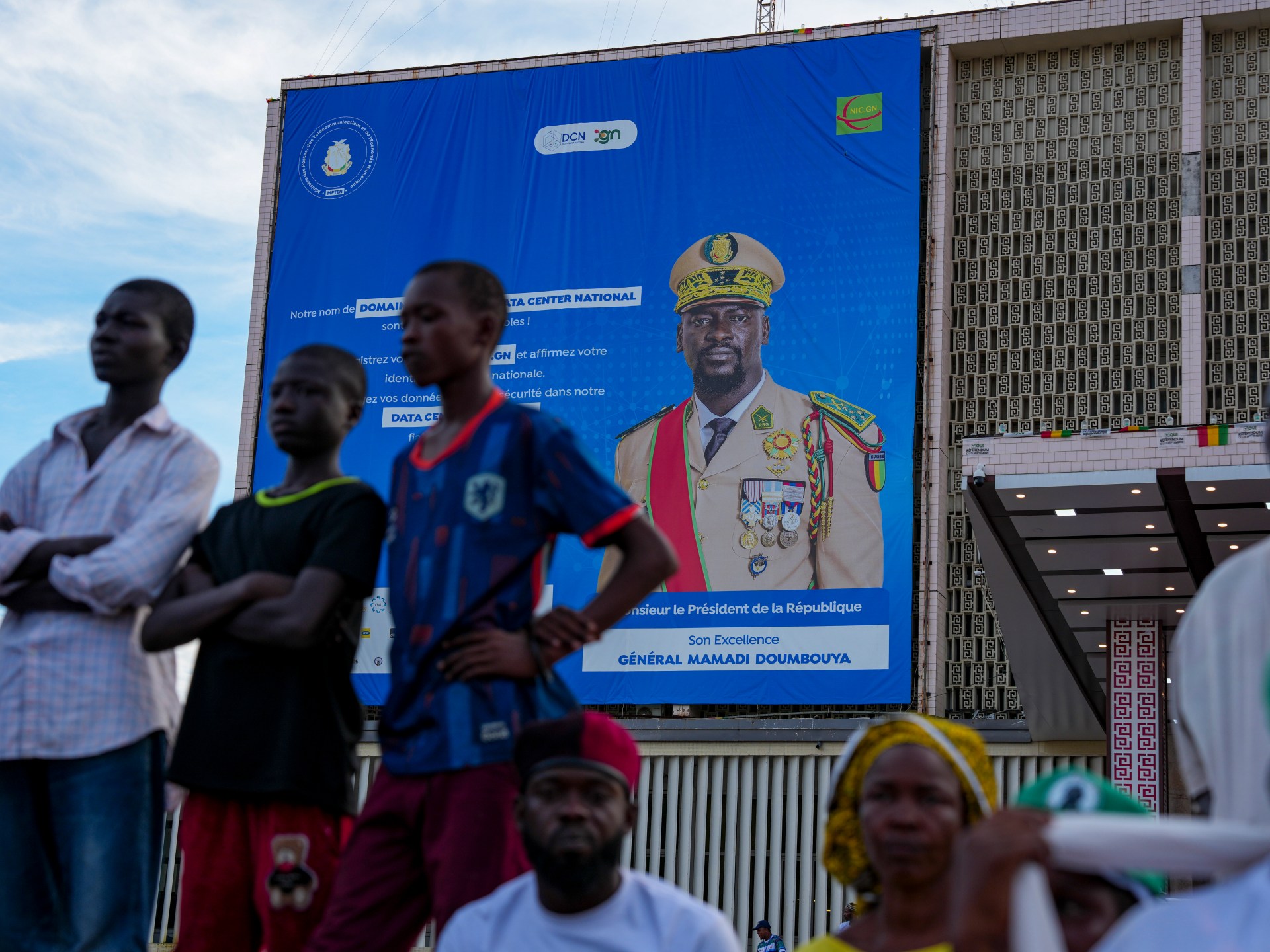
Listen to this article | 3 minsinfoPeople stand in front of a billboard showing President Mamady Doumbouya, ahead of the constitutional referendum in Conakry, Guinea [Misper Apawu/AP]By AFP and The Associated PressPublished On 8 Mar 20268 Mar 2026Click here to share on social mediashare2Share
googleAdd Al Jazeera on GoogleinfoGuinea’s government has dissolved 40 political parties, including the country’s three main opposition groups, in a move critics say marks the final step towards a one-party state under President Mamady Doumbouya.
The Ministry of Territorial Administration and Decentralisation issued the decree late on Friday, citing the parties’ failure to meet their legal obligations.
Beyond stripping them of their legal status, the order froze their assets and banned the use of their names, logos and emblems, with a government-appointed curator assigned to oversee the transfer of their holdings.
The three most prominent parties dissolved are the Union of Democratic Forces of Guinea (UFDG), the Rally of the Guinean People (RPG) – the party of ousted former President Alpha Condé – and the Union of Republican Forces (UFR).
All three had already been suspended last August, weeks before a constitutional referendum that cleared the way for Doumbouya to stand in December’s presidential election.
UFDG leader Cellou Dalein Diallo, speaking from exile, accused Doumbouya of dismantling democratic life to entrench his grip on power. In a video posted to Facebook on Sunday, he said the dissolution was part of a deliberate drive to build a “party-state” and urged supporters to “rise as one” against a government that had lasted “far too long”.
He said that dialogue and legal routes had been exhausted, while his party’s communications coordinator went further, describing the decree as “the final act of a true political farce” aimed at cementing single-party rule.
Ibrahima Diallo, a leader in the pro-democracy National Front for the Defence of the Constitution, said the move had “formalised a dictatorship” and warned that Guinea was sinking into “profound uncertainty”.
The crackdown is the latest in a sustained campaign against dissent under Doumbouya, who seized power in a 2021 coup before winning a presidential election in December, a vote from which all major opposition figures were barred.
Since taking power, his government has shut down media outlets, banned protests and arrested or driven into exile scores of opposition figures and civil society activists.
Several relatives of prominent dissidents have also been abducted, and two well-known pro-democracy activists have been missing since July 2024.
A wave of coups has brought military leaders to power in Africa, across a belt stretching from the Atlantic through the Sahel region to the Red Sea since 2020, while an attempted coup in Benin failed in late 2025.
The development has led to what analysts have described as a “coup belt“.
Madagascar’s and Guinea-Bissau’s armies most recently removed civilian leaders in their respective countries from power in late 2025, underscoring growing discontent with elected governments.
Although often carried out with popular backing, the military takeovers have also seen civil liberties clawed back.
A 2025 study found that while military takeovers have declined globally, the risk of coups in Africa remains comparatively high.