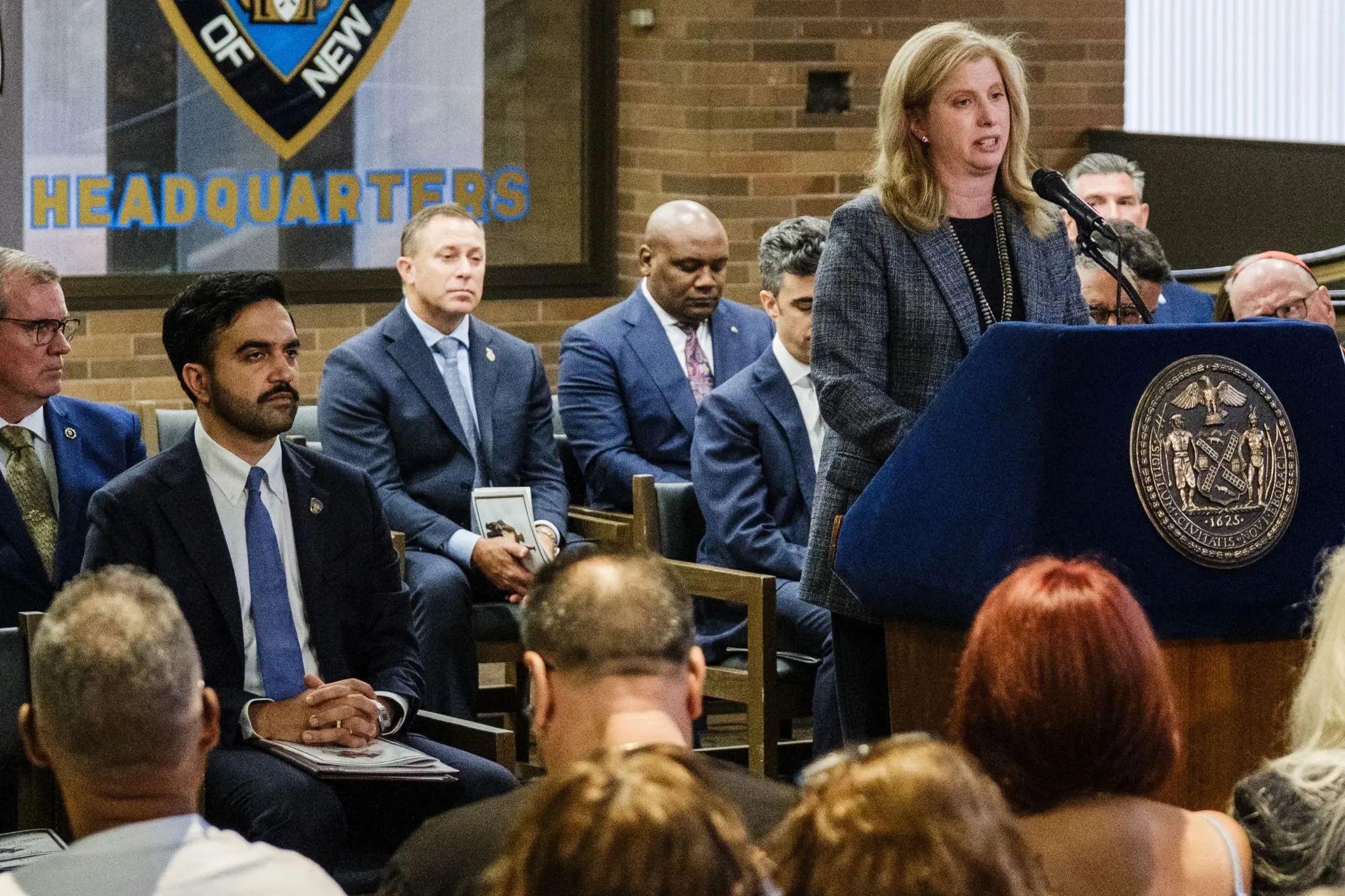
NYPD Commissioner Jessica Tisch speaking at a ceremony at police headquarters to unveil a new plaque honoring the department's 9/11 victims on Sept. 9, 2026. Stephen Yang for NY Post See more of our coverage in your search results.
Add The New York Post on Google Once upon a time, the job of New York’s police commissioner was hard enough: catch the bad guys, curb crime, keep the streets safe.
It fell to NYPD Commissioner Jessica Tisch this week to render the most difficult and most desperately needed service of all — giving us a dose of moral clarity.
“The men who attacked this city were terrorists,” Tisch said in a press conference marking a quarter of a century since the attacks of September 11, 2001.
“The men and women who ran into the towers to save innocent lives were heroes. Twenty-five years cannot be allowed to blur that distinction, and shame on those who do.”
Tisch wasn’t wagging her finger at anyone in particular, but it wasn’t too hard to understand that she was addressing not only the media but the man sitting right behind her, Mayor Mamdani.
The same Mamdani who repeatedly refused to condemn the phrase “globalize the intifada” — as if 9/11 was anything but the most prominent example on record of the intifada, or relentless Islamic violence, being successfully globalized.
The same Mamdani who once rapped enthusiastically about the Holy Land Five — convicted terrorists who subscribed to the very same murderous ideology as Mohamed Atta and his 9/11 band of killer jihadis.
The same Mamdani who called the NYPD a “rogue agency” while waxing poetic about Palestinian terrorism.
The mayor, then, clearly needed the commissioner’s reminder, having failed repeatedly at telling the good guys apart from the bad.
But when it comes to moral clarity, the rest of us could use a refresher as well.
Because lately, we too often swoon over the monsters while scoffing at their victims.
Luigi Mangione, for example, the Ivy League-educated brat who assassinated UnitedHealthcare CEO Brian Thompson, now has 42,000 superfans who have collectively raised more than $1.5 million for his defense and who show up with homemade T-shirts and signs to cheer on their homicidal heartthrob whenever he appears in court.
The case of Lindsay Clancy, the Massachusetts nurse who strangled her small children in cold blood, delivered another shocking reminder that moral clarity is in very short supply. Eleven of her jurors, disregarding overwhelming evidence, voted to find Clancy not guilty because they felt great compassion for the murderous mom and none for Cora, age 5; Dawson, age 3; and 8-month-old baby Callan.
Why do so many Americans, time and again, hop on over to the wrong side of the moral fence?
The answer should keep historians, philosophers and members of the clergy busy for a few decades, but if you’re looking for a succinct explanation, you can do no better than turning to the finest of all manuals on good versus evil: the Bible.
Read the Good Book, and you’ll understand it right away to be, among other things, a record of contests between heathens and believers.
The latter — pious men and women — are preaching mercy and compassion, and advocating a whole battery of laws and observances meant to keep our basest instincts in check.
The former aren’t as cautious; they live in a universe of fear, loathing and appetites.
Like our contemporary woke parents who declare their small children to be transgendered before putting them needlessly under the surgeon’s knife, the heathens of old, too, sacrificed their kids to the latest trendy demon.
Like our eco-terrorists who think nothing of blowing up power lines to protect Mother Earth, the ancient pagans, too, worshipped the trees and the rocks.
Like our “pro-Palestine” marauders who ecstatically applaud the rape of young Jewish women and the murder of Jewish babies, the idolaters we read about in the Scriptures considered tribal violence a sacred and cleansing rite.
There’s nothing particularly new about any of these aberrations.
They surprise us only because so many of us have grown up thinking that ours was a uniquely modern age, one that could replace quaint and absolute terms like “good” and “evil” with a more sophisticated public conversation about root causes and emphatic solutions.
In every generation, we’ll have very bad people committing atrocities, and very good people fighting to stop them.
The only real danger we face is losing sight of which is which.
Liel Leibovitz is editor at large for Tablet and senior fellow at the Hudson Institute.