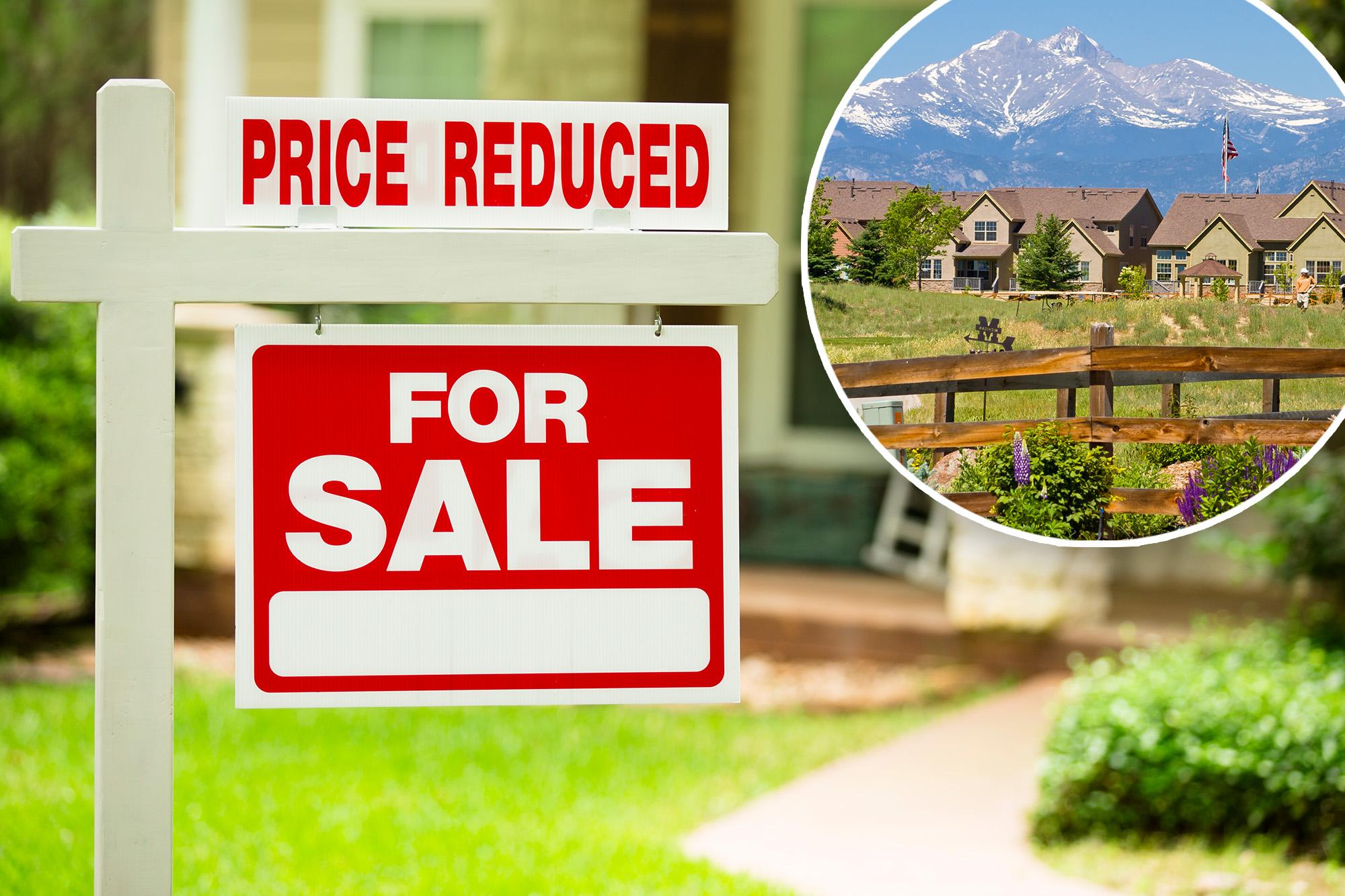
Add The New York Post on Google Home sellers across America are throwing in the towel on their asking prices at a record clip.
A staggering 42% of all active home listings in the United States are currently undergoing price reductions, according to fresh data released this week by real estate analytics firm Parcl Labs.
That figure marks a 24 basis point jump from just one week earlier, with the national inventory of active listings sitting at 1.57 million homes.
The cuts aren’t landing evenly. A cluster of Western and Sun Belt markets have blown past the 50% mark, meaning more than half the homes for sale in those cities are now priced lower than when they first hit the market.
Colorado Springs is leading the pack with 56.3% of its listings slashed. Austin isn’t far behind at 54.1%, followed by San Antonio at 53.4%, Denver at 53.1% and Kingsport, Tennessee at 51.1%.
On the flipside, even sellers in a handful of smaller Northeast and Midwest markets holding firm and barely budging on price still have a good chunk of cuts.
Rochester has the lowest share of price cuts in the country at 17.8%, trailed by Atlantic City at 18.9% and Lincoln, Nebraska at 22.1%. Those markets have largely avoided the glut of inventory piling up elsewhere, giving sellers there far more room to wait out a buyer willing to pay closer to asking.
Zoomed out to the state level, the Parcl map shows the deepest red concentrated in the Mountain West and Southern states.
Colorado and Oregon are both hovering just under the 50% threshold statewide at 49.6% and 49.7% respectively, while Texas sits at 47.9%, South Carolina at 46.8% and Arizona at 46.8% as well.
Tennessee, Florida and Louisiana are all clustered in the mid 40s too, reinforcing just how broadly the discounting has spread across the Sun Belt.
New York, by contrast, sits at a comparatively modest 28.9%, putting it closer to the more insulated markets than the fire sale conditions out west. Connecticut is even cooler at 25.1%, and New Jersey checks in at 28.4%, suggesting the tri-state area’s tighter supply is still giving sellers there some breathing room.
Illinois stands out as one of the lowest in the country at 28.2%, while nearby Indiana runs hot at 46.7%, a reminder that even within the same region, price pressure can vary wildly.
Michelle Griffith of Douglas Elliman said buyers simply aren’t playing along with aggressive pricing anymore.
“Buyers today are incredibly educated and they are willing to wait. If a seller comes to market too aggressively, buyers aren’t afraid to sit on the sidelines and let the property come to them. That’s when you start seeing price reductions,” Griffith told The Post.
She added that many reductions are less a sign of weakness than a correction.
“The properties that are priced correctly from the beginning are still trading, and exceptional properties can still command a premium,” Griffith said.
“You want to come to market at a price that creates urgency. The longer a property sits and the more reductions it takes, the more leverage you ultimately hand to the buyer,” she said.
Ali Wolf, chief economist at NewHomeSource and Zonda, pointed to a broader affordability squeeze driving the trend nationally.
“There’s a bit of a panic among home sellers. The hope going into this year was that interest rates were going to go down, but as time has gone one, we’ve seen the complete opposite. Real-time mortgage rates are back in the 7% [range]. This means that prospective buyers are facing higher monthly payments,” Wolf told The Post.
“For existing homeowners trying to sell, lowering the home price is one way to at least help offset the higher costs for shoppers. Areas that are very expensive (like the Mountain West) or oversaturated with supply (like the Southeast) are bound to see more price adjustments to encourage a sale,” Wolf said.