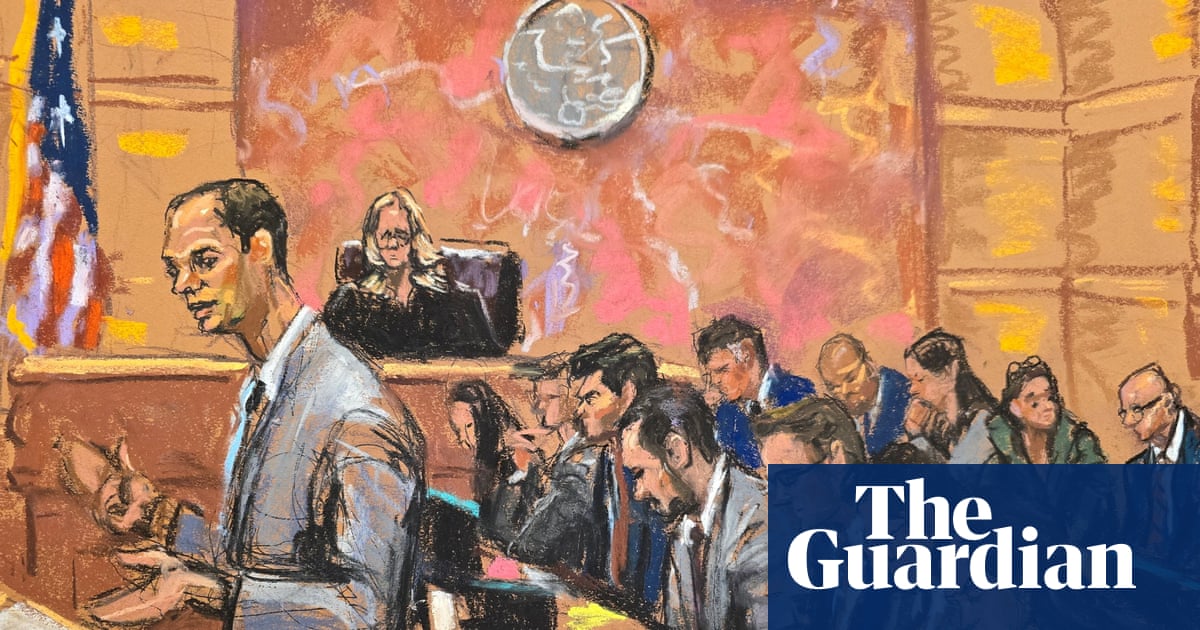
Taylor Stout, a lawyer for the Department of Justice, makes opening statements at the start of the bank fraud trial against China's Huawei Technologies as judge Ann Donnelly presides in federal court in Brooklyn, New York, on Wednesday in this courtroom sketch. Photograph: Jane Rosenberg/ReutersView image in fullscreenTaylor Stout, a lawyer for the Department of Justice, makes opening statements at the start of the bank fraud trial against China's Huawei Technologies as judge Ann Donnelly presides in federal court in Brooklyn, New York, on Wednesday in this courtroom sketch. Photograph: Jane Rosenberg/ReutersChina’s Huawei branded a criminal enterprise as tech firm’s US trial opensThe defense says: ‘It’s about competition, not conspiracy’
A US prosecutor described China’s Huawei as a criminal enterprise that stole from US companies to build its telecommunications empire, as the trial against the tech company kicked off in Brooklyn federal court on Wednesday.
“Theft, lies, cover-up,” Taylor Stout, a trial attorney from the US Department of Justice, said in the government’s opening statement. “For 20 years, that’s how Huawei, a massive Chinese telecommunications company, victimized American companies and abused the American financial system, all in an effort to dominate the telecommunications industry around the world.”
Huawei conspired to steal trade secrets from five US companies, including operating system source code for internet routers from Cisco Systems and a robotic arm to test phones from T-Mobile, to gain an unfair competitive advantage and grow its business, the prosecutor told jurors.
“We’ll hear from people who caught Huawei red-handed trying to steal American tech,” Stout said, adding there was video of an employee stealing the robotic arm.
The defense painted a very different picture of the company and its success in court.
“It’s about competition, not conspiracy. Innovation, not theft. Ordinary business dealings, not criminal conduct,” Brian Heberlig, one of a team of lawyers representing Huawei, said in his opening. “Huawei earned its success ... There was no blueprint for crime.”
Huawei is known for its telecommunications equipment, mobile phones and, in recent years, AI chips. It does business globally but its networking gear is restricted in the US and suppliers are banned from exporting US goods and technology to the company without approval from the Department of Commerce.
On Thursday, a Chinese foreign ministry spokesperson said “the Chinese government firmly opposes the US side’s suppression and containment of Chinese enterprises,” when asked about the case and the US prosecutor’s “criminal enterprise” description.
China “firmly supports Chinese enterprises in safeguarding their legitimate rights and interests”, the spokesperson said at a regular press conference.
The case against Huawei began in 2018 with an indictment charging the company and its chief financial officer with bank fraud and sanctions violations for allegedly misrepresenting its business in Iran to get around US sanctions and move millions of dollars through the US financial system.
In the ensuing years, it grew into a sprawling indictment that includes racketeering, a pattern of illegal activity conducted by an enterprise to generate profit.
Heberlig, defending Huawei, told jurors that prosecutors will describe routine activities by global tech companies “but will twist those ordinary activities to try to make them look criminal”.
He said the incidents involving Cisco and T-mobile were “actions by individual employees” and that management worked to make things right after learning of them.
The prosecutor also accused the company of keeping the nature of its work in Iran secret so it could launder US dollars through the financial system and could help the Iranian government spy on its own citizens. The defense said there was no evidence Huawei knew the dollar-clearing would violate US sanctions law.
In 2018, Huawei’s chief financial officer, Meng Wanzhou, was detained in Vancouver after being picked up on a US warrant as a part of the original indictment. She fought extradition for nearly three years before being freed to return to China in a diplomatic agreement between the US, China and Canada.
The charges against her were dismissed in 2022 as part of a deferred prosecution agreement but admissions she made are set to be introduced as evidence at the trial, which is expected to last three months.