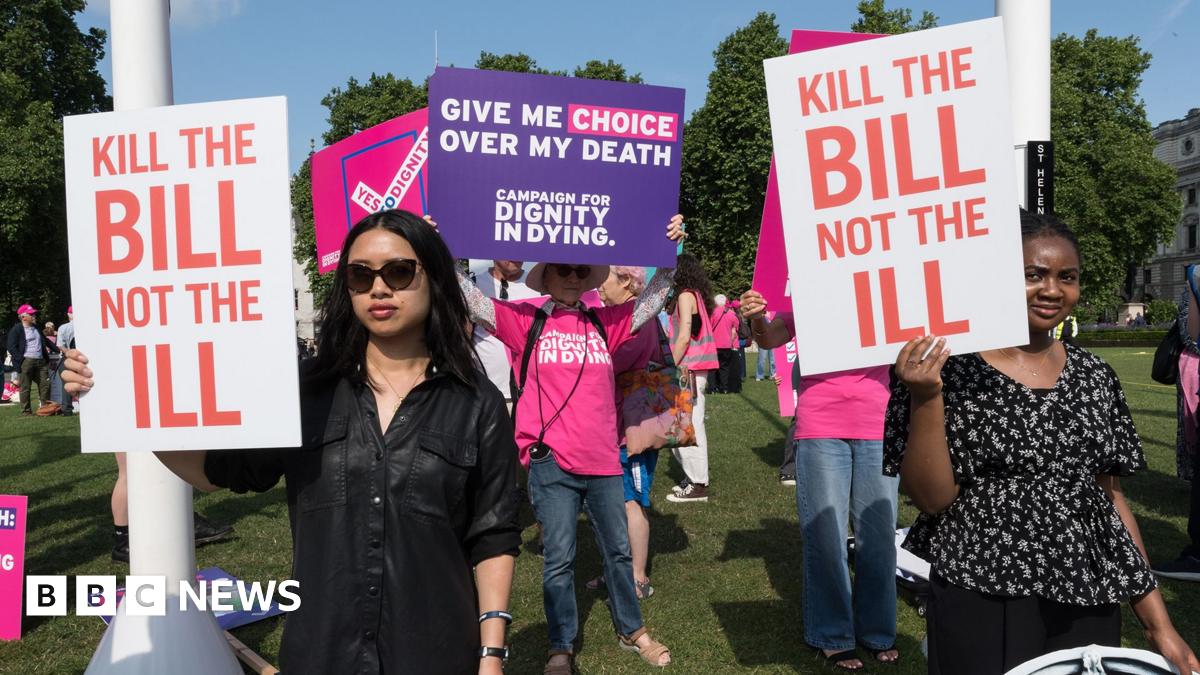
MPs will vote again on proposals to legalise assisted dying in England and Wales on Friday.
The Terminally Ill Adults (End of Life) Bill would allow adults with fewer than six months to live to apply to be given help to end their own life.
This would be subject to certain safeguards, including requiring the approval of two doctors and an expert panel.
Labour MP Lauren Edwards, who has brought forward an identical bill to the previous attempt, says she wants to ask the House of Lords to "finish the job".
The last effort to change the law ran out of time to clear all the necessary stages in Parliament.
Proposals tabled by Labour's Kim Leadbeater in 2024 to legalise assisted dying cleared the House of Commons on 20 June last year with a majority of 23.
But it did not clear all its stages in the Lords, with peers tabling more than 1,200 amendments.
Supporters of the bill accused some peers of using delaying tactics to block the proposals, while critics argued it did not have sufficient safeguards to protect vulnerable people.
From 09:30 BST, what is known as a second reading debate will take place - which gives MPs the opportunity to discuss the main principles of the bill.
The debate cannot run beyond 14:30 BST, and a vote is expected before that cut-off time.
Both sides expect the result to be close. "It's on a knife edge," one of those closely involved told the BBC.
Opponents believe support for the bill has weakened since MPs last considered it. But they are not confident they have the numbers to win the vote.
Supporters and those opposed believe the outcome will come down to who turns up on Friday, a day when many MPs are typically in their constituencies rather than in Westminster.
Several MPs the BBC spoke to despaired that such a significant social change could hinge on their colleagues' diary commitments.
"I can't tell someone not to go to their sister's wedding," said one MP leading efforts to persuade backers of the bill to vote.
Others have been convincing MPs on a planned trip to Ukraine to change their flights in order to be present.
In 2024, more than 160 MPs indicated they wanted to speak during the second reading debate on Leadbeater's bill but fewer have asked to speak this time.
Edwards made clear from the start that she wanted to bring forward a bill that was identical to the one approved by the Commons in June last year.
This paves the way for rarely used powers to override objections from peers should they refuse to pass it again.
Bills usually only become law if both Houses of Parliament agree on its final wording.
Under the terms of the Parliament Acts, external, if an identical bill passes the Commons in two successive parliamentary sessions then the Lords cannot halt its progress a second time.
Peers can suggest amendments which, if agreed by the Commons, would be added to the bill.
But ultimately the powers could enable the bill to become law at the end of this current session even without peers' approval.
The Parliament Acts were last used in 2004 to push through a ban on fox hunting.
Opponents have warned that using this procedure would risk creating a law which disability charities, hospices and others have raised major concerns.
Gareth Snell, a Labour MP who backed the bill last time, has signed a letter to Labour MPs saying he had "a profound concern" at the possibility of using the Parliament Acts.
"This is an extraordinary risk for us to take," he said in a letter co-signed with Dame Meg Hillier, a prominent opponent of assisted dying.
Edwards argues she does not want to use the Parliament Acts but MPs passing an identical bill would force peers to scrutinise, rather than block, the legislation.
If the bill is backed by MPs on Friday then it will proceed to the next stage known as committee, which will see possible amendments debated by MPs. However those behind the bill have made clear they would oppose any amendments suggested by MPs in order for the Parliament Acts to be in force.
Instead they would leave it to peers to suggest potential amendments.
If MPs vote against the bill on Friday, it would fall.
However supporters say even if the bill does not pass, there will be another attempt to legalise assisted dying as soon as possible.
"Whatever happens on Friday this isn't the end of assisted dying," one said. "It will come back again and again and again."
Privately they acknowledge the current makeup of Parliament, with such a large proportion of Labour MPs who tend to support assisted dying, is a "unique moment" to pass this change.
Prime Minister Andy Burnham has said he will not vote on the bill on Friday, noting he has his "own personal views on the issue" but it was "a matter for Parliament to decide".
Writing to Labour MPs last month, Burnham said: "My role, as the prime minister, will be to lead a government that implements the will of Parliament in this area – whether that is to change the law or not."
He also stressed the government would officially remain neutral on the bill.
In July, Burnham said the funding of palliative and social care should be "fixed" before assisted dying is considered in England and Wales.
It was the first time he set out his position on the issue after becoming PM.
During his first stint as an MP, Burnham abstained from a 2015 vote on another bill to legalise assisted dying because of concerns over safeguards and people feeling under pressure.
In 2024, when he was the mayor of Greater Manchester, Burnham told BBC Manchester he would "probably vote in favour" of Leadbeater's bill if he was in Parliament.
He said he had had "family experience in the nine years since that has changed my view".
Burnham caveated his support as being for the principle of assisted dying and insisted he would want a requirement before any new law was implemented that hospices would be "properly funded and sorted out".