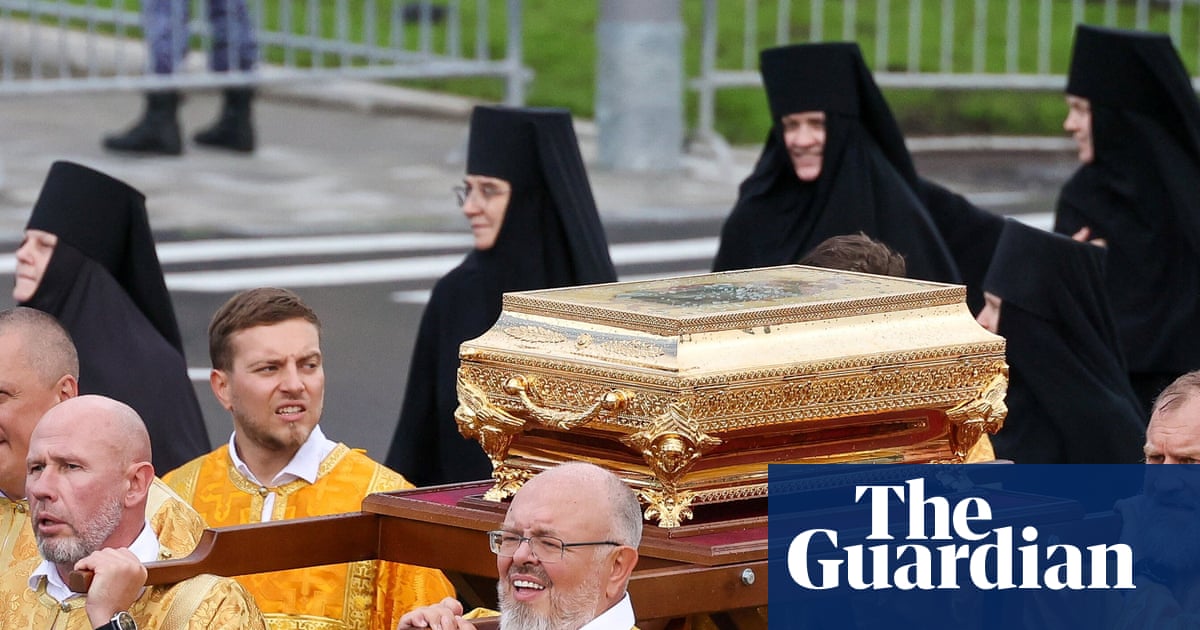
The relic was first brought on Tuesday to the Saur-Mogila war memorial in the Russian-occupied Donetsk region of Ukraine. Photograph: Yaroslav Chingaev/ReutersView image in fullscreenThe relic was first brought on Tuesday to the Saur-Mogila war memorial in the Russian-occupied Donetsk region of Ukraine. Photograph: Yaroslav Chingaev/ReutersOrthodox church sends medieval prince’s remains to Russian troops in UkrainePart of Dmitry Donskoy’s right hand sent to ‘spiritually strengthen’ soldiers
The Russian Orthodox church has sent a fragment of a medieval warrior prince’s remains to troops fighting in Ukraine, saying the relic would “spiritually strengthen” soldiers and help them achieve victory.
A reliquary containing part of the right hand of Dmitry Donskoy, the 14th-century prince revered in Russia for his victory over the Mongolian Golden Horde in 1380, has been taken to Russian-occupied eastern Ukraine and is now being transported along the frontline.
The Russian Orthodox church said in a statement: “The holy commander is going to where the fate of the fatherland is being decided today, so that he may invisibly take his place in the same battle ranks as our defenders.”
The relic was first brought on Tuesday to the Saur-Mogila war memorial in the Russian-occupied Donetsk region of Ukraine, where senior Orthodox clergy held a prayer service alongside representatives of the Russian military.
The Russian-installed Metropolitan Vladimir of Donetsk and Mariupol said its presence would help soldiers and civilians “mobilise their strength” and secure victory over the enemy.
Read moreThe relic’s journey is the latest example of the Russian Orthodox church’s rabid embrace of the Kremlin’s war in Ukraine, which Patriarch Kirill, its leader, has repeatedly portrayed in religious terms.
Since Vladimir Putin launched the full-scale invasion in February 2022, the church hierarchy has become deeply embedded in the Russian war effort. Priests have been sent to military units and occupied territories; while churches across Russia have been instructed to recite prayers asking God to grant victory.
Donskoy’s relics were first formally uncovered only last month during restoration work at the Cathedral of the Archangel inside the Kremlin, where generations of Russian princes and tsars are buried.
Putin, who has grown increasingly close to the Russian Orthodox church over his more than two decades in power, personally attended the ceremony marking the unearthing.
Critics have accused the church of breaking with religious protocol by opening Donskoy’s centuries-old tomb. The location of the prince’s burial had long been known, but the church had previously made no attempt to exhume his remains after he was canonised in 1988.
Alexander Zanemonets, an Orthodox priest and historian based outside Russia, said the decision to uncover the relics almost four decades after Donskoy’s canonisation appeared driven by the demands of wartime patriotism.
He wrote in a piece for the Carnegie thinktank: “By the fifth year of war, the church leadership in Moscow began to wonder what else it could do to show its support for what Russia terms its ‘special military operation’.”
Zanemonets said the portrayal of Donskoy as a defender of the homeland fitted neatly with the Kremlin’s insistence that Russia was defending itself rather than conducting a war of aggression against its neighbour.
Earlier this year, relics of Alexander Nevsky, another medieval prince and military hero revered by the Russian Orthodox church, were also sent to the front.