play Live Sign upShow navigation menuplay Live Click here to searchsearchSign upFeatures|ElectionsMulticultural Malmo: Swedish city loathed by far right braces for electionAl Jazeera speaks to voters in Malmo, a city the far right often singles out for its diversity, ahead of Sweden’s vote.
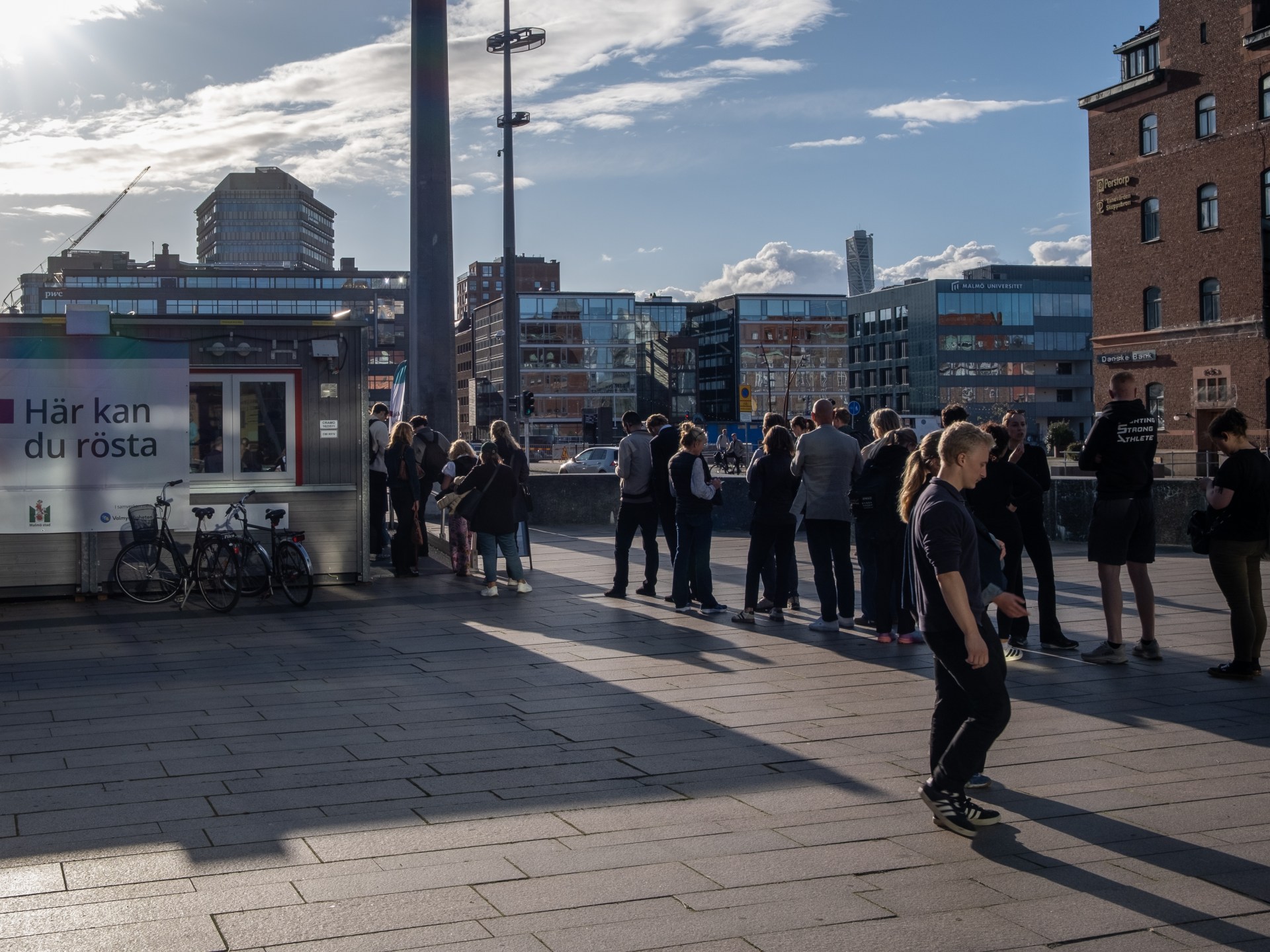
xwhatsapp-strokecopylinkgoogleAdd Al Jazeera on GoogleinfoLining up to vote in Malmo, September 9, 2026 [Nils Adler/Al Jazeera]By Nils AdlerPublished On 10 Sep 202610 Sep 2026*Some interviewees asked that their surnames be withheld because of the political nature of the interviews.
Malmo, Sweden – A very Swedish political tradition is playing out in Malmo, the country’s third-largest city. Rows of twee campaign booths, known as “election cottages”, are packed into a corner of the central square.
National polls have Sunday’s election on a knife-edge, with the centre-left opposition bloc led by the Social Democrats just a few percentage points ahead of the right-wing group – a gap that has tightened over the past month.
In the middle of the row, representatives of the Left Party and the far-right Sweden Democrats (SD), bitter rivals from opposite ends of the political spectrum, campaign a metre apart.
Migration is a key election issue. Multicultural Malmo, with more than a third of the city’s 368,000 residents born outside Sweden, has become the centre of the debate.
For the right, the city represents failures of integration, a cautionary tale it says of what happens when immigration goes unchecked. Beyond Sweden, Malmo draws disproportionate interest.
In 2017, the populist English politician Nigel Farage branded it the “rape capital of Europe”, a claim a leading Swedish criminologist dismissed as nonsense, while Germany’s far-right AfD has used it in its narratives about the dangers of immigration.
In the city’s town hall, a grand building with a Dutch Renaissance-style facade, Anfal Mahdi, an opposition councillor in Malmo for the Left Party, sits amid the splendour of green velvet chairs, historical oil paintings and royal portraits.
Right-wing politicians ignore the socioeconomic challenges of living in the areas built under Sweden’s “Million Programme”, she said, referring to an ambitious scheme to build one million new homes between 1965 and 1974.
It began as a social housing initiative for working-class Swedish families. In later decades, as many of those families moved out, the apartments were allocated to migrant and refugee newcomers.
Observers say what began as a utopian welfare project gradually became the physical framework of today’s segregated suburbs.
Mahdi, whose family fled Iraq after the Gulf War, grew up in one of these areas during cuts to the welfare state that had defined modern Sweden, as public spending tightened after its early-1990s economic crisis.
But what they lacked in welfare, they made up for in diversity, she said.
“I had friends from Bosnia, Palestine, Somalia and when we grew up we did not have much, but we leant on each other,” she said.
The city’s most famous son, Zlatan Ibrahimovic, grew up in Rosengard, a Million Programme estate on Malmo’s eastern side that police still classify as a “particularly vulnerable area”. The famous footballer regularly credits the area for shaping the skill and confidence that defined his career.
“It’s often in these neighbourhoods that people can shine; there is a sense of community that doesn’t exist elsewhere,” said Adam*, a 20-year-old florist who also grew up in one of the areas Sweden officially labels “vulnerable”.
He rejects the stereotypes associated with Malmo, saying young people here are far more concerned with the cost of living, finding work and the everyday pressures of getting by.
Mahdi shared this sentiment, saying “wallet politics”, relating to healthcare and unemployment, are central issues for all sections of society.
Healthcare tops voters’ concerns nationally, while unemployment in Malmo, at around 11 percent, is among the highest of any Swedish municipality.
Lena, a 78-year-old campaigner for the Moderate Party, which leads the right-wing bloc, believes integration along with schooling are taking centre stage. At the last election cycle, it was care for the elderly, she said.
Jacob, a 19-year-old resident who was speaking to representatives of various parties, said a taboo has been broken with more young people turning right, including towards the SD, now polling as Sweden’s second-largest party.
The far-right party with neo-Nazi roots could enter government for the first time if the right-wing bloc wins: Prime Minister Ulf Kristersson has promised cabinet posts, including the migration portfolio.
Sara, a woman in her twenties of Palestinian heritage, said “divisive politics” are normal now. The rhetoric around immigration and Islam in particular has left her feeling some “don’t want integration or even assimilation, they just want you to leave”.
Under the current right-wing government, many teenagers who grew up in Sweden with their families were ordered to leave on turning 18 while their parents were allowed to stay. The government paused the separation in March after a public outcry and moved to reform in June.
In February, the Swedish Migration Agency ordered an eight-month-old boy born in the country, Emanuel, to be deported alone to Iran while the rest of his family kept their permits.
The system concerns Binto Drammeh, whose father is of Gambian heritage.
“Our uncle was made to leave as he didn’t meet the income threshold,” she told Al Jazeera.
The government has repeatedly raised the salary threshold for work permits, most recently in June, when it increased from 80 to 90 percent of the Swedish median wage.
Failing to meet it could ultimately lead to a deportation order.
With a population of 10.6 million, Sweden has one of Europe’s highest rates of deadly gun violence, even though lethal violence fell last year to its lowest level since 2012.
Among the challenges, criminal networks are recruiting children as young as 12 to transport weapons, sell drugs and carry out contract killings. In 2024, Danish gangs were found to be hiring Swedish teenagers to carry out shootings and bombings.
The right prioritises punishment and deterrence, while the left and centre-left emphasise tackling root socioeconomic causes, rehabilitation and preventive social work. The lines are not always clean, however: the Social Democrats backed lowering the age of criminal responsibility, while the Left, Green and Centre parties voted against it.
Young voters appear more engaged than at the last election.
Lena of the Moderate Party said: “I haven’t met one person who said they won’t vote,” while Mahdi said the Palestine issue has had a galvanising effect.
“Right now, all the posts on my TikTok page are from party accounts; they got a lot of likes and views and many videos are trending,” said Jacob, the 19-year-old resident.
Yet some are undecided about whom to vote for, partly because of Sweden’s unusual bloc system. Built on the idea of consensus, it means a vote for one party’s policies may be diluted in coalition, or are hard to push through.
“I will be honest, I have not voted yet,” Adam said, as he looked out at the array of campaign booths next to his flower stand. “Young people are interested in politics, but many of us think that no matter who comes, nothing will really change.”