The Pitt Rivers Museum in Oxford is returning 39 pieces of human remains belonging to the Naga tribes after six years of negotiations. Photograph: Pitt Rivers MuseumView image in fullscreenThe Pitt Rivers Museum in Oxford is returning 39 pieces of human remains belonging to the Naga tribes after six years of negotiations. Photograph: Pitt Rivers Museum‘Our forefathers are coming back’: Naga people celebrate after Oxford museum agrees to return remains Following six years of talks, Pitt Rivers Museum will return body parts collected by British colonial administrators to north-east India
Anthropologists and community leaders from Nagaland, a remote state in north-eastern India bordering Myanmar, have expressed joy and relief that human remains belonging to their ancestors that had been on display in a British museum for nearly a century are finally being returned.
On Monday, the Pitt Rivers Museum in Oxford announced that 39 pieces of human remains – including parts of skulls, a finger and a piece of skin with hair – belonging to the Naga tribes, will be returned to Nagaland after six years of negotiation between the community and the museum.
For the Nagas, the repatriation is not just about “bones and ancestral remains … It is about memory returning to where it belongs,” the community said in a statement.
“We are at peace,” said A Peihwang Wangsa, an Indigenous Konyak man involved in the repatriation negotiations. “Our forefathers are coming back.”
Wangsa, whose ancestors’ remains are among those being returned, added that the homecoming would be a moment of “mourning and celebration”.
NT Thamlong Phom, a Naga community leader from the Phom sub-tribe, said: “I feel joy, I feel blessed.
“Ever since the announcement was made, my entire community has felt happy,” he said. “Our ancestors’ spirit will have a final resting place.”
Thejao Vihienuo, who is also part of the repatriation discussions and went to Oxford in 2025, said he had been “angry and unhappy” to see the remains of his ancestors, which he said had been “taken in a most dubious manner”.
“It was displayed as if it was a trophy, but they silently spoke of the atrocities the British committed on our people,” he said.
The return caused “mixed feelings”, he said, but added: “We owe it to our ancestors to bring their remains back and put them to peaceful rest. And also to our younger generation to decolonise their minds and show that our children are not inferior to any white man.”
The Nagas are a transnational Indigenous group of tribes living in India’s north-east and parts of Myanmar, once associated with headhunting but now predominantly Christian.
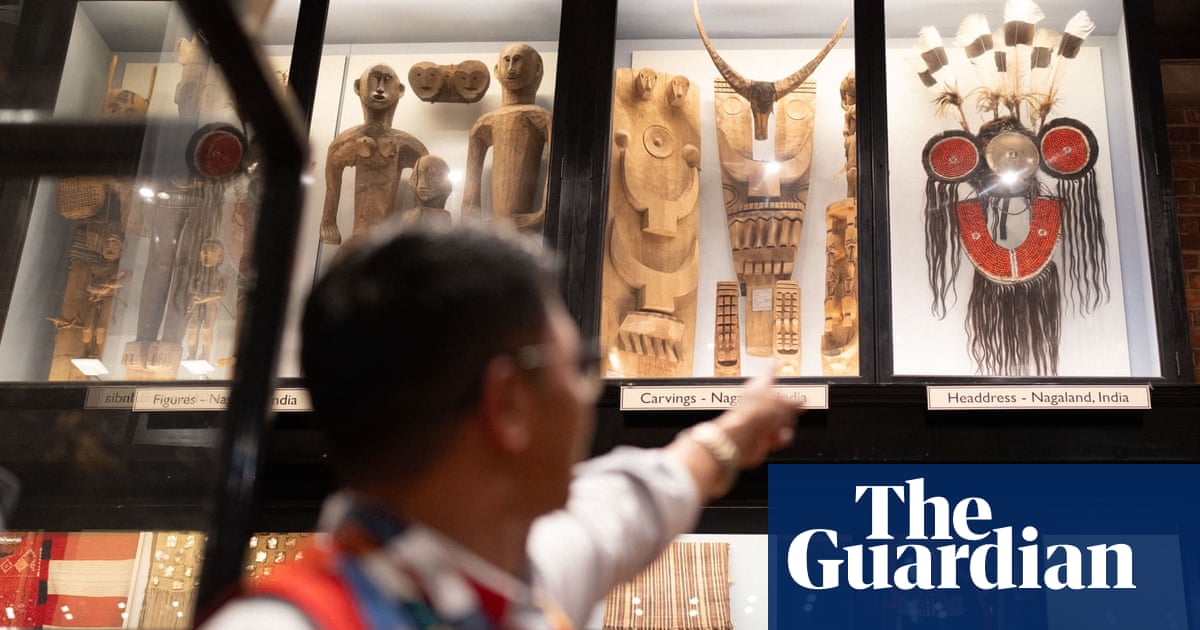
The Pitt Rivers Museum, home to one of the world’s largest ethnological collections, has more than 6,500 Naga objects, 898 of which were on display. Most of the collection was “coercively” acquired by the colonial administrators James Philip Mills and John Henry Hutton.
View image in fullscreenProf Dolly Kikon, a Naga anthropologist (kneeling, centre, in a red scarf) with other Naga delegates and museum staff. Photograph: Pitt Rivers MuseumThe human remains were displayed at the museum for 80 years. In 2020, they were put into storage during a revamp aimed at addressing the institution’s colonial past and how exhibiting human remains “reinforced racist and stereotypical thinking” of other cultures.
The museum said in a statement: “Thirty-nine Naga ancestors will soon begin their journey home from Oxford to Nagaland.”
In November, a Naga delegation will visit Oxford for a handover ceremony and the remains are expected to arrive in Nagaland before the end of the year. They will be laid to rest in a traditional community ceremony in the state capital, Kohima.
The repatriation negotiations were led by representatives from all of the Naga tribes.
“It has been a journey of redemption,” said Prof Dolly Kikon, a Naga anthropologist. “This shows that we are no longer victims of colonial violence. We embrace our roles as people who find redemption and healing by giving dignity and honour to a very violent past.”
The negotiations started in 2020, when Kikon wrote to the museum after reading “an article in the Guardian that they were doing an ethical review” of the collection. “They replied within 24 hours,” said Kikon.
That was just the beginning of a lengthy process that soon expanded into a wider community-led campaign.
The Forum for Naga Reconciliation, a community peace group, assembled a team known as Recover, Restore and Decolonise, bringing together Naga volunteers from across the region to work on the repatriation effort.
View image in fullscreenMembers of the Naga delegation view the relics on display at the Pitt Rivers Museum. Photograph: Pitt Rivers Museum“They travelled to villages and organised meetings to inform people about the remains,” said Arkotong Longkumer, a Naga anthropologist who worked closely with Kikon to lead the initiative, which he described as “open and transparent”.
“It was an intergenerational journey that brought together students, civil society, tribal leaders and the church,” said Longkumer, who teaches at Edinburgh University.
Read moreA Naga delegation, including tribal leaders, visited Oxford in 2025 to officially register a claim to the remains.
“I had never known our ancestral human remains had been taken away like that,” said Wangsa. “I felt angry when I saw them.”
Laura Van Broekhoven, director of the Pitt Rivers Museum and a professor of museum studies and ethics at Oxford University, said the museum was completing paperwork to enable the return of the remains.
“We will then start working towards the ceremonial aspects so we can have everything ready,” she said. “In our experience, handover ceremonies can be very emotional.”