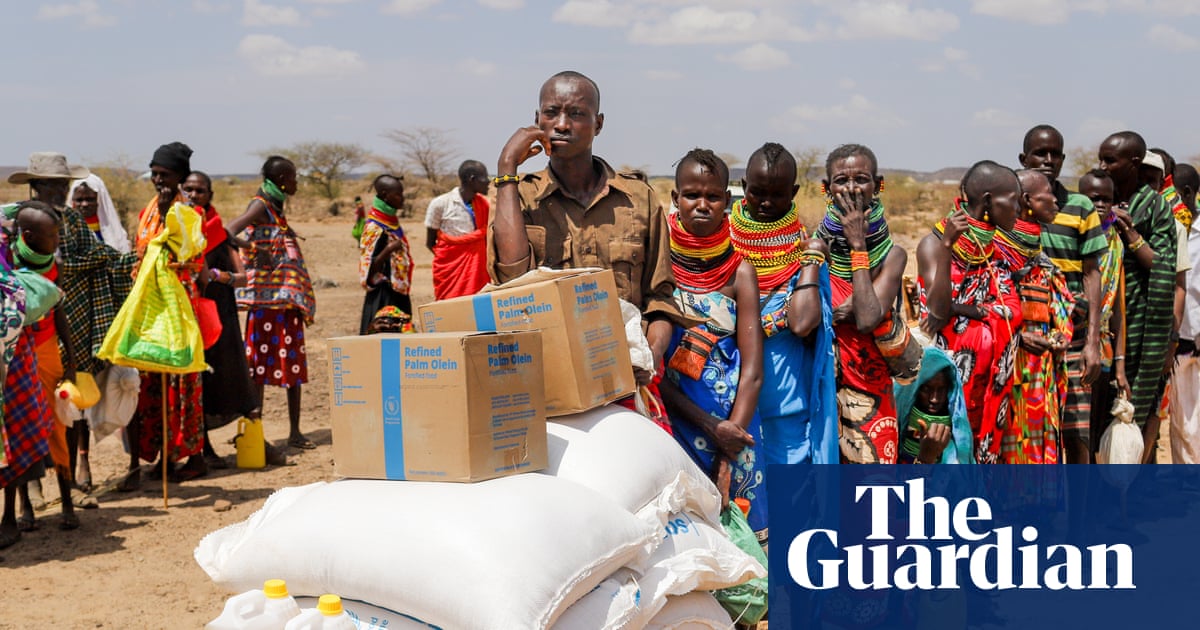
People queue for food during a severe drought in Kenya’s Turkana county in February. Global aid contributions fell by 30% between 2022 and 2025. Photograph: Patrick Ngugi/APView image in fullscreenPeople queue for food during a severe drought in Kenya’s Turkana county in February. Global aid contributions fell by 30% between 2022 and 2025. Photograph: Patrick Ngugi/APTens of millions of people fail to get humanitarian aid as global system crumblesFunding cuts in 2025 left women, children, older and displaced people hard hit, with 64m fewer people receiving aid
The humanitarian aid system is crumbling as funding shrinks, pressures increase and governments not only fail to protect civilians but are increasingly responsible for endangering them, a new report warned on Thursday as figures revealed 64 million fewer people received aid last year.
With aid contributions cut by 30% between 2022 and 2025 and thousands of aid workers losing their jobs, the humanitarian system has suffered one of its biggest contractions since being formed in the post-second world war era, according to the State of the Humanitarian System 2026 report.
In 2025, only those whose lives were in immediate danger became the focus, while support for longer-term issues and the ability to recover from crises was drastically scaled back.
Jennifer Doherty, co-author of the report produced by the humanitarian organisation Active Learning Network for Accountability and Performance (Alnap), said: “The impacts were not felt equally. The combination of reduced funding and restrictive politics meant women, children, elderly people and displaced people were especially hardest hit.”
Doherty, who said up to 23% of humanitarian staffing was estimated to have been lost in 2025, said: “Specialised services closed and targeted support became harder to sustain.”
According to the report, funding fell to an estimated $33.3bn (£24.6bn) in 2025, from a peak of $47.5bn in 2022.
While USAID sustained the most dramatic cuts, with a 55% reduction in 2025, there were also cuts by other leading donors, with 13 of the top 20 reducing their aid donations last year.
The report also highlighted the growing pressure from governments on how aid could be spent, such as the US spending freeze on programmes considered driven by diversity, equity and inclusion (DEI) policies.
The aid cuts also meant that for the few people who did receive support, the targeted amount for each person dropped from $178 in 2021 to $90 in 2025, despite the actual needs of each person having risen to $255.
An aggravating factor was that governments not only failed in their duties to protect civilians but were also often actually endangering people. States were responsible for 64% of attacks on healthcare workers and largely responsible for violence that affected aid workers through the use of airstrikes.
View image in fullscreenDisplaced people receive food aid in Al-Khawkhah, in Yemen’s Hodeidah province, in July. Photograph: Khaled Ziad/AFP/Getty ImagesYemen was one of the countries badly affected by aid cuts, with nutrition worsening and diphtheria cases rising because vaccination campaigns were suspended.
Mohammed Bahashwan, Action for Humanity’s country director in Yemen, said diminishing levels of aid were exacerbating the crises faced by families.
“Problems are not occurring separately. A family may have lost its income, be unable to afford food, have a malnourished child and still need to travel considerable distances or pay costs they cannot afford to access healthcare,” he said.
The report said there were examples of the humanitarian system mobilising to support those most in need, often led by local aid organisations, and of diaspora networks stepping in. But it also said the international system did not coordinate well with these networks and that it was often local aid organisations and staff who were worst affected by cuts.
Meg Sattler, chief executive of the Vienna-based organisation Ground Truth Solutions, which carries out regular surveys of people who need aid, said there should be more focus on localisation because the international humanitarian system had not adapted fast enough or pushed back against the cuts and stipulations imposed by the US.
“We have definitely spoken to people feeling the pinch of this contraction. It is especially causing distress where aid is now considered ‘life-saving only’ and isn’t letting people do things such as send their kids to school or save to start a business – things that would help them be less reliant on aid in the future,” she said.