Add The New York Post on Google OpenAI stunned the mathematics world when it announced Tuesday that its artificial intelligence model cracked a legendary math problem left unsolved for nearly a century in just 88 hours.
But an NYU academic has chimed in — saying the AI giant tried to strong-arm him into helping the bots solve the dizzyingly complex equation, and may have cribbed the work he had already done.
The ChatGPT creator on Tuesday claimed its AI had solved a so-called Millennium Prize Problem — one of seven famous unsolved math problems designated in 2000 by the Clay Mathematics Institute, which offers a $1 million bounty for devising the correct solution to each.
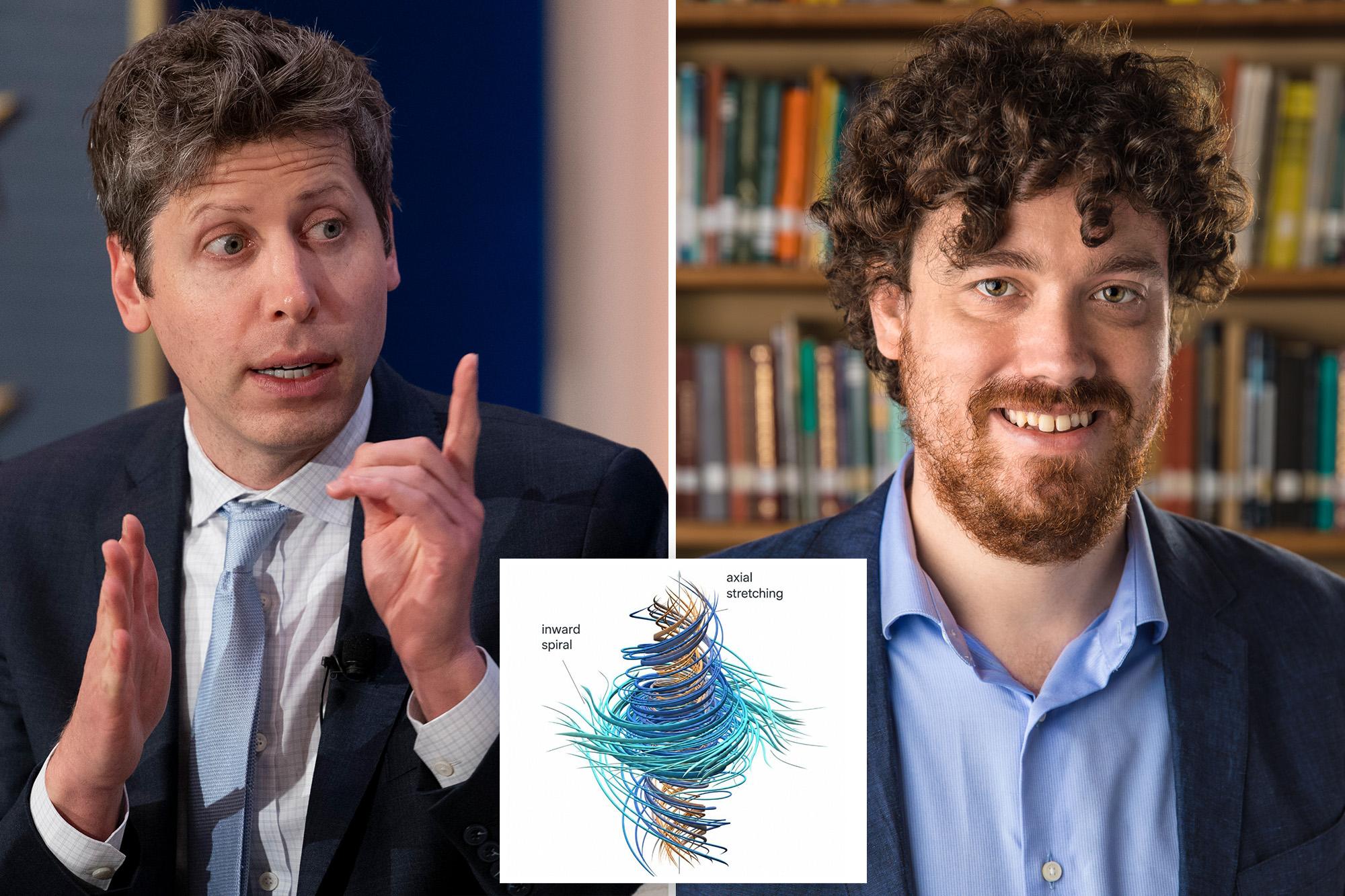
Currently in dispute is the claim over who solved what is known as the Navier-Stokes existence and smoothness problem, which asks “whether smooth, three-dimensional fluid flows can always maintain smooth behavior or if they can develop a singularity with infinite velocity,” according to OpenAI.
However professor Tristan Buckmaster, a British-Australian researcher who trained in Germany, has come forward alleging OpenAI may have copied his work after asking him to collaborate — with one of the company’s scientists allegedly warning he might “ruin his career” if he refused.
Buckmaster had been working with Long Island-raised math prodigy Levent Alpöge, a researcher with OpenAI rival Anthropic, on a different elusive fluid dynamics equation, known as the Euler problem, when he found a solution using AI tools from both Anthropic and ChatGPT.
He said scientists from OpenAI approached him and tried to convince him to jointly announce the solution, claiming they had independently solved Navier-Stokes.
Buckmaster questioned the timing of their finding the solution in a blog post, noting OpenAI had only done so “in the past few days” — after the company became aware of his work.
He asked OpenAI experts whether its AI systems used to solve the equation had been “trained on, or had access to” his research, but said they declined to answer, prompting him to wonder how they had advanced toward the solution so quickly.
The puzzle is “not the direction one arrives at in a few days,” Buckmaster wrote incredulously.
Sébastien Bubeck, a French-American OpenAI scientist, allegedly asked him, “Why would you want to ruin your career?” ominously adding, “If you don’t want me to be nice, then I don’t have to be nice.”
In OpenAI’s post on its website sharing the Navier-Stokes proof, which it credited to Astra, the company’s latest AI bot, the firm insisted no user data was incorporated into its model to solve the problem.
However, it noted that it “cannot rule out” that anonymized data was used to “improve our models.”
“We congratulate Levent Alpöge and Tristan Buckmaster on their remarkable mathematical work,” OpenAI said in the announcement.
Buckmaster shot back, “Is it ethical to use customer’s data to try to scoop their customer?
In a post on X, Bubeck later said he only meant to warn the professor about potential damage to his career by making “unfounded claims” — but admitted his threatening-sounding response was a “poor choice of words.”
Only one Millennium Prize Problem has been solved in the 26 years since the list was compiled, when Russian mathematician Grigori Perelman cracked the so-called Poincaré conjecture between 2002 and 2003.
In doing so, Perelman proved that a finite, three-dimensional space without any holes is topologically equivalent to a three-dimensional sphere. He famously declined the $1 million prize in 2010.
In 2018, renowned British-Lebanese mathematician Sir Michael Atiyah claimed to have solved another, known as the Reimann hypothesis, but his solution was rejected after the mathematical community determined his proof contained fatal logical flaws.
OpenAI did not immediately respond to a request for comment.