Add Decider on Google More On: Ending Explained ‘Furious’ Ending Explained: Emmy Rossum and Liz Meriwether Break Down That Intense Catherine Reveal, Tease Season 2 Does JJ Come Back in Outer Banks Season 5? His Death Explained Netflix’s ‘The Last House’ Movie Ending Explained: Why Is the Family Trapped in the House? ‘The Drama’ Movie Ending Explained: The Meaning Behind the Zendaya Movie About Morality and Judgment Casper Kelly’s horror movie Buddy isn’t at all a feature-length expansion of his Cartoon Network/Adult Swim short Too Many Cooks, but it has a similar sense of invention: What starts as a sketch-comedy-style game with increasing variations gives way to something more unexpected and sinister as a simple (and seemingly difficult-to-sustain) premise becomes more complicated. Rather than a meticulously rendered imitation of ’80s and ’90s sitcom credits sequences, Buddy hangs on a meticulously rendered imitation of ’90s kids’ TV, specifically a lower-rent version of the PBS mainstay Barney and Friends. Over the course of three sample “episodes” that open the movie, the audience sees the Barney-like Buddy (Keegan-Michael Key) become an increasingly threatening figure. But what happens when the fake show’s reality starts to break down? Let’s get into the various turns of Buddy‘s plot and what the ending means. Spoilers abound from this point forward.
To some extent, seeing Buddy in a movie theater telegraphs the movie’s eventual pivot; the dynamics of a tediously cheerful TV show that, at the time, pushed the boundaries of how young a television audience could be presumed to be, are reproduced here in a TV-style aspect ratio and video texture, both of which look dissonant on the big screen, which is where the movie is available for the moment. (Having posted a rare second-weekend gain at the box office, it’s unlikely to turn up at home for at least a few weeks, if not longer. Halloween is a good bet, just in time for Buddy costumes to pop up at various parties.) Yet Kelly lingers in this world long enough for the movie to register a major shift when, after three increasingly disturbing (and eventually glitchy) episodes of It’s Buddy!, where several of the seeming show’s child cast members are killed and several more escape, the film switches to the “real” world — one in a more cinematic aspect ratio, and more technically polished look, which should make it look less real but here registers as the less artificial option.
Here we meet Grace (Cristin Milioti), a woman living with her husband (Topher Grace) and two sons in a seemingly idyllic suburban home. But Grace is having episodes of her own, suggesting that there’s something missing from her life. She eventually becomes convinced that there is a third child, a daughter, missing from their home, that no one else remembers. She’s further disturbed when she encounters an episode of It’s Buddy! on television and cannot find any evidence of the show existing. Later, she is pulled into the show, where she is recast as one of the characters who has been killed by the monstrous Buddy. She also remembers that Freddy (Delaney Quinn), one of the children who previously attempted to escape Buddy, is actually her daughter from the real world, whose presence has been forgotten by everyone in her life.
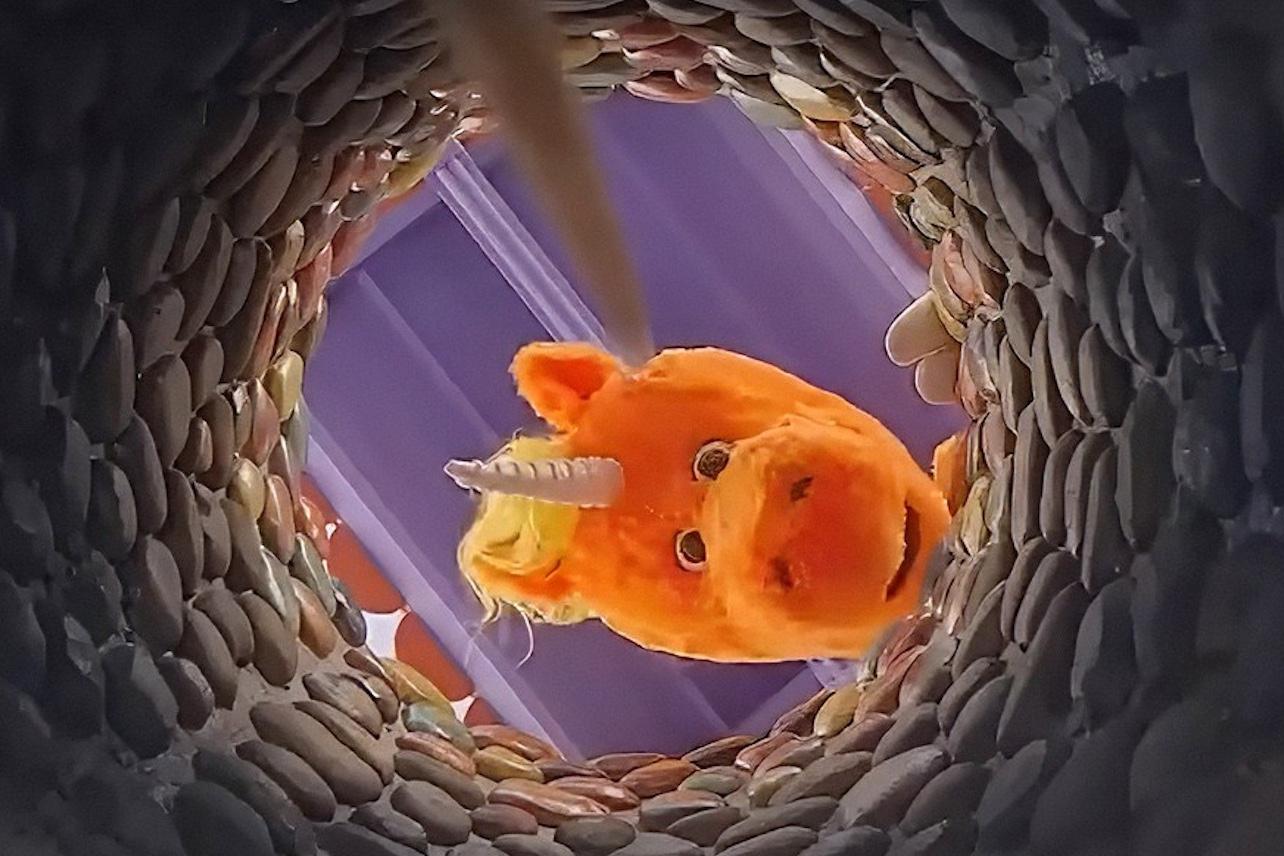
Following that escape attempt back in the It’s Buddy! world, and the revelation that the forest outside of Buddy’s fences does not lead anywhere else, Freddy and the other kids she escaped with are returned to Buddy’s house in an episode-style reset, with more replacements for the characters Buddy has semi-secretly killed. Grace, playing the show’s nurse, assists the children with another escape attempt, and sacrifices herself in the process. Freddy leads the remaining children down a well on the show’s set, which leads into a prop room and a mysterious facility. By this point, the other children have all been killed by a wounded Buddy, and Freddy discovers a series of televisions broadcasting It’s Buddy! to various children in their homes, with the apparent goal of sucking them into the TV sets to erase their memories and make them casting fodder for the show, as happened with Grace. After Freddy finally dispatches Buddy for good, she finds a TV looking in on an empty room, and jumps through to return herself to the real world.
It’s around this point that it’s easy to wonder whether Kelly has run out of inspiration — which, all told, is a pretty impressive sustaining act, given that this is around the 90-minute mark, and mere minutes before the end of the film. When Freddy travels through the portal, the puppet friends who had accompanied her — Strappy the Backpack and Mr. Mailbox — turn back into normal, non-speaking versions of those objects, a fairly predictable result. Less predictably but not particularly satisfyingly, a man enters the room and asks, in Spanish, who she is. Wherever Freddy has landed, it doesn’t seem to be anywhere near her original home, and of course her mother has been killed back in the world of It’s Buddy! Whether she fully remembers her old family life is unclear, though presumably returning to the real world would bring those memories back eventually.
It’s a perfectly logical ending — Freddy has become a kid version of the horror-movie Final Girl, and of course the TV portal wouldn’t simply drop her back at her own home. But after locating a surprisingly emotional, affecting storyline beneath a parody of Barney & Friends, involving Grace’s reality-bending reconnection with her lost child, with all the thorny symbolism of a woman subsuming herself in a sinister children’s TV show in order to rescue the kid she’s lost to it… well, ending on Freddy escaping immediate danger but essentially stranded in the real world feels like a big shrug. It’s as if the movie has called “time!” on itself after performing such clever extensions of a potentially one-joke horror premise for its entire runtime.
So Buddy doesn’t exactly end on a cop-out. It plays fair with the established world. But disappointingly, it doesn’t particularly invite much thought or reflection about its clever use of kiddie-show iconography, horror tropes, or fusion of two different narratives (a child’s adventure inverted into terror and a mother’s ennui revealed to be supernatural, media-driven gaslighting). After 90 minutes of surprising dexterity, Kelly does a one-yard fumble, trying to get away with a TV-style cut to credits. While this may be a welcome break from the prescriptiveness of so many metaphor-driven horror movies, the ending of Buddy also doesn’t leave much room for interpretation; it doesn’t leave room for much of anything, really. Maybe it’s a chilling admission that even an astute satirist with a taste for horror can be sucked back into the self-imposed limits of disposable TV shows.