play Live Sign upShow navigation menuplay Live Click here to searchsearchSign upEXPLAINERNews|US-Israel war on IranWhat is Jordan’s Al-Azraq base and why is Iran targeting it?Tehran appears to be increasingly targeting Jordanian assets in the latest round of escalation with the US.
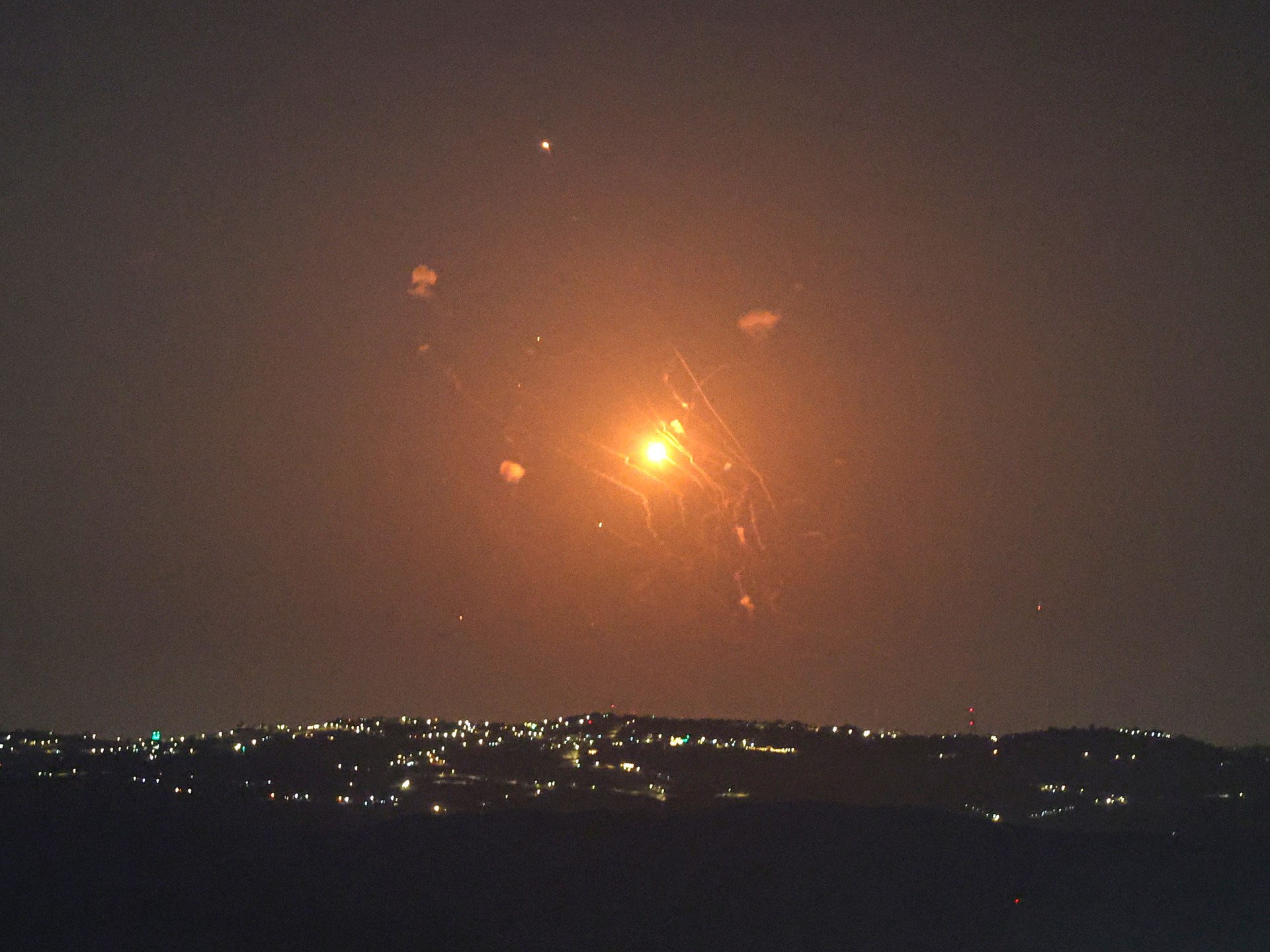
xwhatsapp-strokecopylinkgoogleAdd Al Jazeera on GoogleinfoIran's Islamic Revolutionary Guard Corps (IRGC) announced that they had launched missiles at a US base in Al-Azraq in Jordan, in response to US attacks on Iranian oil tankers [Atef Safadi/EPA]By Yashraj SharmaPublished On 9 Sep 20269 Sep 2026As the United States and Iran trade strikes on oil tankers in the Strait of Hormuz this week, Iran has also launched several ballistic missiles towards Jordan’s Al-Azraq airbase, which hosts US military assets and personnel, in what it has called retaliatory attacks.
The Jordanian Armed Forces said 18 of 20 missiles had been intercepted and destroyed overnight on Tuesday and on Wednesday morning, while two fell in open areas. No casualties have been reported.
So, what is at the Al-Azraq airbase, and why has Iran targeted it?
Overnight, Iran’s Islamic Revolutionary Guard Corps (IRGC) said it had launched “devastating” missile strikes at US forces stationed at the Muwaffaq Salti Air Base, also known as Al-Azraq base, near Azraq in Jordan’s Zarqa governorate.
Missiles “struck the maintenance, preparation, and deployment sites of F-35, F-16, and F-15 fighter jets, as well as their shelters, inflicting heavy damage on the enemy”, the IRGC said in the statement reported by the semi-official Tasnim news agency.
The Jordanian Armed Forces said the kingdom had engaged 20 ballistic missiles, intercepting and destroying 18 of them, while two fell in open areas.
A Trump administration official in Washington, DC, said the barrage of ballistic missiles fired at US forces in Jordan did not inflict any casualties. “The Iranian response was ineffective against integrated air and missile defences,” the official told Al Jazeera on condition of anonymity.
Iran is targeting Jordanian assets in the latest round of escalation, which began two weeks ago with US attacks on rocket launchers on Iran’s Larak island in the Strait of Hormuz. The US claimed Iran was preparing to use the launchers to scatter sea mines in the strait, and Iran responded with strikes on US assets in neighbouring Gulf countries. It has now widened this to include Jordan.
The US does not publicly reveal the capacities of its foreign military sites and assets, but Jordan is known to host nearly 4,000 US soldiers, according to a 2026 US Congressional Research Service report.
Some of them are stationed at the Al-Azraq base. Jordan also hosts US soldiers at the King Faisal Air Base in southern Jordan, and at so-called Tower 22, a remote US military logistics outpost in northeastern Jordan close to the borders with Syria and Iraq.
In the ongoing war, Tehran has claimed strikes on the Al-Azraq base more than 10 times between March and September. Iran first launched air strikes on Al-Azraq in early March.
On June 10, Iran again claimed to have struck the Al-Azraq airbase, as well as other bases hosting US military personnel and assets in Kuwait and Bahrain, after US forces struck Tehran’s assets in the Strait of Hormuz, a day after a US Apache helicopter had crashed near the waters.
On that occasion, the IRGC said its long-range missiles had destroyed several targets at the Al-Azraq airbase, including hangars and command centres. However, authorities in the countries targeted said all projectiles had been intercepted without casualties.
In the following weeks, Iran claimed to have hit the Al-Azraq base multiple times, inflicting heavy damage to US assets stationed there.
On July 17, Iran claimed it had hit US military aircraft stationed at the Al-Azraq base with ballistic missiles and drones, claiming to have destroyed several refuelling aircraft and fighter jets. US Central Command (CENTCOM) later confirmed that two US service members had been “killed in action” in the Iranian attack, while one was missing and four others were injured.
The Muwaffaq Salti Air Base near Azraq is located nearly 100km (62 miles) northeast of Amman, in the country’s sparsely populated Eastern Desert. Its official name is a tribute to a Jordanian fighter pilot, Lieutenant Muwaffaq Salti, who was killed in combat with Israel in 1966 in the Battle of Samu.
Amman and Washington signed a defence cooperation agreement in 2021 that granted US forces and contractors access to 12 military installations across the kingdom.
“Al-Azraq base is among the few that host F-35s, F-16s, and F-22s [fighter jets],” said Tahani Mustafa, a lecturer in international relations at the Department of War Studies at King’s College London. “It has hangars where the Americans can hide [their assets], and that’s what the Iranians have been targeting.”
The sprawling base, which has two runways, makes it an important asset for the US – and a target for Iran, Mustafa told Al Jazeera.
In the run-up to the US-Israel war on Iran, the base became “a key logistics hub” for US C-17 transport planes and about 60 combat aircraft, David Schenker, a fellow at the Washington Institute, a US think tank, told The Associated Press news agency.
“Jordan provides great strategic depth,” he said, calling the kingdom’s position “essential” to the US war on Iran, given the distance it provides against Iran’s missiles and drones as compared with the GCC countries, which are much closer.
A 2023 report by Washington’s Congressional Research Service underlined that “Jordanian air bases have been particularly important for the US conduct of intelligence, surveillance, target acquisition, and reconnaissance (ISR) missions in Syria and Iraq.”
That report also noted that the US “never officially acknowledged its presence at Muwaffaq Salti Air Base prior to the 2021 agreement”, even though “satellite imagery shows it has hosted US Air Force (USAF) unmanned aerial vehicles (UAVs) and fast jets since at least 2016”.
In July this year, The New York Times reported that Jordan became more important in the early days of the ongoing war, as a number of US troops stationed in Bahrain, the United Arab Emirates and Qatar were relocated there.
In 2017, the US Congress authorised $143m in air force construction funds to expand the base’s ramp space, reportedly the biggest such project at the time.