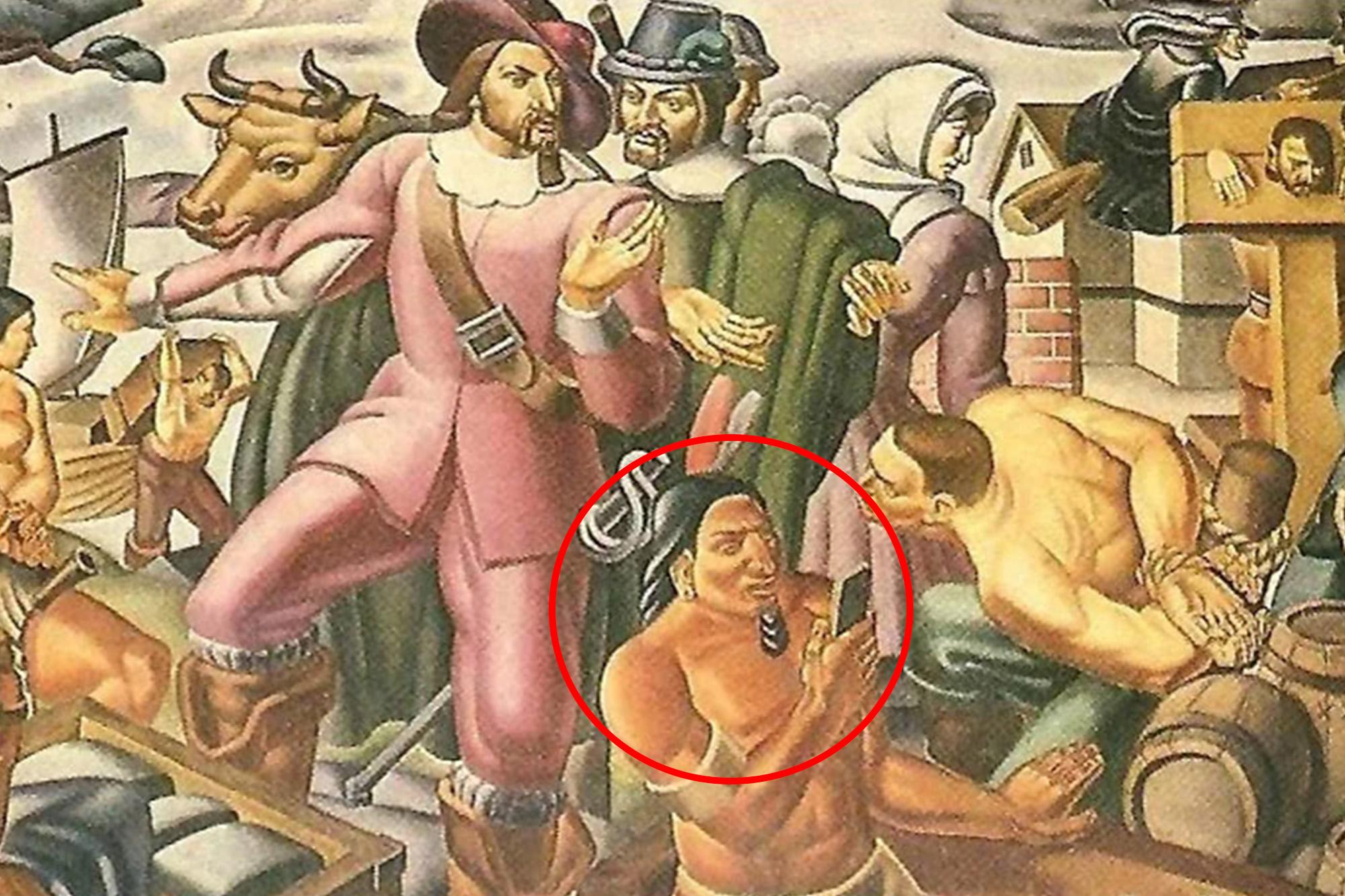
Add The New York Post on Google A nearly 90-year-old painting has generated online buzz and a bizarre conspiracy — that an indigenous man depicted in the artwork is holding a contemporary smartphone.
“Mr. Pynchon and the Settling of Springfield,” by Italian American muralist Umberto Romano, depicts the indigenous man alongside other tribesmen and early English colonists in 17th century Springfield, then part of the Massachusetts Bay Colony.
“iPhone in painting from 1937 JUST DISCOVERED???” wrote one poster on X Tuesday.
“Now that one actually looks like a cell phone,” another user reportedly posted.
Time travel claims have exploded after a detail was spotted in the 1937 painting “Mr Pynchon and the Settling of Springfield.” United States Postal Service The man can be seen front and center within the artwork, which was created in 1937.
He stares at a rectangular device, which has a coal color on the back and what appears to be chrome or reflective trim.
X users noted last March that the mural is located in the Commonwealth of Massachusetts State Office building, which was once the Springfield Main Post Office.
The mural was one of six created for the post office, which Romano finished with students, funded by the Federal Arts Project, a 1935-1943 government program that hired visual artists during the Great Depression, according to the Smithsonian National Postal Museum.
Despite the social media speculation, historians reportedly believe the object is simply a mirror.
Mirrors were common trade items in 17th-century American colonies, which likely explains why the man appears to be studying his own reflection in the object.
“Mr. Pynchon” in Romano’s painting is one of the founders of present-day Springfield.
“Mr. Pynchon and the Settling of Springfield,” by Italian American muralist Umberto Romano, shows an indigenous man, apparently holding a smartphone, in 17th century Springfield, Massachusetts. Pynchon moved to North America from Essex, England, in 1590 and arrived in Massachusetts Bay Colony, where he became a founder and assistant treasurer.
He acquired the land that would become Springfield from the Agawam Native Americans in 1636.
To ensure historical accuracy, Romano consulted with local historian Harry Andrews Wright and author Esther Forbes, intending to capture the region’s development from 1636 to 1936, according to the Smithsonian.
Rather than a single moment, the mural functions as a mosaic of the settlement’s establishment, featuring Pynchon as the central figure overseeing the interactions between the English settlers and the local Pocomtuc and Nipmuc peoples.
While the work reflects the complex history of the area, art historians note that Romano’s semi-abstract style and deliberate choices in composition, absent anachronistic technology, are the intended focus of the piece.