Add The New York Post on Google Lucky folks in these US states may get to experience the magic of the Northern Lights tonight and tomorrow.
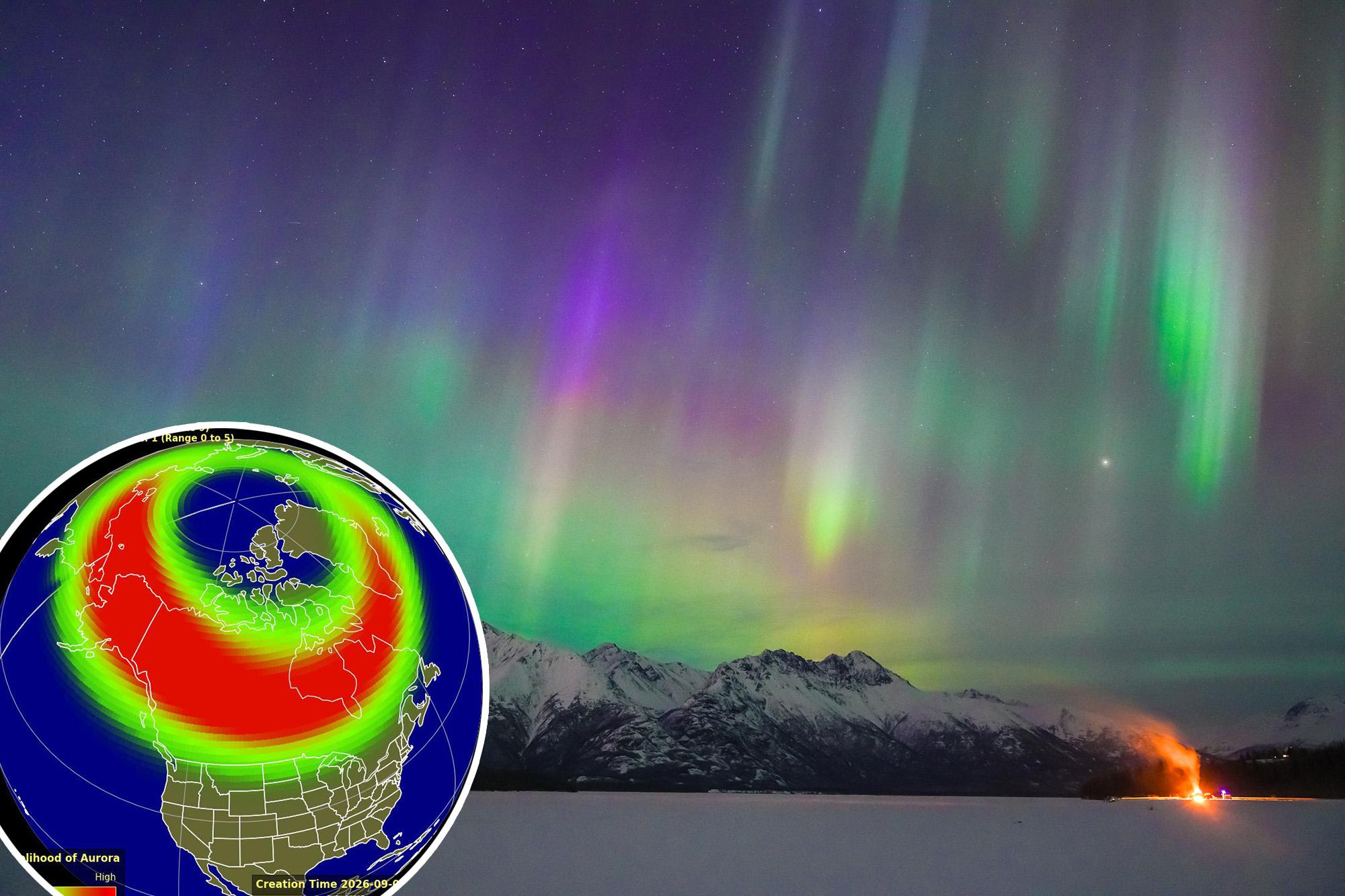
Provided the skies are clear, residents of Alaska, Washington, Idaho, Montana, North Dakota, South Dakota, Minnesota, and Wisconsin will have the best chance of seeing the light display between 6 p.m. and 6 a.m. US Central Time, on Tuesday, September 8, and Wednesday, September 9, according to the National Oceanic and Atmospheric Administration’s Space Weather Prediction Center.
NOAA predicts prime viewing between 6 p.m. and 6 a.m. US Central Time, especially with clear skies and this week’s new moon. Anadolu via Getty Images Also known as the aurora borealis, the Northern Lights form when charged particles from the sun interact with magnetic field lines toward the poles, crashing into nitrogen and oxygen molecules and causing them to emit energy as ribbons of shimmering lights.
Undetectable during daylight hours, the aurora borealis can often be observed just after sunset or just before sunrise.
When the aurora is bright and conditions are right, you can see the lights from as far as 62 miles away.
The week’s new moon will provide dark skies that could enhance viewing conditions.
According to NOAA, Northern Alaska has the highest chance of seeing the northern lights, while the states on or near the U.S.-Canadian border will have a lower chance of catching the phenomenon.
Meanwhile, our northern neighbors are in luck as most of Canada has a high likelihood of seeing the lights.
September is prime time for the northern lights, thanks to the vernal equinox— a pattern known as the Russell-McPherron effect. In effect, geomagnetic activity is higher when the Earth’s magnetic poles are perpendicularly aligned with the sun, such as they are during an equinox.
Northern Alaska has the highest chance of seeing the northern lights, while the states on or near the U.S.-Canadian border will have a lower chance of catching the phenomenon. Space Weather Prediction Center To get the best view of this natural spectacle, find a spot away from city lights, which is easiest to find using a light pollution map or dark-sky finder.
While auroras are difficult to predict and come in waves, checking live forecasts throughout the evening can be helpful.
A short-term forecast along with the last 24 hours of activity can be found on the Aurora – 30 Minute Forecast page
This spring, parts of the Northern US were treated to the sky show thanks to a large hole that opened up in the Sun’s corona, the outermost layer of its atmosphere.
These “coronal holes,” as they’re called, are where the Sun’s magnetic fields open up, allowing solar wind to escape into the cosmos at high speeds known as High Speed Streams (HSS).
When these solar wind bursts arrive on Earth, they can trigger elevated Geomagnetic activity and intensify auroras.
For those hoping to capture the moment on camera, try switching to Night Mode or Pro Mode on iPhone settings. The Main lens is best — not ultra-wide.
RAW format, if available, is also ideal if the plan is to edit later.