Add The California Post on Google California could soon be a state without a DMV — at least if Republican gubernatorial candidate Steve Hilton gets his way.
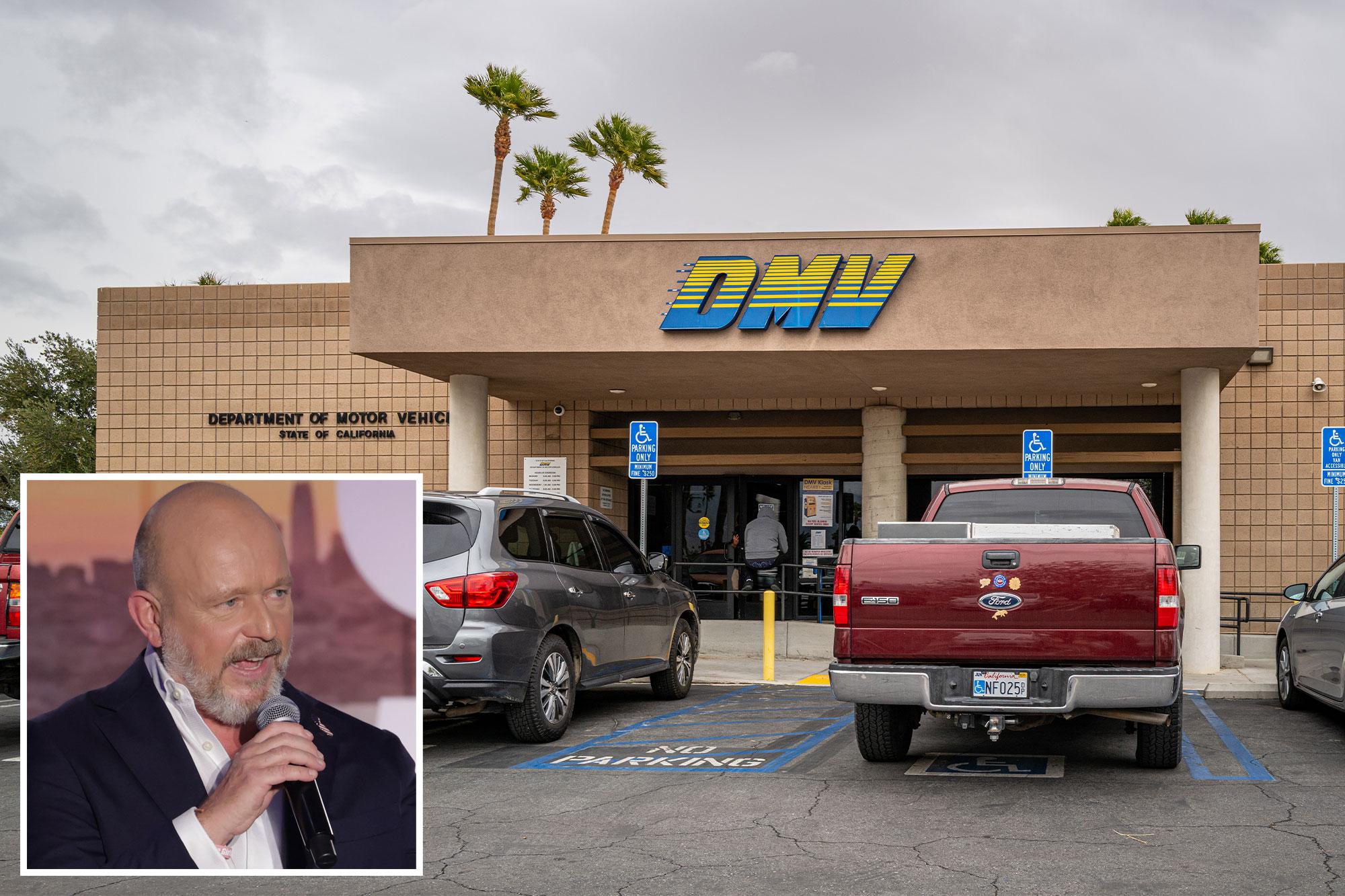
Hilton unveiled a sweeping plan Tuesday to abolish California’s Department of Motor Vehicles, shuttering its state-run field offices and replacing the agency’s services with a decentralized system of local offices and other providers.
The proposal, which Hilton’s campaign says is designed to slash bureaucracy and reduce costs for drivers, marks one of the most dramatic government shake-ups proposed in the 2026 race.
Hilton announced the plan outside the DMV’s West Hollywood office.
The proposal comes as the former Fox News host and Trump-endorsed Republican campaigns on a promise to dismantle what he describes as California’s bloated bureaucracy and “one-party rule.”
“The DMV is a symbol of California’s bloated, costly, nanny state bureaucracy that treats people with complete contempt,” Hilton told The Post leading the protest outside the DMV. “It gives people such terrible service that it’s become a global laughingstock.”
Hilton framed the cuts as long overdue, taking a swipe at the DMV’s notoriously poor customer service with a joke about its cameo in Disney’s Zootopia — where a painfully slow sloth became the movie’s comic embodiment of government bureaucracy.
Hilton’s plan would bring sweeping changes beyond simply eliminating the DMV as a standalone agency.
His campaign says the proposal would cap annual vehicle registration fees at $73, a move it estimates would slash registration revenue by roughly $8.3 billion a year.
To make up for the shortfall, the plan calls for reducing state spending on roads, while shifting DMV functions to local governments and authorized private providers.
The proposal would also limit commercial driver’s licenses to foreign nationals who meet English-language requirements, and allow unused DMV offices to be converted into vocational training centers or sold off.
The British-American politician noted that this was the beginning of his “make California affordable,” agenda.
“We’ve got to shut down a lot more than the DMV. They’ve doubled the budget of the state of California in the last 10 years, even though two million people have left the state, and everything is worse. So this is just the start,” he told The Post.
California vehicle registration costs vary widely depending on the vehicle and location.
For a standard passenger vehicle, drivers can face several hundred dollars in annual fees, with costs potentially reaching $1,000 or more for newer or higher-value vehicles.
Those costs are made up of multiple charges, including the base registration fee, a California Highway Patrol fee, a value-based Transportation Improvement Fee, local county or district charges and the Vehicle License Fee, which is calculated as a percentage of a vehicle’s depreciated value.
The proposal follows Hilton’s earlier promise to cap registration fees at the state’s basic registration charge.
He has previously argued that California drivers are hit with layers of additional fees on top of the basic charge, saying the system has become a costly burden for motorists.
“Of course, it is important that the state maintains secure records, issues legitimate licenses, and has strong fraud prevention measures,” Hilton’s plan reads.
“But that does not require people to spend hours in line for rude, surly and painfully slow service for tasks that are handled entirely online in other countries and states.”
“We’ve got to shut down a lot more than the DMV. They’ve doubled the budget of the state of California in the last 10 years, even though 2 million people have left the state, and everything is worse. So this is just the start,” he told The Post.
But the idea of a California without a traditional DMV is less far-fetched than it may sound.
California currently operates a sprawling DMV system with 187 field locations, according to the state agency’s 2026 statistics.
The DMV also lists thousands of business-partner locations that already process certain transactions. And California would not be the first state to move away from a traditional standalone DMV model.
Arizona, for example, houses its Motor Vehicle Division inside the state Department of Transportation rather than operating a separate DMV.
The Arizona DOT also contracts with private companies that provide vehicle-registration and, in some cases, driver’s-license services.
The state says its authorized third-party network includes more than 70 providers and more than 170 locations.
Colorado has taken another approach, dividing responsibilities between the state and counties. Its state DMV handles driver’s licenses and related services, while county motor-vehicle offices conduct most title and registration transactions.
Tennessee likewise routes vehicle-registration applications through local county clerks, while Mississippi directs most vehicle registrations to county tax collectors.
Hilton’s proposal would take elements of those systems and push them further — eliminating California’s state DMV field-office model while relying on local and private alternatives for services Californians currently associate with the DMV.
The candidate has made shrinking government a central theme of his campaign.
Earlier this year, he launched his Cal DOGE initiative, arguing that California has too many state agencies and promising an aggressive effort to eliminate waste and bureaucracy.
He has also recently proposed an “Office of Fun and Freedom” aimed at eliminating regulations affecting nightlife, entertainment and community events.
His campaign said last week that he would follow that announcement with the separate plan to abolish the DMV. The announcement comes at a pivotal moment in the governor’s race.
Hilton will face Democratic nominee Xavier Becerra in the Nov. 3 general election, with the two candidates scheduled to debate Sept. 30 before election day on Nov. 3