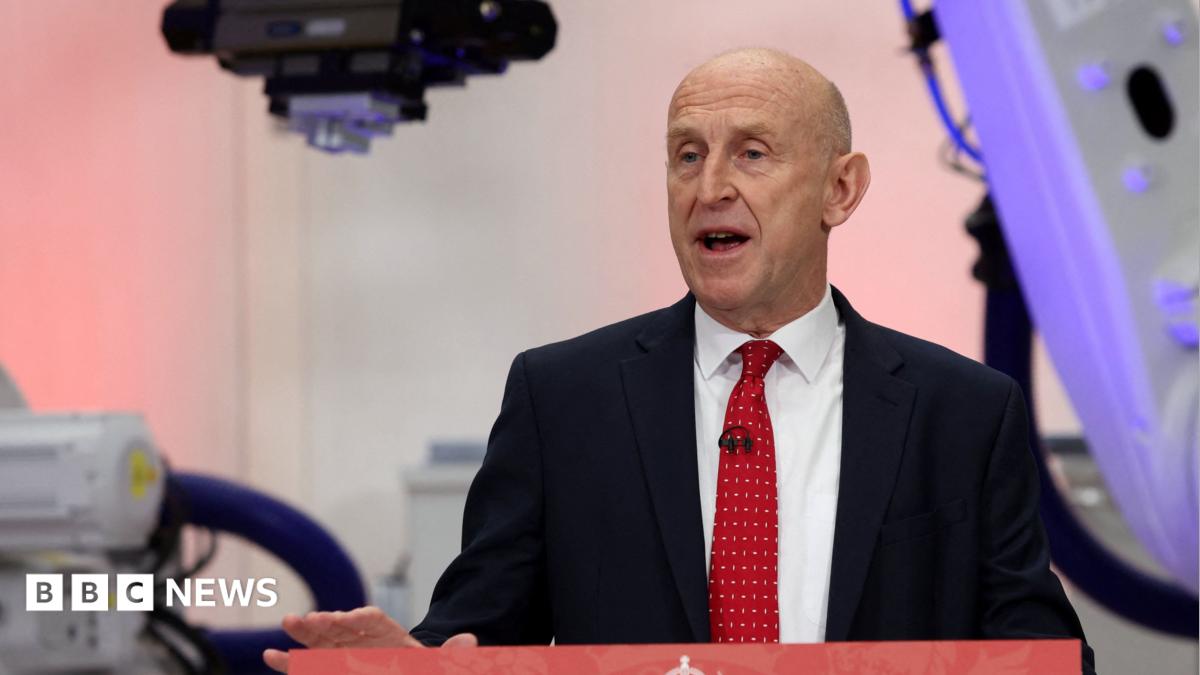
Image source, ReutersByFaisal IslamEconomics editorPublished18 minutes agoThe chancellor may have thought about shifting the venue of his first major speech this morning.
It was an absolute and total coincidence that he chose to make it in the Coventry Manufacturing and Technology Centre (MTC), just a few minute's drive from the city's totemic HQ of Jaguar Land Rover (JLR).
In the event, no one was pulling punches. The 4,000 office-based job losses at JLR were confirmed as John Healey answered questions a few miles away.
Healey chose to lean into it as an example of the global turbulence against which the UK needs more resilience.
The difference between this chancellor and his predecessor was he also feels that stressing fiscal discipline should instil confidence in consumers, businesses and investors, and not sap it away amid rolling fears of tax hikes.
So the prime minister and his chancellor have been engaged in a conscious attempt to boost the economic vibes - "a new story", as he called it.
In his speech, and in a BBC interview afterwards, this was clear. There are some positive underlying signs from consumer, business and recruiter confidence measures that indicate this message has been heard, although the hot weather and World Cup have also been factors.
The Downing Street duo are trying to maintain this precious commodity of confidence and the promotion of economic animal spirits that have been suppressed by years of political and economic chaos.
"Borrowing costs are too high," Healey acknowledged at the start of his speech. The global rise in bond yields is like a boa constrictor squeezing the Budget maths, slowly and relentlessly, occasionally loosening its grip, but never actually slithering away entirely.
It raises some reasonable questions therefore about how to balance reining in borrowing with protecting mildly better confidence?
The speech did not seem to me to prepare the ground - a "pitch roll" - for significant tax rises, as I heard at the equivalent Budget "scene setters" for the past two years.
"Am I right?" I asked the chancellor on this point. A pause as he sought precisely the right word formulation. "I won't comment. I can't comment. No chancellor can ahead of a Budget I will take and announce on October 28th".
OK, what about the advice from one of the PM's favourite economists Lord O'Neill that the rise in borrowing rates is a golden opportunity to scrap the triple lock?
This lock guarantees the state pension rising each year in line with either inflation, wage increases or 2.5% - whichever is the highest - but some have argued it is unaffordable.
"The prime minister has said, like I have, that we must bring down welfare costs, but we are also responding to the extreme pressure that is there in wider markets," Healey said.
Neither answer was a denial, but nor were they any type of confirmation. Like a stubborn batsman, the chancellor is going to stay at the crease, giving little away, in his case, about next month's Budget.
Chancellor refuses to rule out tax hikes in October Budget
Two decades ago, Healey was responsible for the Regional Development Agencies, scrapped by the Coalition Government, that helped fund this very facility.
In his speech there was a big clue about how to square the circle of investing in industrial policy at a time of tricky public finances.
The "Pufins" - public finance institutions - such as the British Business Bank and National Wealth Fund can invest strategically, less constrained by the government's borrowing rules. Part of the plan is Pufins to breed more unicorns ($1bn tech startups) in the UK.
This is the other part of the global backdrop. Amid the tumult of trade and military wars, there is arguably one of the biggest financial events in world history.
In the coming weeks, hundreds of billions of dollars will be invested and trillions in value confirmed from flotations of big American AI firms. The UK has some standout technology in this sector. The government wants to promote it.
The chancellor was also, however, cautious about the impact of AI on security and on jobs. Some degree of "public control" could be required to make these changes work for everyone. It appeared a little less cheerleading than the stance of the Starmer administration.
The chancellor was perhaps mindful of the army of manufacturing robots, laser welders, 3D metal printers, whirring into action around him.
Long term, it will be growth that will determine whether his borrowing rules are met, he said.
Ultimately he will be judged by his actual policy choices, but where there are trade-offs between balancing the books and economic growth across the country, this sounds like a chancellor who might prioritise the latter.