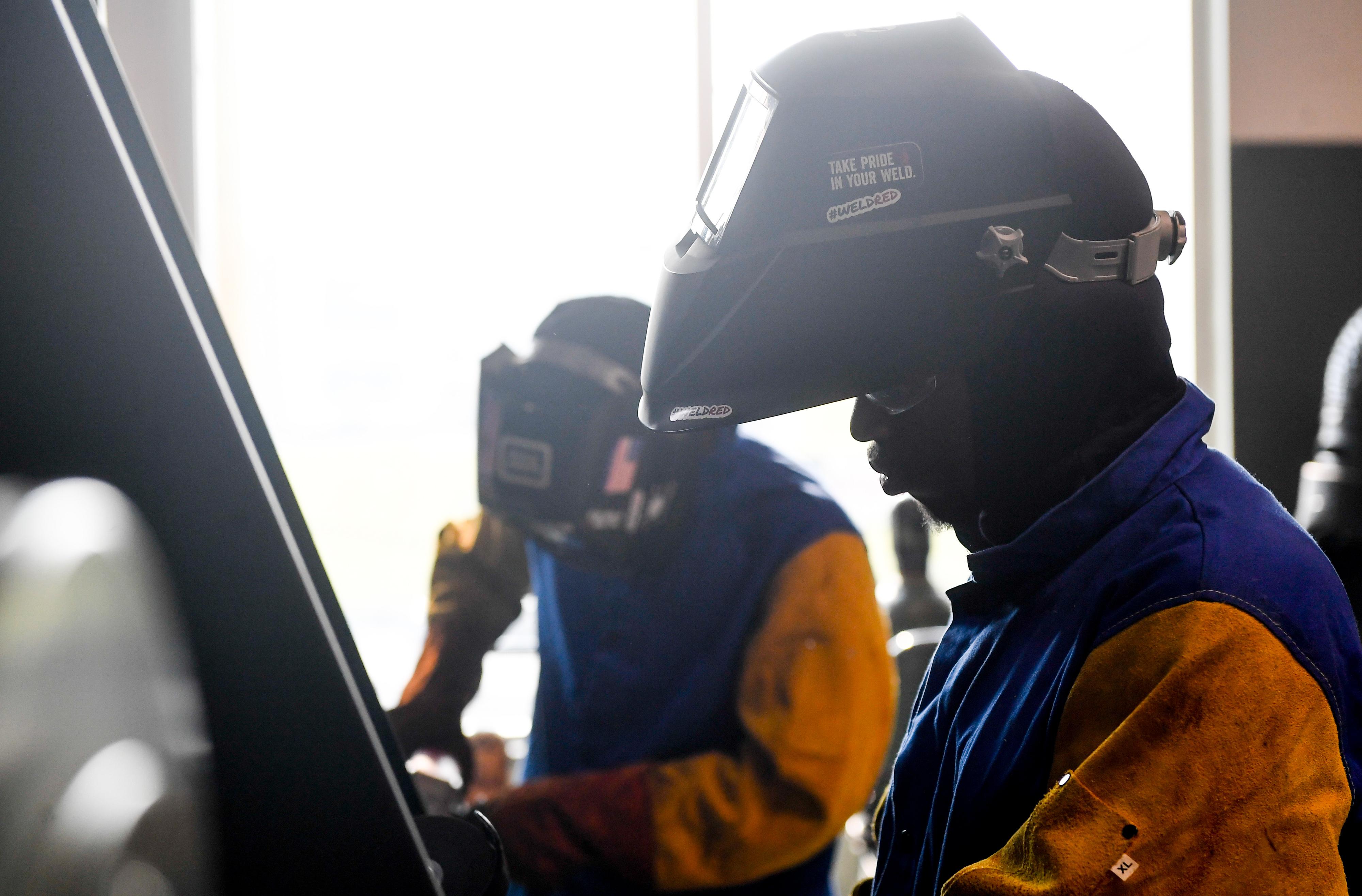
Attending trade school instead of expensive colleges may be a better option for many young Americans, writes columnist Jason Isaac. Bloomberg via Getty Images See more of our coverage in your search results.
Add The New York Post on Google Jacob Palmer, age 23, is debt-free, fully independent and running his own electrical business in North Carolina.
Palmer began as a $15-an-hour apprentice and spent his first years out of high school accumulating the hours needed for a North Carolina electrical contractor license.
At 21, he passed the state licensing exam and opened Palmer Electrical one month later.
His one-man operation grossed $175,000 last year.
“I don’t owe anybody anything,” Palmer told Fortune.
Like Palmer, Tanner Burgess questioned whether the college-and-desk-job route was his only option.
He chose welding instead — and after completing a nine-month training program, was helping install pipes for a new hospital in San Diego by age 20.
He expects to earn six figures after five years in the trade.
“It feels good at the end of the day,” Burgess told The Wall Street Journal. “I’m physically doing something, and there’s a sense of completion.”
Palmer and Burgess chose a different path from the four-year college track we’ve sold to most young Americans as the only way to build a good life.
In fact, many college graduates are now buried in debt and struggling to find work that pays enough to buy a home, much less support a family.
And as it happens, the industries that propelled opportunity for Palmer and Burgess are hiring.
Electricians keep the grid running; welders build and maintain the pipelines, refineries and plants that keep the country powered.
But we’re short of workers for these roles — and that means the success young people long for is hiding in plain sight.
These are well-paying careers rooted in our communities, offering an increasingly rare path to an independent life.
Right now, America’s energy industry desperately needs electricians, welders, pipefitters, mechanics, equipment operators, technicians, engineers and other skilled professionals.
By 2035, two out of every three new energy workers will be needed simply to replace retirees.
Across advanced economies, there are already 2.4 energy workers nearing retirement for every new entrant under 25.
Whoever fills these openings can be rewarded handsomely.
Oil and gas extraction remains one of America’s highest-paying industries, with an annual mean wage of roughly $123,000.
Petroleum engineers earn a mean salary near $194,000, while many field, maintenance and operations positions pay well above the national average — without requiring a traditional four-year degree.
In the Permian Basin of West Texas and New Mexico, producers are hiring drilling crews, pipeline welders and refinery technicians even as production hits record highs, and new liquefied natural gas terminals along the Gulf Coast are adding thousands of jobs as they come online.
Coal tells a similar story: Still a workhorse of grid reliability in much of the country, it continues to support well-paying mining and power plant jobs.
Nuclear energy, though, may offer the biggest opportunity of all.
The industry faces a serious generation gap, with roughly 1.7 workers nearing retirement for every young entrant, just as electricity demand is beginning to surge.
The Department of Energy estimates that the nuclear workforce could grow from approximately 100,000 people today to 375,000 by 2050 as advanced reactors are deployed.
That would require bringing another 275,000 people into the industry.
Oklo, for example, says its planned advanced fuel-recycling and fuel-manufacturing facility in Oak Ridge, Tenn., aims to create more than 800 permanent, full-time jobs ranging from engineering and manufacturing to security and operational support.
And projects like it are only going to become more common as demand for nuclear energy grows and more reactors are built.
But filling these jobs will remain difficult so long as skilled work is treated as a second-rate option.
Many of the trades in demand begin with technical school, an apprenticeship, military experience or on-the-job training alongside someone who has performed the work for decades.
America’s high schools should present apprenticeships and technical programs to their students with the same enthusiasm they currently reserve for college admissions.
And states should remove unnecessary credentialing barriers, giving employers more freedom to train workers on the job.
A capable 18-year-old who wants to work with his or her hands and earn a good living — without incurring backbreaking student-loan debt — is choosing a serious path, one worth as much pride as any four-year degree.
Palmer and Burgess found careers that offer both financial security and a sense of accomplishment.
Millions of young Americans are looking for the same opportunity, and energy employers need them.
Jason Isaac is the founder and CEO of the American Energy Institute.