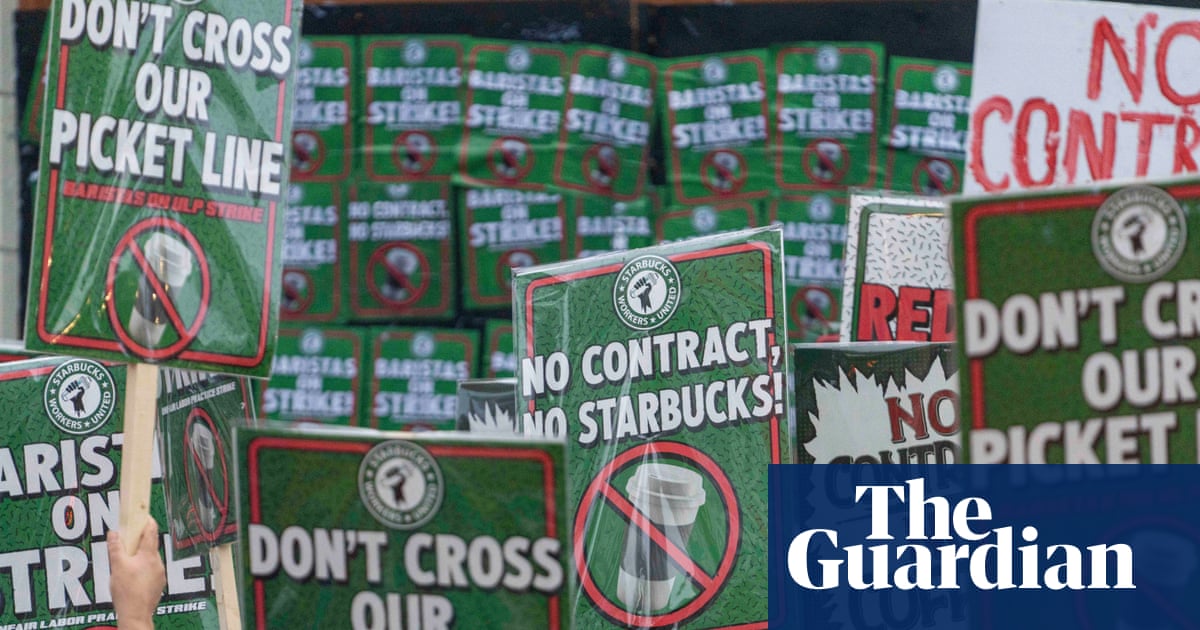
Striking Starbucks baristas and SEIU members rally outside the former Starbucks Reserve Roastery during a Red Cup Rebellion strike over alleged unfair labor practices by Starbucks Coffee Company in Seattle, Washington, on 13 November 2025. Photograph: M Scott Brauer/ZUMA Press Wire/ShutterstockView image in fullscreenStriking Starbucks baristas and SEIU members rally outside the former Starbucks Reserve Roastery during a Red Cup Rebellion strike over alleged unfair labor practices by Starbucks Coffee Company in Seattle, Washington, on 13 November 2025. Photograph: M Scott Brauer/ZUMA Press Wire/ShutterstockUS labor unions saw membership gains in 2025, mostly in states with bargaining protectionsUptick in US union membership coincides with high public approval ratings of unions
After years of decline, union membership in the US increased by 411,000 members in 2025, the largest increase since 2008, according to a new report.
The report makes clear the impact that “right to work” laws can have on union membership: most gains were concentrated in states that protect collective bargaining.
Union membership rates in those states were nearly triple than the 26 states with so-called “right-to-work” laws that weaken union membership, according to the report from the Illinois Economic Policy Institute (ILEPI) and the Project for Middle Class Renewal at the University of Illinois at Urbana-Champaign.
States with collective bargaining protections saw an increase of nearly 305,000 union members in 2025, compared to about 107,000 in “right-to-work” states. States with protections have over 10.9 million members out of 76.9 million workers, compared to “right-to-work” states that have 3.7 million members out of 69.7 million workers.
“Right-to-work” laws allow workers to “free ride”, or work under a collectively bargained contract agreement without paying union membership dues. Most right-to-work legislation was passed in the 1940s and 1950s after a movement from conservative activist Vance Muse, who coined the term and championed it in southern states with arguments to preserve Jim Crow-era laws.
“The data consistently shows that workers earn higher wages when they are union members and work in states that protect collective bargaining rights,” said Frank Manzo IV, economist at the ILEPI and coauthor of the report. “More Americans are turning to unions as a bulwark against the rising cost of living..”
In 2025, 19 US states passed 88 laws that expanded workers’ rights, according to a 3 September issue brief by State Futures and NYU Wagner Labor Initiative. Legislation included paid sick leave and medical leave passed in Virginia, warehouse worker protections passed in Connecticut and banning nearly all non-compete agreements in Washington.
Earlier reports had shown that 2025 was a big year for unions: 16.5 million workers were represented by unions in 2025, the highest level recorded in 16 years, accounting for 11.2% of all wage and salary workers in the US. Union density, or the percentage of workers in a union, increased from 9.9% to 10.0% nationally in 2025.
The uptick in union membership coincides with high public approval ratings of unions. According to a recently released Gallup poll, 71% of Americans approve of labor unions and 47% want unions to have more influence.
Ahead of Labor Day, the AFL-CIO, the largest federation of labor unions in the US, released poll results that found 52% of the American public said they trust labor unions, compared to 32% who said they trust Democratic party and 26% who trust the Republican party.
The poll also found young workers trust unions at higher rates, with 57% of young workers who are not in a union stating that they would join one if it were an option.
“This Labor Day, shit’s too expensive,” said Liz Shuler, president of the AFL-CIO, during an address last week ahead of Labor Day. “That’s what 94% of workers told us, in our new poll. Four out of five say: paychecks aren’t keeping up with the cost of living – groceries, rent, childcare, gas. This is happening, by the way, in a country where CEOs now make an average of 312 times what the median worker makes. CEOs got a 21% raise in one year – who else gets that?”
Researchers of the new report found that labor unions raise average wages by 8% nationally and workers in states that protect collective bargaining rights earn 8% more, after accounting for cost of living differences, than those in states with restrictions. Workers in these states also experienced 3% slower wage growth from 2019 to 2025.
This wage gap between workers in states with protections versus those without has more than doubled over the past decade, from 3.2% in 2015 to 6.7% in 2025, translating to over $4,000 less per year for the median full-time worker.
“By raising the wage floor, collective bargaining benefits union and non-union workers alike,” said Robert Bruno, professor at University of Illinois at Urbana-Champaign and director of the Project for Middle Class Renewal. “The data makes clear that a rising tide lifts all boats.”