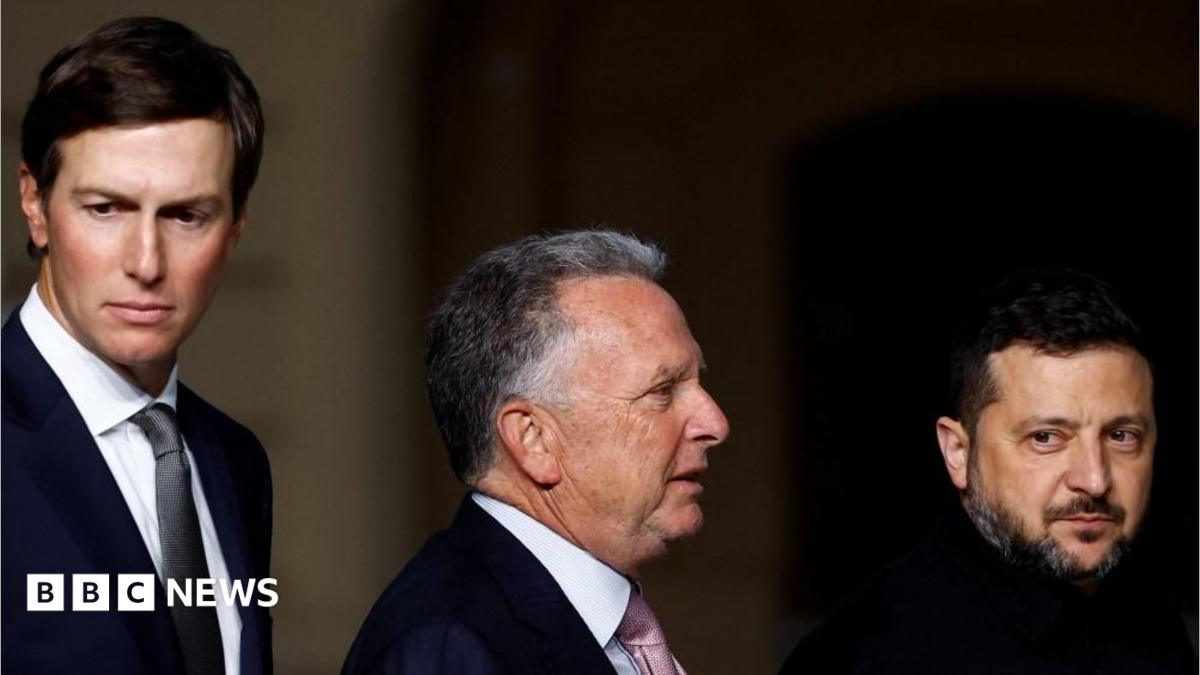
Image source, ReutersByJames LandaleDiplomatic correspondentPublished7 minutes agoThe talks in Kyiv were rich in symbolism. The sight of Donald Trump's envoys setting foot on Ukrainian soil for the first time since Russia's full-scale invasion.
The fact they had to travel by train because they could not risk flying and running the gauntlet of Russian drones - weapons launched on the orders of the man at whose table they sat in the Kremlin only hours ago.
The symbolism of Ukrainian President Zelensky greeting Steve Witkoff and Jared Kushner at Kyiv's Saint Sophia Cathedral, not only an icon of Ukraine's ancient history, but also just a few yards from where Russian drones hit the headquarters of the country's security services on Friday.
You did not have to join too many dots to work out the point Zelensky was making.
Both sides held talks for several hours; they were later joined by some European national security advisers, including the UK's National Security Adviser Jonathan Powell.
And afterwards, all sides spoke warmly of having held substantive discussions. They spoke hopefully of reviving past "trilateral talks" involving both the US and Europe.
Image source, ReutersBut fundamental differences remain. The US envoys had come hot foot from Moscow where Vladimir Putin had told them Russia was making "tangible advances" on the battlefield.
The story they heard from Ukraine was different, in fact the opposite. Ukrainian officials claim that in August they gained more territory than they lost and Russia suffered 42,000 casualties, dead or wounded.
Putin had also told the US envoys the root causes of the conflict had to be addressed, shorthand for his longstanding strategic demands that Ukraine cede territory, abandon hopes of joining Nato and reduce the size of its army.
After the talks, Zelensky insisted Ukraine would require "strong and clear" security guarantees, including a strong army. Nor did he give any sign of being willing to give up any territory in the eastern Donbas region, an issue he described dryly as "difficult".
To play this video you need to enable JavaScript in your browser.This video can not be played
Watch: President Zelensky welcomes US envoys in Kyiv
Witkoff insisted progress had been made and the ingredients for a settlement were there.
But he admitted both sides would have to make compromises to narrow the differences between them. And right now, it is hard to see either side doing that.
So for now, the expectation in Kyiv is that the fighting will continue and they will face a hard winter ahead.
Some diplomats talk of a window of opportunity for a possible settlement next spring. Others are less optimistic.
Zelensky thanked the US envoys for their visit because the short-term pause in air strikes agreed by both sides had given the people of Kyiv a brief respite. Few expect it to last for long.
To play this video you need to enable JavaScript in your browser.This video can not be played
Watch: US envoys Witkoff and Kushner say they are "encouraged" by Ukraine talks
Zelensky says he expects war to continue into winter after talks with US envoys
The 'thorny' issues that threaten to derail a Russia-Ukraine peace deal
Russia hits Ukrainian security headquarters in drone attack, Zelensky says