Add The New York Post on Google No one at the major league level has seen more of Nate Lavender’s fastball than Luis Torrens, whose job catching the new Mets reliever has gone from challenging to almost comical.
In the first days of Lavender’s major league life, the ball jumped on Torrens a bit faster than he expected. Now from his crouch, he is watching opposing hitter after opposing hitter go through the same adjustment process.
Access the Mets beat like never before Join Post Sports+ for exciting subscriber-only features, including real-time texting with Mike Puma about the inside buzz on the Mets.
“I feel like the hitters know the numbers, the metrics, but actually when they’re going to face him, you see weird takes against the fastball,” Torrens said this weekend.
Hitters will seek out the four-seamer and then get the exact pitch they were looking for. And yet they don’t swing because it is already upon them.
“They go like, ‘Oh f–k, that’s the fastball,’” Torrens said with a smile.
With a funky delivery that sneaks up on seemingly every hitter he has seen, Lavender has emerged as not just a nice piece but among the most dominant relievers in the sport since his call-up.
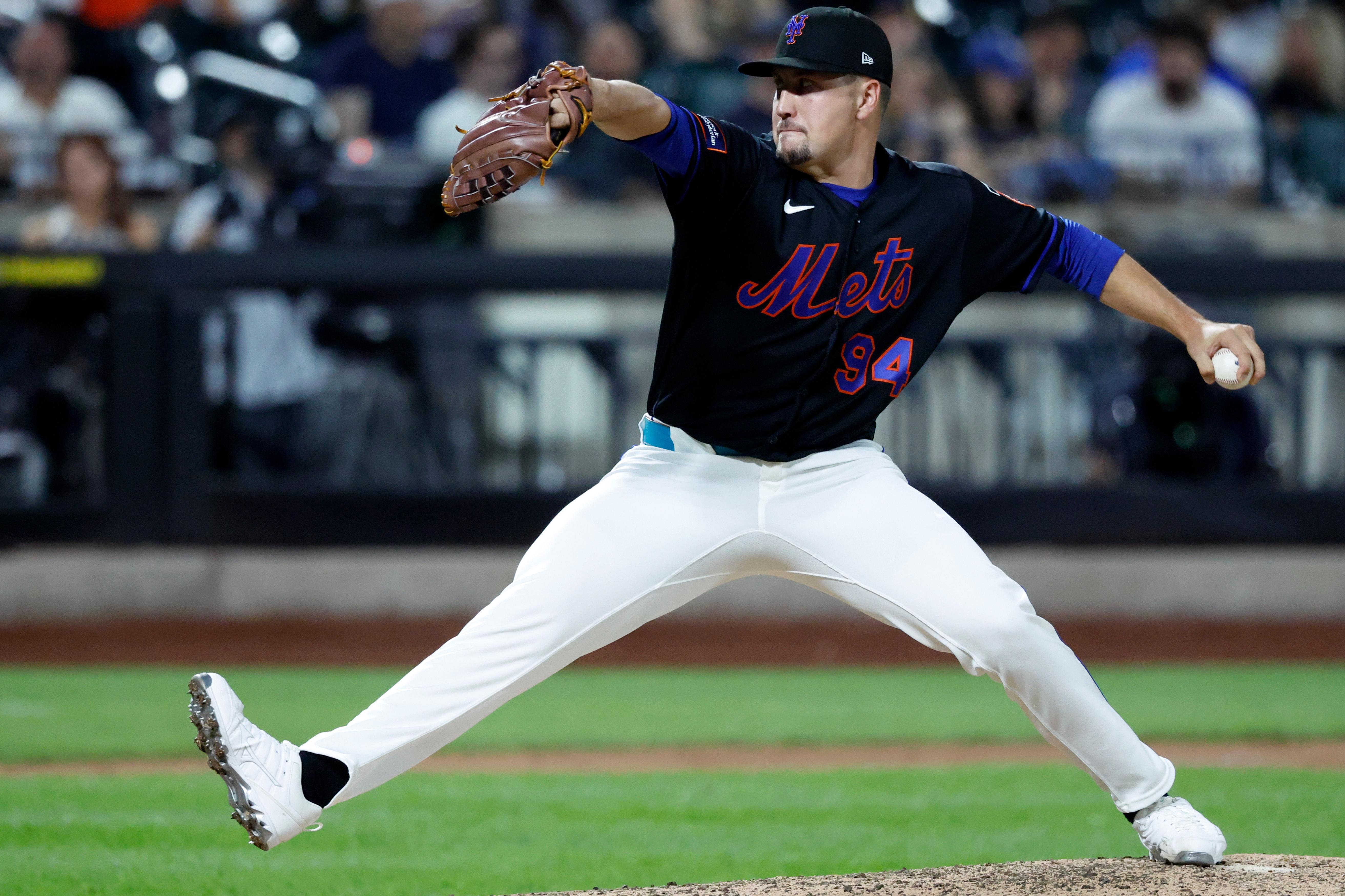
New York Mets pitcher Nate Lavender throws to the Houston Astros in the sixth inning at Citi Field in Queens, New York, Friday, August 28, 2026. JASON SZENES FOR THE NEW YORK POST Entering Saturday’s 9-5 loss to the Giants at Citi Field, Lavender had been the third-most valuable reliever in baseball — according to FanGraphs’ version of WAR — since debuting Aug. 4, a touch behind Houston’s Josh Hader and Pittsburgh’s Mason Montgomery.
His numbers have been otherworldly, carrying a 0.00 ERA this season, the 12 consecutive scoreless innings to begin his career the second-longest such streak in team history. The lefty had faced 44 batters and allowed just eight to reach (five hits, three walks) while striking out 14.
No, Lavender has not come out of nowhere: He was a rising prospect with the Mets before injuries (notably 2024 internal brace surgery) struck, went to the Rays as a Rule 5 project and was returned in December because injuries (notably 2025 bone spur surgery) struck again.
Delivering insights on all things Amazin’s Sign up for Inside the Mets by Mike Puma, exclusively on Sports+
But his fastball continues to seem to come out of nowhere, a weapon that has barely been touched and apparently barely been seen — all while averaging a touch over 92 mph, one of the slower four-seamers in the majors.
“But it plays like 97 [mph],” Torrens said. “It’s a heavy, heavy 92.”
The heaviness is a product of deception and extension, neither of which was necessarily a goal, Lavender said, but happy accidents that have helped him since he was a child whose father just wanted him to stay healthy.
The pride of Hudson, Ill., had to develop a good fastball as a kid because, well, Dad said so: He didn’t want his son throwing breaking balls and risking injury. If Lavender wanted to throw a different pitch, “Throw a changeup” was the advice.
“I’m sure there’s remnants [in my delivery] of that kid in there that just picked up a ball,” Lavender said, “and that’s just the way I naturally throw it.”
He fought one of those natural instincts as a freshman at the University of Illinois, where a pitching coach worked with him to shorten his arm path to protect against injury. Previously, he would reach back so his arm would lag behind the rest of his body, and then lift it at a bit under a 90-degree angle before releasing. It was a long whip-around, and the shorter arm path would help keep him healthy (a hope whose irony Lavender acknowledged).
A side benefit: With such a short path, there is very little time for hitters to pick up the ball.
New York Mets pitcher Nate Lavender walks off in the eighth inning against the San Diego Padres at Citi Field on Monday, August 17, 2026, in Queens, NY. Corey Sipkin for the NY POST And so as a professional, Lavender’s left hand goes from glove to behind him to delivery in remarkable speed. His body hides the ball, then his right, gloved arm serves as another blocker before his head is the final shield, the ball whipping out from behind his cap and then bearing down on the batter, a fastball that averages just 92.7 mph but holds hitters to 2-for-25 with 10 strikeouts entering play.
“I wouldn’t say I’ve necessarily always tried to hide the ball well,” the 26-year-old said, “I think it’s just been a byproduct of my natural delivery and then just trying to keep the body in good positions.”
Adding to hitters’ discomfort is Lavender’s 6-foot-2, long stature. His right, lead foot gets far down the mound, which makes for an elite amount of extension. By the time the ball leaves his left hand, he is an average of 7.1 feet closer to the plate, among the best in the majors.
Lavender is aware that his extension is a strength, but it’s not one that he said he has cultivated.
“I think it’s just part of my natural stroke to the plate,” he said.
Both the natural and the learned arm path have teamed to turn a 2021 14th-round selection who leads with a fastball that hasn’t touched 95 mph into one of the best relievers in the game for the past month and a surefire, real piece for the 2027 Mets.
They have left opposing hitters muttering at a 92.7 mph four-seamer.
“I’m thankful that that deception’s in there,” Lavender said, “and I can use it to my advantage.”