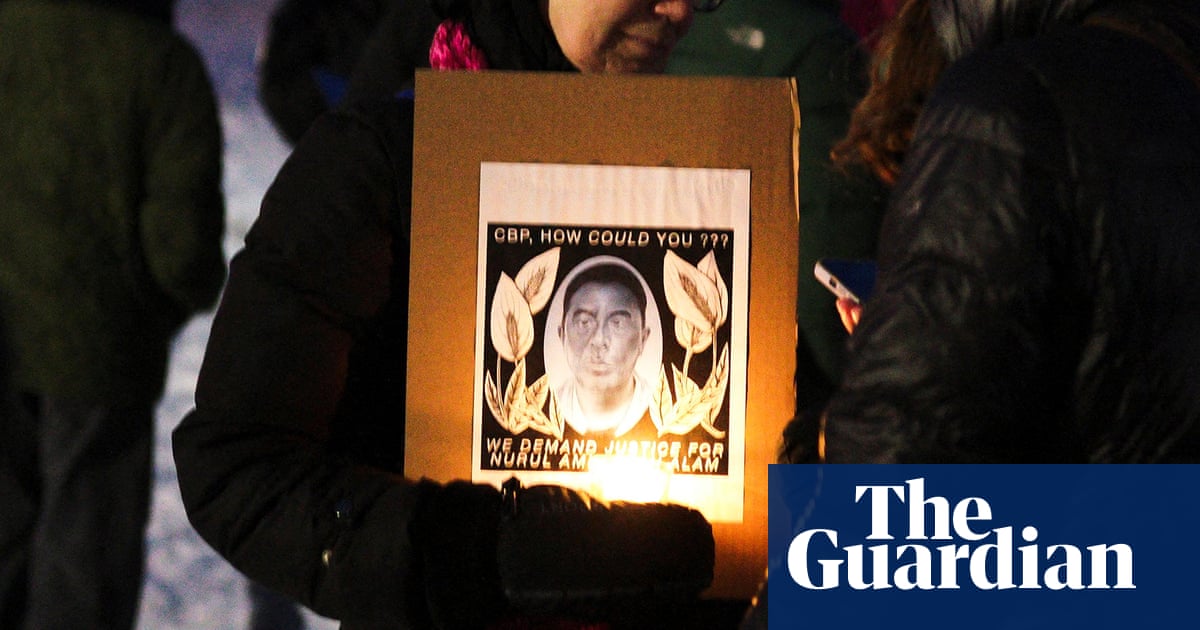
A memorial to Nurul Amin Shah Alam in February. Photograph: Craig Ruttle/ReutersView image in fullscreenA memorial to Nurul Amin Shah Alam in February. Photograph: Craig Ruttle/ReutersDemocrats condemn DHS over death of Rohingya refugee abandoned by border agentsLawmakers demand agency cooperate with investigation into death of nearly blind Nurul Amin Shah Alam in Buffalo
Democratic lawmakers are demanding that the Department of Homeland Security turn over records and fully cooperate with an investigation into the death of Nurul Amin Shah Alam, a nearly blind Rohingya refugee who died after US border agents left him outside a closed coffee shop on a freezing night in Buffalo earlier this year.
At a press conference in Buffalo on Friday, standing just a few feet away from where Shah was found dead, Tim Kennedy of New York was joined by Bennie Thompson of Mississippi, the ranking Democrat on the House homeland security committee, Lou Correa of California, and Nellie Pou of New Jersey in calling on DHS to cooperate with the Erie county district attorney’s investigation.
Kennedy said: “The Erie county medical examiner has ruled his death a homicide, yet DHS still won’t hand over a single meaningful record. Not to my office, not to attorney general [Tish] James, and not to the Erie county district attorney. Simply put, they are obstructing the pursuit of justice by local law enforcement.”
Kennedy added: “Mr Shah Alam’s family deserves to see justice served by our legal system. I won’t stop demanding it until DHS complies.”
Shah Alam, 56, was a Rohingya refugee who had lost much of his sight and spoke little English. On 19 February, after his release from the Erie county holding center, he was taken into the custody of US border patrol agents while his family waited outside the jail expecting to bring him home.
Hours later, agents left Shah Alam outside a closed Tim Hortons coffee shop. His family and attorneys were not told where he had been taken or where agents had left him. Five days later, Shah Alam was found dead roughly four miles away.
In April, the Erie county medical examiner ruled his death a homicide, determining that he died from complications of a perforated duodenal ulcer precipitated by hypothermia and dehydration. The district attorney’s office is continuing to investigate the circumstances surrounding his death.
Kennedy has also sought legislative changes in response to the case. In June, he introduced the DHS Release Transparency Act, which would require immigration authorities to notify a detainee’s designated family member, attorney, or other contact before the person’s release and provide information about where the individual is being released.
In March, New York attorney general Letitia James opened a formal investigation into Shah’s death. But in August, James closed the criminal investigation, citing the refusal of US Customs and Border Protection to cooperate.
According to a letter obtained by Investigative Post, James had requested that CBP identify the agents who “retrieved and released Mr Shah Alam” and produce “all records related to the detainer, transport, custody, dispatch communications, GPS/vehicle data, body-worn camera footage, and incident reports.”
CBP declined to share any information, according to an Investigative post.
The New York attorney general’s office then referred the investigation to the Erie county district attorney.
On 2 September, Kennedy and Thompson sent a formal letter to DHS secretary Markwayne Mullin, who had said during his confirmation hearing in March that the department was investigating Shah’s death.
In the letter to Mullin, the lawmakers demanded that “DHS fully comply with the Erie county DA’s investigation”. The lawmakers wrote that six months after Shah’s death, they had not received “a single meaningful or substantive response” from DHS, despite multiple oversight letters to the department.
Speaking at the press conference, Thompson added: “If DHS has nothing to hide, then they need to turn over the records and cooperate fully with the Erie County law enforcement. It is that simple.”