Add The New York Post on Google Earlier this summer, Samsung launched the eighth-generation foldable lineup and new wearables at the Galaxy Unpacked July 2026 event.
I’ve tested smartwatches for many years and have one on my wrist constantly. So, when I heard of the new Galaxy Watch 9, I had to see for myself if it was worth the upgrade.
The biggest draw to this model is the new Snapdragon processor, which increases efficiency and advanced AI health tracking, including sleep apnea detection. These features matter most for anyone who wants a smartwatch that does more than track steps — especially those looking for better sleep insights, faster performance and more proactive health alerts throughout the day.
I spent three weeks testing the Galaxy Watch 9, from wearing it at the gym to wearing it daily while asleep — and everything in between.
The Galaxy Watch 9 is a strong pick for anyone who wants a lightweight smartwatch with advanced wellness tools, workout tracking and an easy-to-use interface. It’s especially worth considering if you’re upgrading from an older Galaxy Watch or want a health-focused wearable that still handles everyday notifications, apps and voice controls.
Sizes: 40mm, 44mm | Weight: 31.5g, 34g | Display: 1.34-inch or 1.47-inch Super AMOLED | Battery life: Up to 30 hours | Processor: Snapdragon Wear Elite | Storage: 32GB | Memory: 2GB | Durability: IP68, 5ATM, MIL-STD-810H |
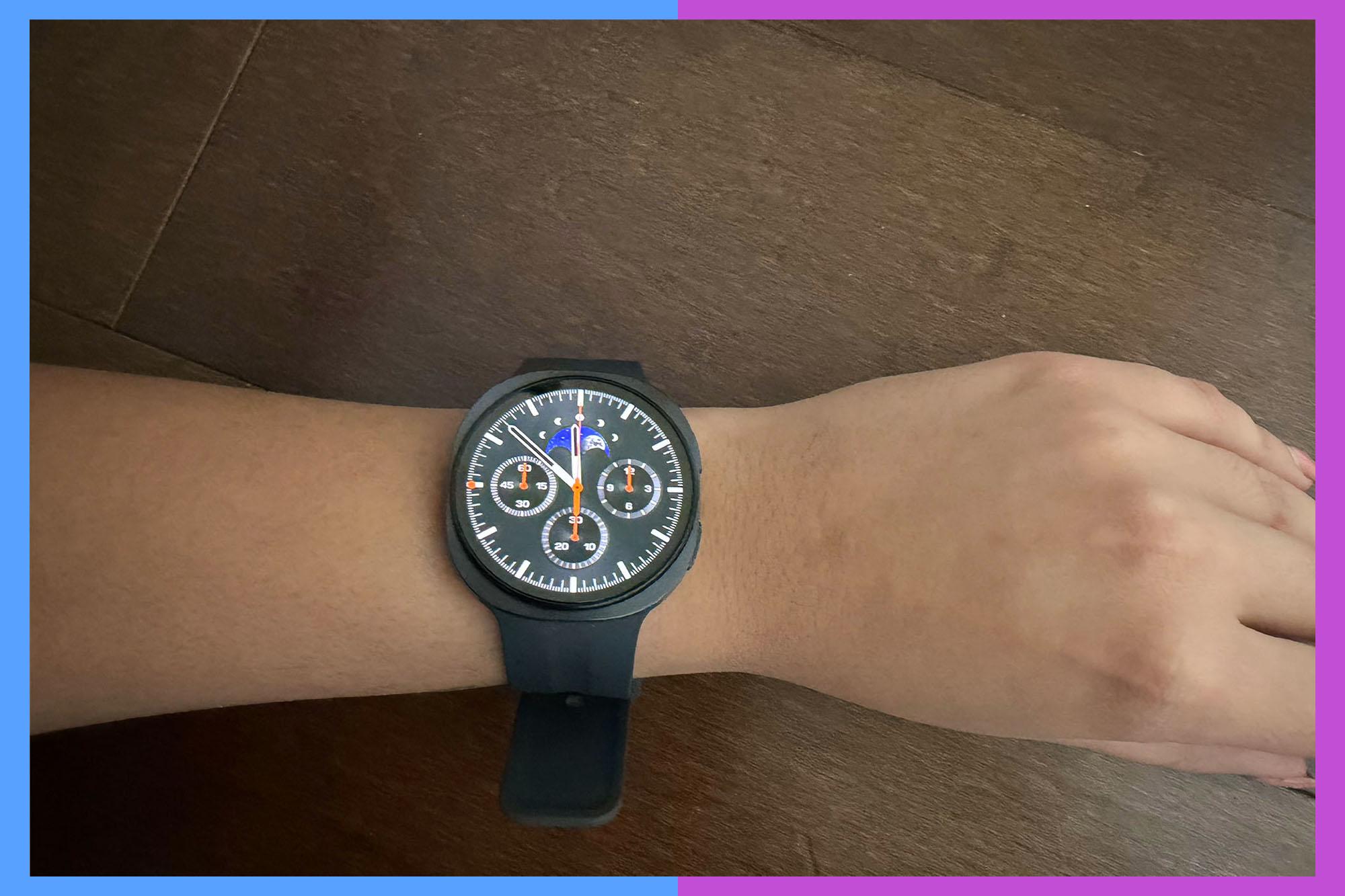
Out of the box, the Galaxy Watch 9 has a very similar design to its predecessor. The dial is still circular, and the weight is basically the same. Samsung watches have always been lightweight, so it felt comfortable on my wrist for all-day wear and didn’t bite into my skin while wearing it overnight. I still do find the circular dial just a little bit clunky, though, since I have small wrists.
That said, the main upgrade for this smartwatch has nothing to do with its design. It’s with what Samsung does best: health tracking.
Body composition analysis Nishka Dhawan Samsung watches have always been ahead of the game when it comes to health tracking, doing far more than the generic calorie count and heart rate sensing. They’ve been able to detect body composition, including measuring how much muscle weight and body fat your body stores. Samsung measures this by using a Bioelectrical Impedance Analysis (BIA) sensor that sends safe, invisible microcurrents through your upper body to estimate body fat and muscle weight.
Stress levels (left) Vitals (right) Nishka Dhawan New with the Watch 9 is the vitals tracking feature. You wear the Galaxy Watch for a total of seven nights for it to establish your baseline. From there, if your heart rate, HRV or breathing rate changes, for example, the watch will flag these changes to you. After a night out with friends, my watch correctly suspected I was both dehydrated and fatigued the next morning.
There’s also a comprehensive fitness index, which is built by tracking your steps and endurance. Unlike some of the other health features, which require a week’s worth of tracking, this index only requires you to wear your watch for two days. Mine averaged around 50 to 52 over the course of seven days. It was interesting for me to see areas of improvement. For example, my flexibility is quite low, and that helped me add five minutes of extra stretching every day to hopefully see an improvement in this category.
Other health scores include a heart health score, though you need to be able to measure blood pressure with your watch before you can get this to fully function, and a daily cardio load score, which tells you how much your body can push that day.
Similar to the Watch 8, you can also track antioxidant indexes and vascular loads with your watch. As someone who normally wears an Apple Watch every day, it was really interesting to get more in tune with my health and pay attention to specific triggers — like fatigue and dehydration — which I haven’t been able to measure before with other smartwatch competitors.
Sleep Coaching (left) Sleep Tracking (right) Nishka Dhawan Sleep tracking stayed consistent compared to previous Galaxy Watch generations. I wore my watch every night for seven days and found that the watch could accurately track time asleep, as well as any times I woke up. I also discovered my sleep animal is a penguin.
This is because I sleep quite deeply but wake up quite a bit in the middle of the night. That puts me as a stage 3 sleeper, out of four, according to Samsung metrics, and above average compared to other individuals my age. Other ‘sleep’ animals include a lion (the idea sleep type) and the shark — someone with high restlessness who doesn’t get enough sleep per night. Samsung introduced this feature in 2023, but it’s still a fun one to revisit.
I didn’t discover any anomalies during sleep tracking and found the watch to work accurately across all seven nights.
One of the biggest questions I get asked as a tech reporter is, “Will I like the Samsung watch if I’ve used an Apple interface for years?” The answer to this is yes.
There’s not much to do in terms of gestures (for hands-free navigation) and learning to adapt to a Galaxy Watch. You get a quick two-minute tutorial when you put this watch on that helps you learn how to navigate the home page and where to find apps. Samsung’s Galaxy Watch also uses a raise-to-talk feature, which lets you access Gemini hands-free.
Even as someone who usually wears an Apple Watch, I didn’t feel lost switching to Samsung’s interface, which says a lot.
The gesture controls include shaking your wrist to dismiss a call, among others.
As for exercise tracking, my favorite feature is how quickly a Galaxy Watch can detect your workout. Every time I hit the gym, my watch could immediately detect whether I was on an elliptical or doing a walking workout. I was also able to set up custom workouts.
I’m not a runner, but Samsung’s flagship running coach still exists and uses a 12-minute calibration test, which then prioritizes any goals you give it to accurately coach you. I’ve been meaning to run a 5K by the end of 2026, so this feature will definitely come in handy for me as I train.
I also liked that the watch automatically paused and resumed my walking workouts without me having to plug it in manually. There’s also, of course, water lock in case you’re showering with your Samsung Watch, which does have an IP68 water-resistance rating.
Still, the Watch 9 isn’t perfect. While the health features impressed me, battery life was the one area where I wanted more.
Samsung promises battery life should last about 30 hours with daily use, yet I found my watch’s battery life drained a lot faster. I had to recharge it at least once every day, and charging took close to two hours.
In the battle of the wearables, the Galaxy Watch 9 edges out the Watch 8 for users craving a more fluid and efficient daily companion. The standout change is the Snapdragon Wear Elite Platform, a processor that offers snappier response times and a seamless feel throughout the day. Samsung also debuted its Vitals tool on the Watch 9, which establishes a baseline by monitoring metrics like heart rate variability and respiratory rate to flag physical changes before you even notice them.
However, the Galaxy Watch 8 still remains a competent choice, offering familiar wellness metrics like Sleep Coaching and alerts for sleep apnea risks. While the foundations are similar, the Watch 9 pulls ahead with its enhanced battery capacity and proactive health alerts, positioning itself as the ideal coach for anyone dedicated to tracking their recovery and fitness with precision.
If I wanted a smartwatch that focuses on health features but was looking for an option that still had a lightweight design and was easy to adapt to, I’d be choosing the Samsung Galaxy Watch 9.
I didn’t own the Watch 8, so upgrading to the Watch 9 felt like a big change for me. However, if you do own the Watch 8, it’s up to you to decide if the new health features are worth it, because the design pretty much stays the same.
That said, as someone who takes her health quite seriously, I loved having the vital tracking features and enjoyed how quick and responsive the new Snapdragon processor made the Watch 9. Yes, the design is a little clunky and battery life could still use improvement, but Samsung’s Galaxy Watch 9 is the health companion I’d choose to use daily. If you’re someone who wants a smartwatch that feels more like a health coach than just a notification hub, the Galaxy Watch 9 makes a strong case.
This article was written by Nishka Dhawan, Commerce Reporter for the New York Post. Nishka reports on the latest tech launches, innovations and trends to separate the best new products from the “AI slop.” Taking the latest technology for a spin, Nishka tests home appliances and tech products that actually improve your life, from vacuums to headphones to gaming gadgets and more – all while finding the best deals and lowest prices. Before joining The Post in 2026, her work appeared in Rolling Stone, ABC, NBC Select, Reviewed and Digital Trends.
Looking for a headline-worthy haul? Keep shopping Post Wanted.