Maltese businessman Yorgen Fenech has been found not guilty of complicity to murder journalist Daphne Caruana Galizia. Almost nine years after the attack, the question of who ordered her death remains unanswered.
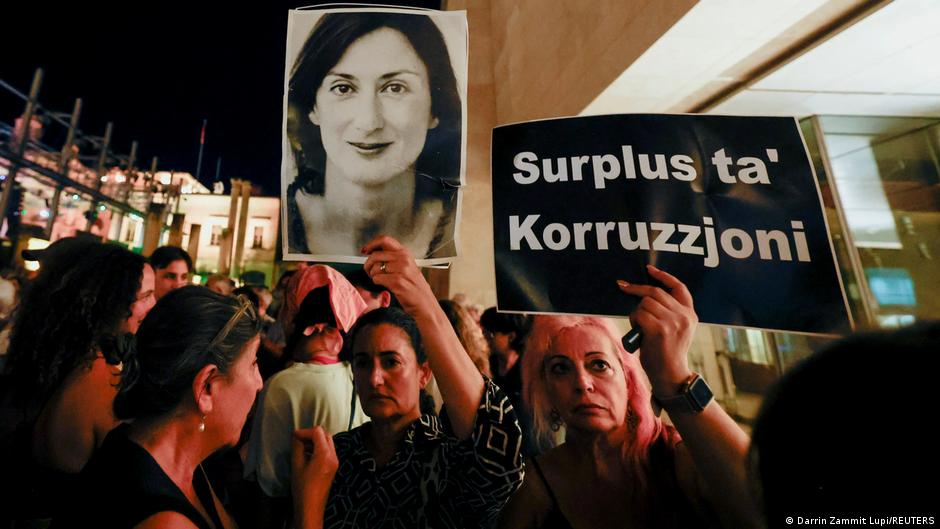
https://p.dw.com/p/5LaXAProtesters gathered outside the Maltese Parliament following the verdict in the Caruana Galizia murder trial on WednesdayImage: Darrin Zammit Lupi/REUTERSAdvertisement"Murderer!" — "Scum!" — "Mafia!"
As Yorgen Fenech left the courthouse in Valletta on Wednesday evening, he was confronted by the furious crowd outside. The 44-year-old Maltese businessman pushed through, flanked by his security guards. Just minutes earlier, a jury had acquitted him of ordering the murder of the 53-year-old investigative journalist Daphne Caruana Galizia.
The verdict came as a shock to her family. Her son, Matthew Caruana Galizia, said it was a "terrible decision by the jurors that our country may never recover from." He later doubled down on his criticism, describing the verdict in a post on Facebook as "obscene" and saying: "Their decision flies in the face of all evidence, of all logic, of the truth."
Almost nine years after Caruana Galizia's murder, Malta is again confronted with the crucial question: Who was responsible for her death on October 16, 2017? The men who procured the bomb, placed it under the driver's seat and detonated it remotely have already been convicted. But the person who contracted them to do it has still not been legally identified.
For years, Fenech was considered to be the central figure in the investigations. His arrest on the morning of November 20, 2019, was like something out of a movie. His luxury yacht, Gio, had just left harbor when it was stopped by a Maltese military patrol boat. Fenech was arrested on board and subsequently interrogated by the police.
Fenech's arrest, and suspicion that people in government circles were involved in the crime, sparked protests all across the country. Joseph Muscat, prime minister at the time, was accused of protecting political allies and stepped down in January 2020. Fenech spent more than five years in detention before being released on bail, under strict conditions, in early 2025.
His trial only began this summer, and the final verdict was decisive. Eight of the nine jurors rejected the prosecution's argument that it was Fenech who had ordered the journalist's murder.
The prosecution case relied above all on the testimony of Melvin Theuma, who confessed to being the middleman and testified that Fenech had contracted him to organize the murder. Theuma received a pardon in exchange for his cooperation.
But Fenech's defense called Theuma's credibility into question, highlighting contradictions in his testimony and false statements he had made previously.
Fenech's lawyers also sought to prove that evidence pointing to Keith Schembri, chief of staff to Muscat at the time, was not properly followed up. Schembri has denied any involvement in the murder, and the investigators did not charge him as a suspect in this case.
The public prosecutors' argument was that Caruana Galizia had been investigating Fenech, specifically his company 17 Black and the energy consortium ElectroGas, on suspicion of corruption. This, they said, meant Fenech had a motive for silencing her. She had not, however, been on the point of publishing anything that could have threatened him.
Many in Malta are outraged by the not-guilty verdict. But there is no indication to date that Fenech did not receive a fair trial, or that the process was manipulated. For him to be convicted, Fenech's guilt had to be proved beyond reasonable doubt.
Caruana Galizia's family are therefore also focusing on institutional failures that they believe facilitated the murder. They complain that these have not been addressed, and necessary reforms not implemented. An official investigation already established, in 2021, that an "atmosphere of impunity" in Malta created conditions that made the murder possible.
Since then, Malta has made progress with a series of reforms, but many say they do not go far enough. This is especially the case with regard to press freedom. In 2021, the committee of inquiry recommended that journalists be better protected against political and economic pressure and their role institutionally strengthened, yet the country is still waiting for comprehensive media reform.
Following years of discussion and a public consultation, the Maltese government brought the relevant bill before parliament in March 2026, but the legislation was not passed before early parliamentary elections in May.
In its latest Rule of Law Report, the European Commission only certifies limited progress made by Malta. It acknowledges that it has introduced some specific protection measures for journalists, but says core recommendations from the investigation into the murder of Daphne Caruana Galizia remain unfulfilled.
But the government paints a different picture. It has highlighted changes to the judiciary and anti-corruption measures, as well as better protection of journalistic sources, and additional measures to protect media professionals. This is what the EU Commission referred to as progress in specific areas.
The case has also shone a spotlight on the slow pace of the Maltese justice system. According to a report by the Daphne Caruana Galizia Foundation, 46% of homicide cases brought to trial between 2010 and 2020 had still not been concluded in mid-2025. The foundation regards this as a structural problem, and warns that when proceedings go on for so long, it compromises the chances of an effective prosecution.
No decision has yet been made as to what will happen now, following Fenech's acquittal. Judge Edwina Grima has ordered that the evidence presented at trial be passed on to the chief of police, who will decide whether criminal proceedings should be brought against anyone else.
On Thursday, former PM Muscat said that, according to the public prosecutors, further investigations were ongoing.
The Institute of Maltese Journalists (IGM) has called on the authorities to pursue every line of inquiry that came to light during the trial — including, explicitly, those that lead to former high-ranking politicians. The acquittal must be respected as the outcome of the constitutional process, the IGM said, but it does not close the case.
The demonstrators outside the courthouse in Valletta are in no doubt. Someone must have issued a contract for the murder of Daphne Caruana Galizia. And almost nine years after her death, still no one has been held responsible.
This article was originally written in German.