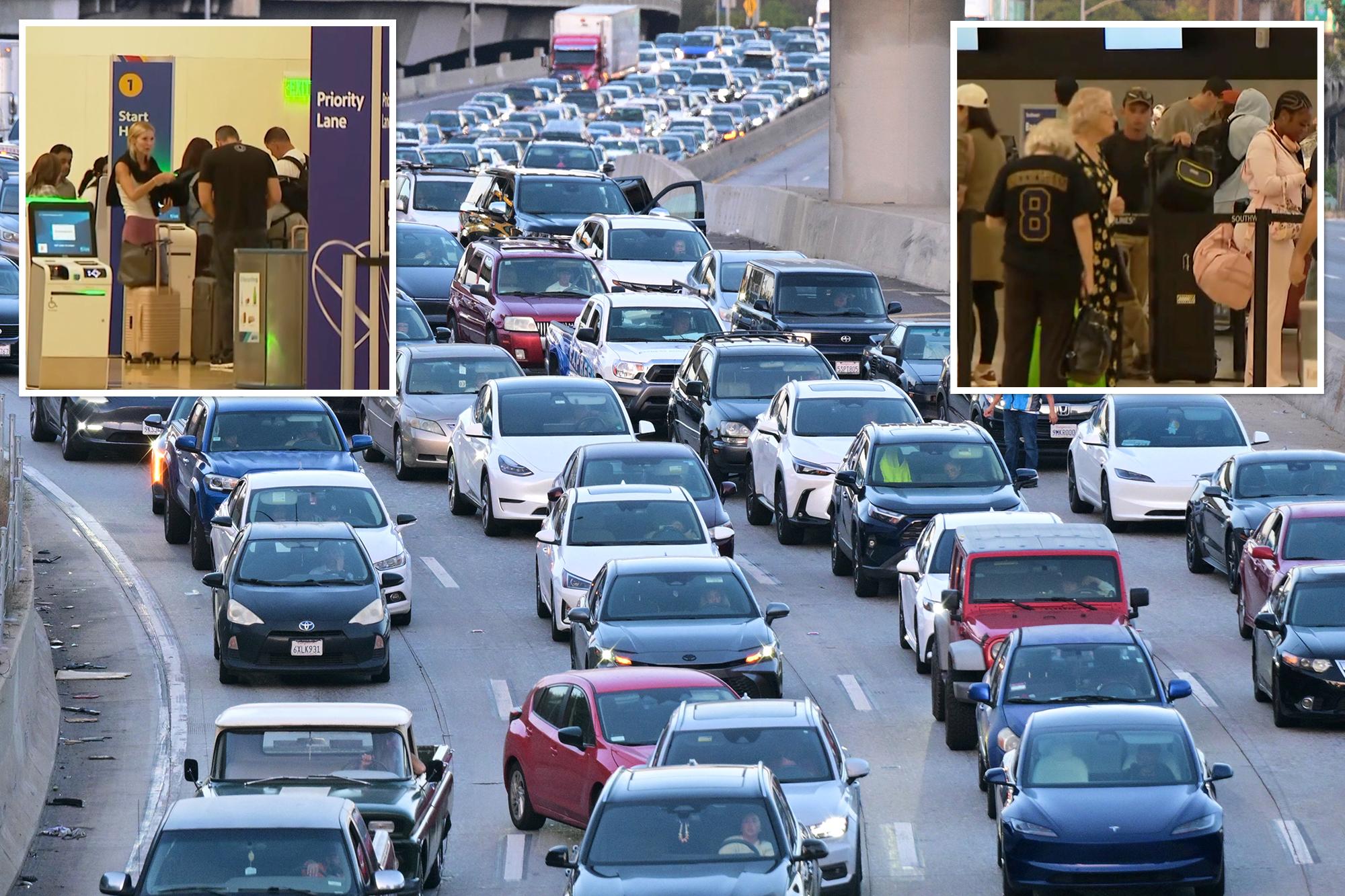
Add The California Post on Google California’s Labor Day weekend getaway could begin with an unwelcome tradition: staring at the bumper in front of you for hours.
As millions of people pack up their trunks and head towards coastal or desert escapes for one last hurrah this summer, holiday travelers face a brutal mathematical reality, according to a report from mobility analytics firm INRIX and AAA.
Unlike Christmas or Thanksgiving, where holiday departures disperse across several days, Labor Day travel is notoriously concentrated into a punishing bottleneck. But there’s one simple trick for dodging the worst of it: beat everyone else onto the freeway.
INRIX expects the getaway rush to be most concentrated Thursday and Friday afternoons, as long weekend travelers collide with the usual commuter traffic.
Friday road-trippers should try to leave before noon, since 12 p.m. and 8 p.m is expected to be the thick of the holiday rush. If you miss Friday’s window, Saturday morning will offer a momentary breather before bumper-to-bumper delays return between 1 p.m. and 5 p.m.
Sunday remains the undisputed weekend winner with minimal traffic disruptions expected across the state, while the return wave on Labor Day Monday will snare anyone who fails to hit the tarmac before traffic peaks fiercely between 2 p.m. and 5 p.m.
Nowhere will that congestion bite harder than Southern California’s premier vacation corridors.
The crown for holiday highway hell goes to Interstate 5 South from Los Angeles down to San Diego. The peak bottleneck hits Friday at about 6 p.m., when commutes could stretch to an excruciating 5 hours and 19 minutes — a 75% increase over normal traffic times.
Meanwhile, desert-bound travelers going from San Diego out towards Palm Springs via Interstate 15 North faced their worst nightmare on Thursday at 5:45 p.m., with estimated drive times ballooning to 4 hours and 12 minutes, marking a 50% surge from normal traffic.
Up north, those going to the state’s capital from San Francisco on Interstate 80 East will face the worst of it on Friday at 4:45 p.m., where traffic spikes by 81%, turning an otherwise quick drive into a 4 hour and 40 minute road trip.
Compounding the misery of inching along baking asphalt is California’s infamous fuel sticker shock. While the national average sits around $4.14 a gallon, Golden State drivers are coughing up an eye-watering average of $5.80 statewide.
San Diego County drivers are getting squeezed for roughly $5.92 a gallon and Los Angeles County for $5.85, according to AAA.
California Post News: Facebook, Instagram, TikTok, X, YouTube, WhatsApp, LinkedInCalifornia Post Sports Facebook, Instagram, TikTok, YouTube, XCalifornia Post Opinion California Post Newsletters: Sign up here!California Post App: Download here!Home delivery: Sign up here!Page Six Hollywood: Sign up here!