play Live Sign upShow navigation menuplay Live Click here to searchsearchSign upEXPLAINERNews|TechnologyAs the China-US AI race reaches Cairo, Egypt faces a strategic decisionEgypt walks a tightrope as China and the US vie for dominance in AI data centre development.
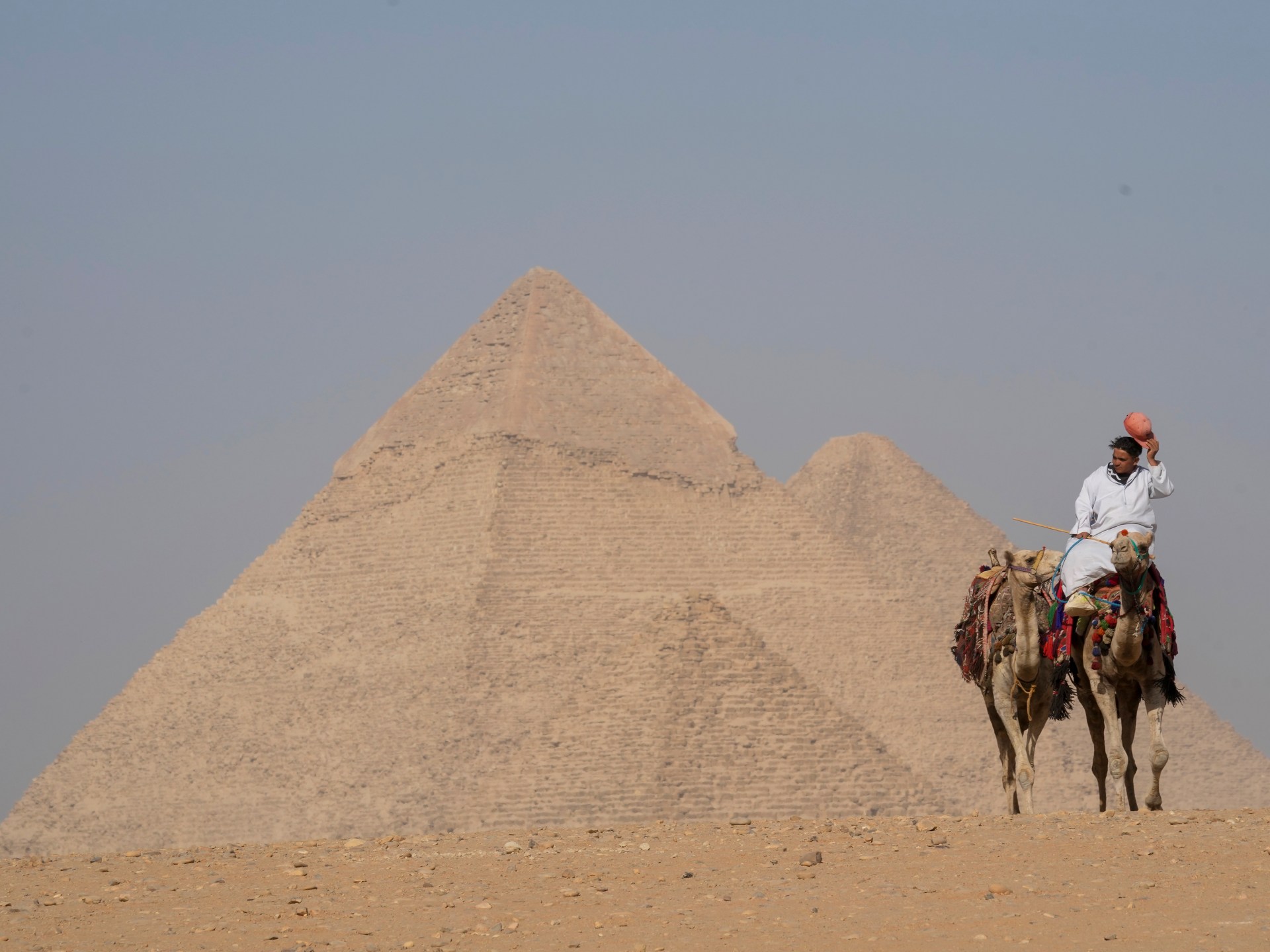
xwhatsapp-strokecopylinkgoogleAdd Al Jazeera on GoogleinfoPyramids of Giza, on the outskirts of Cairo, Egypt, on Thursday, October 24, 2024 [Amr Nabil/ AP Photo]By Yasmeen EltahanPublished On 4 Sep 20264 Sep 2026Chinese President Xi Jinping’s three-day visit to Egypt, coinciding with the 70th anniversary of diplomatic relations between the two nations, marked his first trip to the Middle East in four years and the first to Egypt in a decade.
The trip caused debate among geopolitical observers over Egypt’s diplomatic balancing act between China, one of its largest economic partners, and the United States, a major defence and strategic partner.
But Egypt also finds itself in another tightrope walk between the two superpowers: it is emerging as a potential battleground in the US-China artificial intelligence race.
Xi’s visit came at a time when Chinese tech giant Huawei has submitted a tender to build Egypt’s AI data centres. The US, meanwhile, is reportedly pulling together an offer to counter Huawei’s bid. Whoever wins the contract to build the data centres will also gain an opportunity to strengthen their political and economic ties with Egypt.
Egypt, which receives roughly $1.3bn a year in US military aid and remains a major American defence partner, has been steadily deepening its economic and military ties with China in recent years.
So what does all of this mean for Egypt’s relations with the US and China, and who stands to benefit from AI data centres in Egypt?
Huawei has offered to supply “1,408 Ascend 950 processors for AI model training, plus 600 Ascend 950 or older 910B chips” to build two computing clusters.
The company proposed a 12-month build timeline, and if the project goes through, the deal would mark the first known export of Huawei’s Ascend AI processors, according to documents reviewed by Bloomberg. The infrastructure that would house the AI chips would be used for military, surveillance and other public-sector operations, the news agency reported.
According to anonymous sources quoted by Bloomberg, the US State Department is working on a counteroffer to Huawei’s AI chip bid through companies including Nvidia, Advanced Micro Devices Inc, and Microsoft Corp.
Currently, China and the United States are leading globally when it comes to AI development and investment. The gap between the world’s two biggest economies is narrowing fast, though. On spending alone, the US still dominates, with American firms pouring $285.9bn into private AI investment in 2025, against China’s $12.4bn, according to the 2026 AI Index Report by Stanford University.
Al Jazeera contacted Huawei for comment but received no response.
“The US and China are globally competing over data centres”, human rights advocate from the Egyptian Initiative for Personal Rights (EIPR), Mohamed Ramadan, tells Al Jazeera. “The question of data centres is a very significant geopolitical one”, he added.
“This competition primarily revolves around data and the ability of both nations to integrate data from different regions worldwide, which is essentially a battle over the future in some way.”
Ramadan, however, argued that China might have an advantage over the US in Egypt as “Huawei has been in Egypt for years” having signed numerous agreements with the Egyptian government for the supply of telecom equipment. He also added that the “Chinese often likely have the advantage of being cheaper compared to American companies.”
Environmentally, Egypt sits at a disadvantage when it comes to water scarcity and air pollution. The country’s per capita water share has fallen below 500 cubic metres a year, under half the UN’s water poverty threshold, according to Egyptian government data.
Data centres are notoriously water and power-hungry because high processing power requires significant cooling. Egypt’s capital is also ranked among the world’s most polluted cities, raising the question of whether an AI data centre could make the situation more severe.
Speaking to Al Jazeera, Egyptian political analyst Maged Mandour said that despite water scarcity being a prominent issue, the government will likely supply the project “the water that it requires, and the energy that it needs while depriving other parts of the country of the needed resources”.
He added that the deal would be “an export deal of AI technologies” and would not necessarily benefit the Egyptian economy.
“I think it’s unlikely to lead to sustained employment … maybe it would create some jobs, but it’s not something that would be economically transformative long-term in general in a large country like Egypt.”
Why did China choose Egypt for an AI data centre?
The reason lies in where Egypt sits on the map. The country controls the Suez Canal, and it sits at the crossroads of Africa, the Middle East, Europe and Asia, making it both a sizeable market for Chinese companies and a potential manufacturing and logistics hub for reaching everyone around it.
Against a backdrop of regional conflict, driven by the six-month US-Israel war on Iran, and the partial closure and restriction of the vital waterway, the Strait of Hormuz, the Suez Canal’s strategic significance has only grown. It is today an obvious choice for an alternative shipping route. Routing through the Suez Canal sidesteps both the Hormuz and Bab al-Mandeb straits, letting cargoes avoid any potential risks that could be faced there.
China is Egypt’s largest trading partner in non-petroleum goods, with bilateral trade reaching nearly $20.7bn by the end of 2025, according to the State Information Service (SIS).
Egypt is also an important economic partner for China. The North African country imported $10bn of Chinese goods in the first half of this year alone, according to Egyptian government data, up more than 14 percent from the same period a year earlier.
Chinese investment has surged since Egyptian President Abdel Fattah el-Sisi signed a strategic partnership agreement in Beijing in 2014. Since then, Chinese firms have poured billions into different Egyptian projects ranging from container ports, green hydrogen and factories producing iron pipes, car tyres and satellites.
According to figures cited by China’s Xinhua news agency, the China-Egypt Suez Economic and Trade Cooperation Zone attracted more than 200 companies and created more than 10,000 direct jobs by the end of June. That zone is a major international industrial and manufacturing hub located along Egypt’s Red Sea coast and was established as a joint project between China and Egypt as part of China’s Belt and Road Initiative.