As the Serbian government leaves the decision about Ratko Mladic's funeral arrangements to his family, international pressure on the country is mounting. How do Serbs feel about the matter?
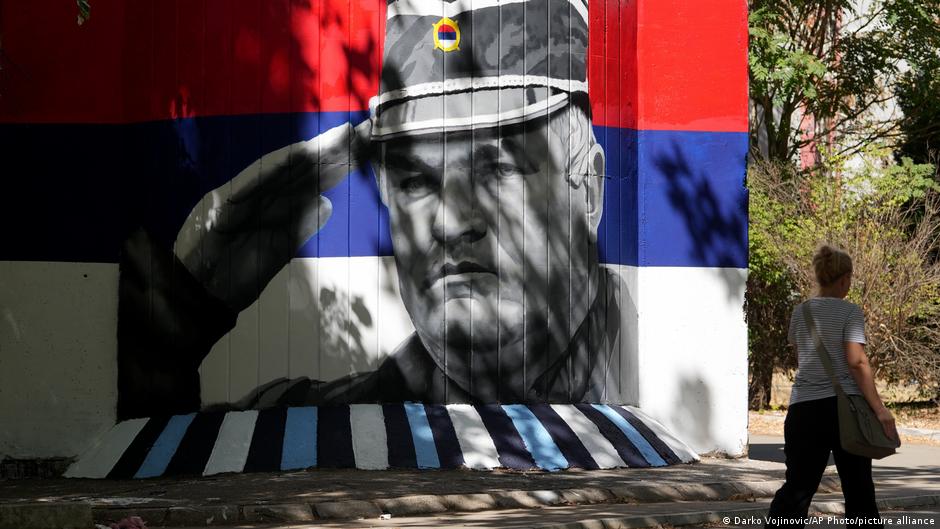
https://p.dw.com/p/5LGDC'There is no small town in Serbia without at least one mural glorifying Ratko Mladic,' says Jasmina Lazovic, executive director of the Humanitarian Law CenterImage: Darko Vojinovic/AP Photo/picture allianceAdvertisementThe body of the former Bosnian Serb army commander Ratko Mladic, who died last week in The Hague, where he was serving a life sentence for genocide and other war crimes in Bosnia and Herzegovina, has arrived back in Serbia.
Wrapped in the Serbian flag, Mladic's coffin was carried by members of the Serbian Armed Forces from the plane to a vehicle that transported his remains to the Military Medical Academy for autopsy.
Several groups of citizens gathered along the route from the airport to the hospital. Standing on overpasses, they greeted the motorcade carrying Mladic's body, holding banners that read "Thank you, General" and "Heroes never die."
Pro-government tabloids provided minute-by-minute coverage, referring to Mladic as a "Serbian general" and claiming that he had been "killed in The Hague."
Ratko Mladic was sentenced in 2017 to life imprisonment by the International Criminal Tribunal for the former Yugoslavia in The Hague for the genocide in Srebrenica, in which more than 8,000 Muslim men and boys were killed, the years-long siege of Sarajevo during the 1992–95 Bosnian War, and other war crimes, including the establishment of detention camps for non-Serb civilians and prisoners of war.
Belgrade media report that Mladic will be buried in Belgrade on Monday. Justice Minister Nenad Vujic had previously announced that the funeral would be held with the highest state honors.
Serbian President Aleksandar Vucic, however, says the decision will be left to the family.
Security agencies estimate that tens of thousands of people could attend the funeral.
"We will be there to provide all kinds of logistical and transport support and to maintain public order and security," said the president, adding, "It is very difficult to ensure and guarantee the safety of everyone."
For Jasmina Lazovic, executive director of the Belgrade-based Humanitarian Law Center, which has spent decades working on transitional justice and dealing with the past, none of this comes as a surprise.
She points to the long-standing glorification of Ratko Mladic in Serbia and his legacy.
"There is no small town in Serbia without at least one mural glorifying Ratko Mladic. The narrative that he was unjustly convicted has existed for years," she told DW. "Now a narrative has emerged that he was killed, despite the fact that he died at the age of 85 after suffering several strokes."
Lazovic says that these narratives suit the state leadership's portrayal of Serbia as a country that fought exclusively defensive wars and do not leave enough room for a discussion of the consequences of those wars and the victims they left behind — neither in the media nor in the education system and institutions.
"And there are hundreds of thousands of victims across Croatia, Bosnia and Herzegovina and Kosovo. Above all, these were crimes committed against civilians, crimes that left the countries of the region — particularly Bosnia and Herzegovina — with a completely transformed ethnic structure," she said.
Lazovic says that the list of victims also includes those who survived rape and torture, as well as those who were forcibly displaced. "The list is long, and our knowledge is limited," she added.
The announcement that Mladic could be buried with the highest state honors drew swift responses from the international community.
"Glorification of war criminals is contrary to European values. There is no place for it either in EU member states or in candidate countries. I hope the government in Belgrade is aware of that," said European Commissioner for Enlargement Marta Kos.
Aleksandar Vucic responded by accusing the West and the Hague Tribunal of blaming only Serbs for war crimes and failing to deliver justice for Serbian victims. But for now, he has officially left the decision on whether the deceased general will receive state honors to Mladic's family.
Jasmina Lazovic believes Vucic will once again take a pragmatic approach and that the final decision will depend on an assessment of what brings the authorities greater political benefit and what could cause greater damage.
She also points out that the issue is not only political, but legal.
"What is being overlooked here is the fact that Ratko Mladic was indeed a general, but he was sentenced to life in prison. Under the Law on the Serbian Armed Forces, anyone sentenced to more than one year in prison for a criminal offense loses their rank and, therefore, all the privileges that come with that rank," she told DW.
"If Ratko Mladic were buried with the highest state honors in accordance with the rank he held during the armed conflicts, that would be a direct violation of the law of this country," said Lazovic.
On the question as to how they view Ratko Mladic, Serbian citizens interviewed by DW in several cities across the multi-ethnic autonomous province of Vojvodina expressed sharply differing views, ranging from those who are convinced that Mladic was unjustly convicted to those who accept the genocide designation without reservation.
"What was he supposed to do, let them kill all the Serbs? Thank you [Mladic], for everything," one man from Ruma told DW.
"For me, the matter was settled when the genocide verdict was handed down," said a student from Novi Sad.
But most people simply wave the question away. "I have enough of my own problems," said Svetlana from Zrenjanin.
Goran, from Novi Sad, believes that it is simply another political issue: "They've been making fools of us for years. Nothing is different now," he told DW.
Jasmina Lazovic believes that most Serbs are apathetic about the matter.
For her, this is a greater problem than just the pro-government media portraying Serbia as wanting to say goodbye to Mladic as a general. She argues that confronting Mladic's legacy and the past is essential if Serbian society is to move forward.