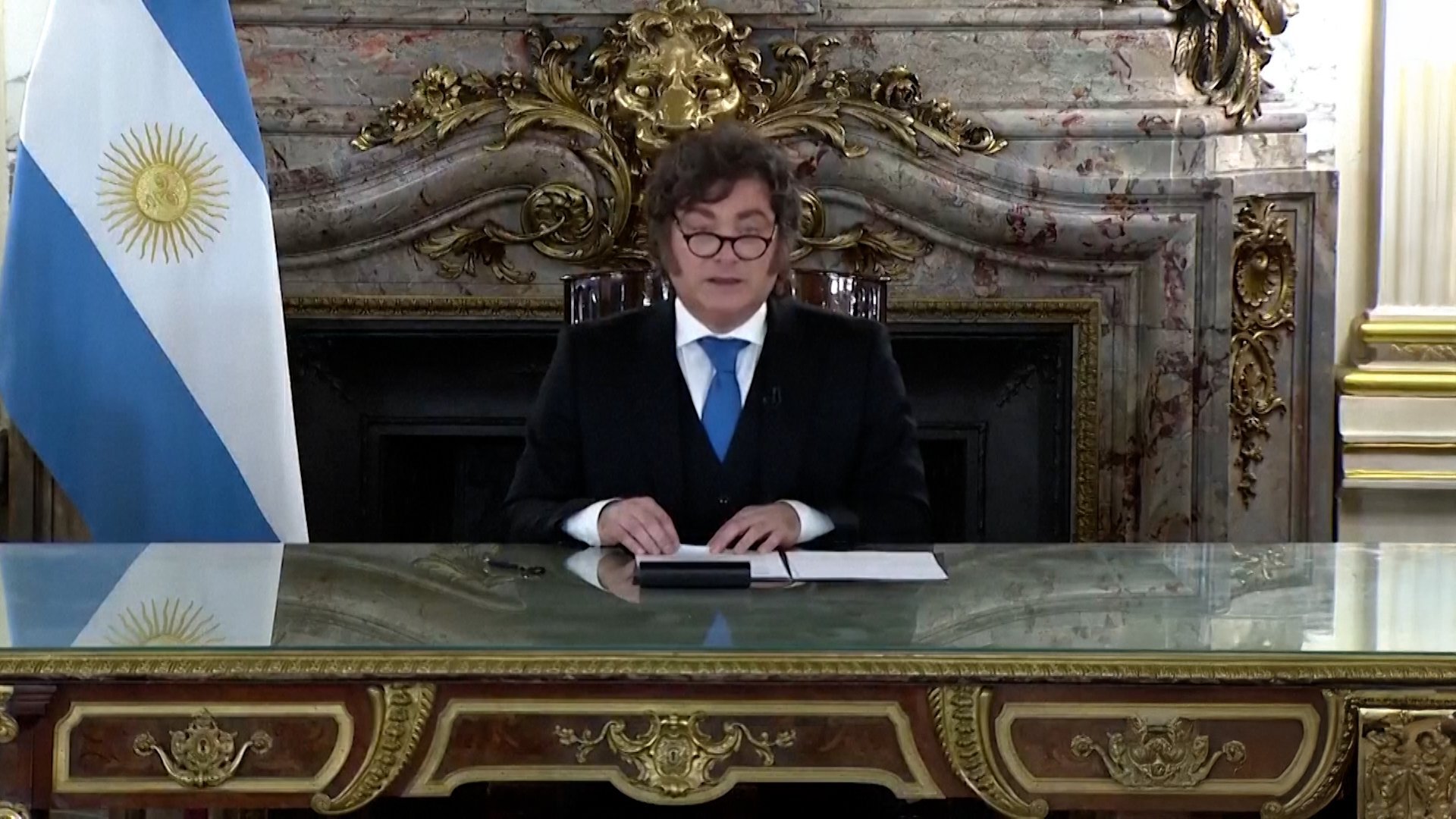
Argentina's President Javier Milei delivers a speech in which he said the "winds of change" favoured Argentina's claim to the Falkland Islands. Photograph: Juan Mabromata/AFP/Getty ImagesView image in fullscreenArgentina's President Javier Milei delivers a speech in which he said the "winds of change" favoured Argentina's claim to the Falkland Islands. Photograph: Juan Mabromata/AFP/Getty ImagesPresident Javier Milei says ‘winds of change’ support Argentina’s claim to Falkland IslandsPresident cites Donald Trump’s suggestion that he might reconsider US support for British sovereignty, and threatens swifter sanctions on British oil interests
President Javier Milei has said “winds of change favourable” to Argentina’s claim to the Falkland Islands were “blowing around the world” in a televised address, citing signs that Donald Trump might reconsider the US position on the islands’ sovereignty.
“Recently, President Trump declared that the US is re-evaluating its historic position in relation to the Malvinas,” he said, using the Argentinian name for the islands.
The Argentinian president said the UK was facing “multiple crises of a migratory, demographic and economic nature that are unlikely to be resolved. It is clear that they are on a path of decline. Argentina’s future, however, is flourishing and will prevail.”
Read moreEarlier on Thursday, Trump was asked by British outlet GB News if he would “come to the UK’s aid” during a potential territorial dispute over the Falkland Islands with Argentina, and hinted that he would not, adding that the UK “weren’t there to help me [with Iran]”.
Supporters had expected Milei to use his address to the nation on Thursday night to announce an unprecedented US endorsement of Argentina’s sovereignty claim over the Falkland Islands.
Instead, the self-styled libertarian, when asked whether he was reviewing the US position on the islands, repeated the US president’s words, saying: “I always review every position. That’s just one of many.”
The far-right president then portrayed Trump’s response as a “threat” that was “not innocuous”.
“The US is considering this change of position because it knows that Argentina has a reliable partner, aligned with western values, in a strategically important position that can be a valuable ally in the decades to come,” he said.
The US has formally recognised the UK’s de facto administration of the islands but has not taken a formal position on sovereignty. The first reports of a possible revision emerged in April, when an internal Pentagon email reported by Reuters raised the prospect of Washington reconsidering its stance as one possible way of punishing Nato allies that declined to join the Iran war.
In Thursday’s interview, Trump said of the UK: “Your country was not there to help me. We didn’t need help, but I did ask Nato, and I asked your former leader [Keir Starmer], ‘why don’t you send a couple of ships?’. He said, ‘We don’t have any’. It was pretty sad, the whole thing.”
Despite the expectations created by Milei and his supporters – the president summoned all his ministers to stand alongside him – the main new elements of the speech were a few decrees announced by the president.
One of them is to speed up sanctions “against those participating in oil extraction initiatives”, specifically citing an offshore oil project in the North Falkland Basin led by the Israeli company Navitas alongside its British partner Rockhopper. Milei claimed the project violated a UN call for neither Argentina nor the UK to take unilateral action in the territory.
Read moreDespite his “radical” austerity policies, Milei also said he would sign an emergency decree to increase resources for the defence ministry, prioritising the construction of an integrated naval base in Tierra del Fuego. The project to build a base there predates Milei, and construction began in 2022.
The UK said earlier this week that its position on the Falklands was “long-standing and unwavering”. It said in a statement: “Sovereignty rests with the UK, and the islanders’ right to self-determination is paramount. The UK’s position is clear. The islanders have repeatedly expressed their wish to remain a British overseas territory.”
Some analysts had already viewed Milei’s recent embrace of the Malvinas cause as another attempt to create a “smokescreen” at the lowest point of his popularity since taking office. He is expected to seek re-election next year.
Amid corruption allegations involving members of his government and poor economic results – his “chainsaw” austerity policies have brought inflation under control, but unemployment and poverty have risen – the far-right president has increasingly turned up the volume on controversial measures, including claims of an anti-Argentina campaign dating back to the World Cup, attacks on Brazil’s leftwing president, Luiz Inácio Lula da Silva, and an immigration crackdown modelled on the US Immigration and Customs Enforcement (ICE).
Many have also noted that his interest in the issue is recent. Milei had long described himself as a great admirer of Margaret Thatcher, the British prime minister during the 1982 Falklands war, and only began adopting a public pro-sovereignty stance a few months ago, after reports emerged that the US might be reconsidering its position.
The far-right leader also dismissed the principle of self-determination invoked by the UK – in a 2013 referendum, 99.8% of the islanders voted to remain a British overseas territory.
Echoing the same phrase used by Argentina’s national team on a banner celebrating their victory over England in the World Cup semi-final, Milei said that “The Malvinas are Argentinian.”