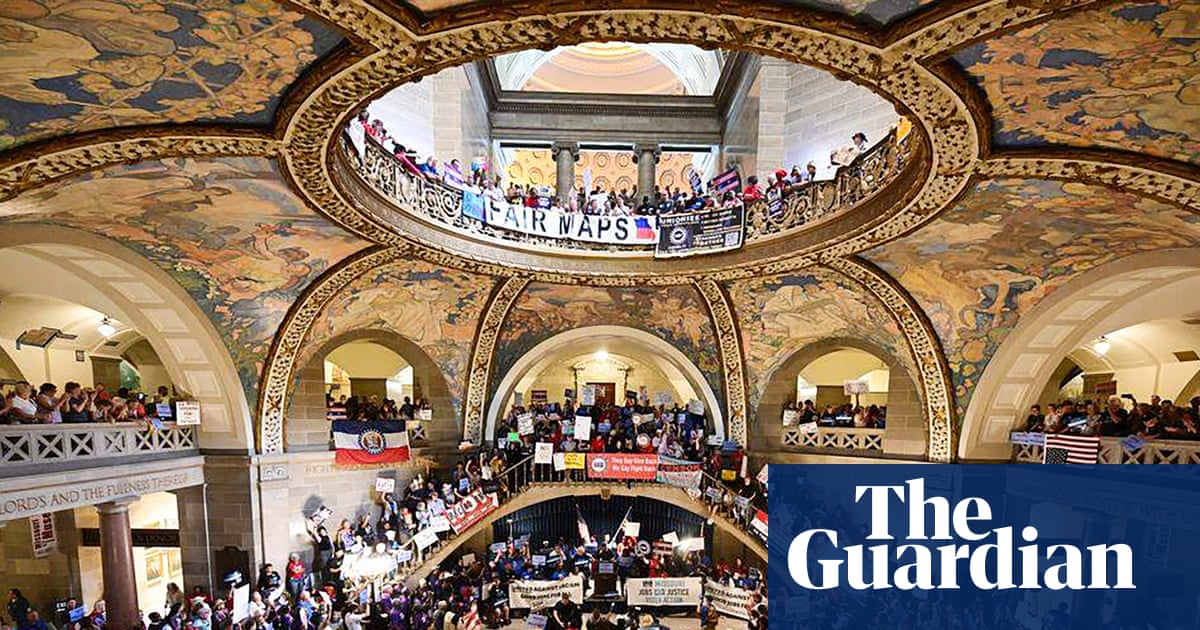
A protest at the Missouri statehouse in Jefferson City in September against the state’s efforts to change its congressional maps. Photograph: Tammy Ljungblad/Kansas City Star via Getty ImagesView image in fullscreenA protest at the Missouri statehouse in Jefferson City in September against the state’s efforts to change its congressional maps. Photograph: Tammy Ljungblad/Kansas City Star via Getty ImagesMissouri supreme court throws out new congressional maps backed by TrumpSetback for Republicans in redistricting battle as court orders forbids maps from being used in November elections
The Missouri supreme court has unanimously blocked new congressional districts backed by Donald Trump from being used in the November election and ordered a statewide vote on whether to uphold or reject the new map.
The decision Thursday marks a rare setback for Republicans in a national redistricting battle. Republicans had hoped Missouri’s new congressional boundaries could help them win an additional seat and hold onto their slim House majority in the midterms. The ruling still could be appealed to the US supreme court.
Missouri’s new districts were used in the August primaries. But the state supreme court said they cannot be used in the November general election – or ever again, unless voters first uphold the new districts passed by the Republican-led legislature.
The court placed the new districts on hold because citizens submitted petition signatures seeking a referendum.
“The referendum petition was legal, sufficient, and timely, and the secretary incorrectly concluded otherwise,” the court said in its ruling. The legislation containing the new districts “did not go into effect and will not go into effect unless and until approved by the voters.” As as result, the congressional map adopted after the 2020 census “remains in full force and effect for the November 2026 general election”.
The Missouri constitution does not specifically say a referendum petition can be used for a congressional redistricting law passed by the legislature. But the supreme court ruled that a constitutional provision allowing a referendum on “any act” of the Legislature encompasses congressional redistricting.
The ruling capped a year of political maneuvering and legal wrangling over the new districts.
After Trump urged Republicans to redraw congressional districts to their advantage, Missouri governor Mike Kehoe called lawmakers into a special session last year to dramatically reconfigure the fifth congressional district, held by Democrat Emanuel Cleaver.
Opponents submitted over 300,000 petition signatures in December seeking to put the map to a vote of the people. But Republican secretary of state Denny Hoskins waited until primary election day in August to reject the petition. He asserted that the referendum process cannot be used for congressional redistricting. A lower court agreed , resulting in an appeal to the state’s highest court, which overturned Hoskins’ decision.
Attorneys representing Hoskins and Republican party committees had argued it was too close to the general election to revert to the prior districts without causing confusion and chaos.
Missouri currently has six Republicans and two Democrats in the US House.
Cleaver, who was unopposed in the August primary, has carried the Kansas City-based district with at least 60% of the vote in each of the past two elections.
Republican state senator Rick Brattin won an August primary in the reshaped fifth congressional district, which had been stretched eastward to include rural Republican areas. About 59% of the district’s voters were new under the revised map, according to an Associated Press estimate.
Cleaver had not posted campaign signs in many of the new rural areas, explaining that he was waiting for the Missouri supreme court’s decision. But he had vowed to continue his re-election campaign regardless of the outcome.
Congressional districts typically are redrawn at the start of each decade, based on new census data. But Trump’s quest for a midterm election advantage triggered an unusual mid-decade redistricting battle that spread to more than a dozen states — and triggered a dozen lawsuits in Missouri alone. All told, Republicans had hoped to net as many as 10 additional seats nationally.
The Missouri supreme court ruling was one of only a few nationally to go against Republicans’ redistricting plans.
Prior to its latest ruling, Missouri’s top court already had rejected claims that the special session was illegal, mid-decade redistricting isn’t allowed and the new districts aren’t compact enough .