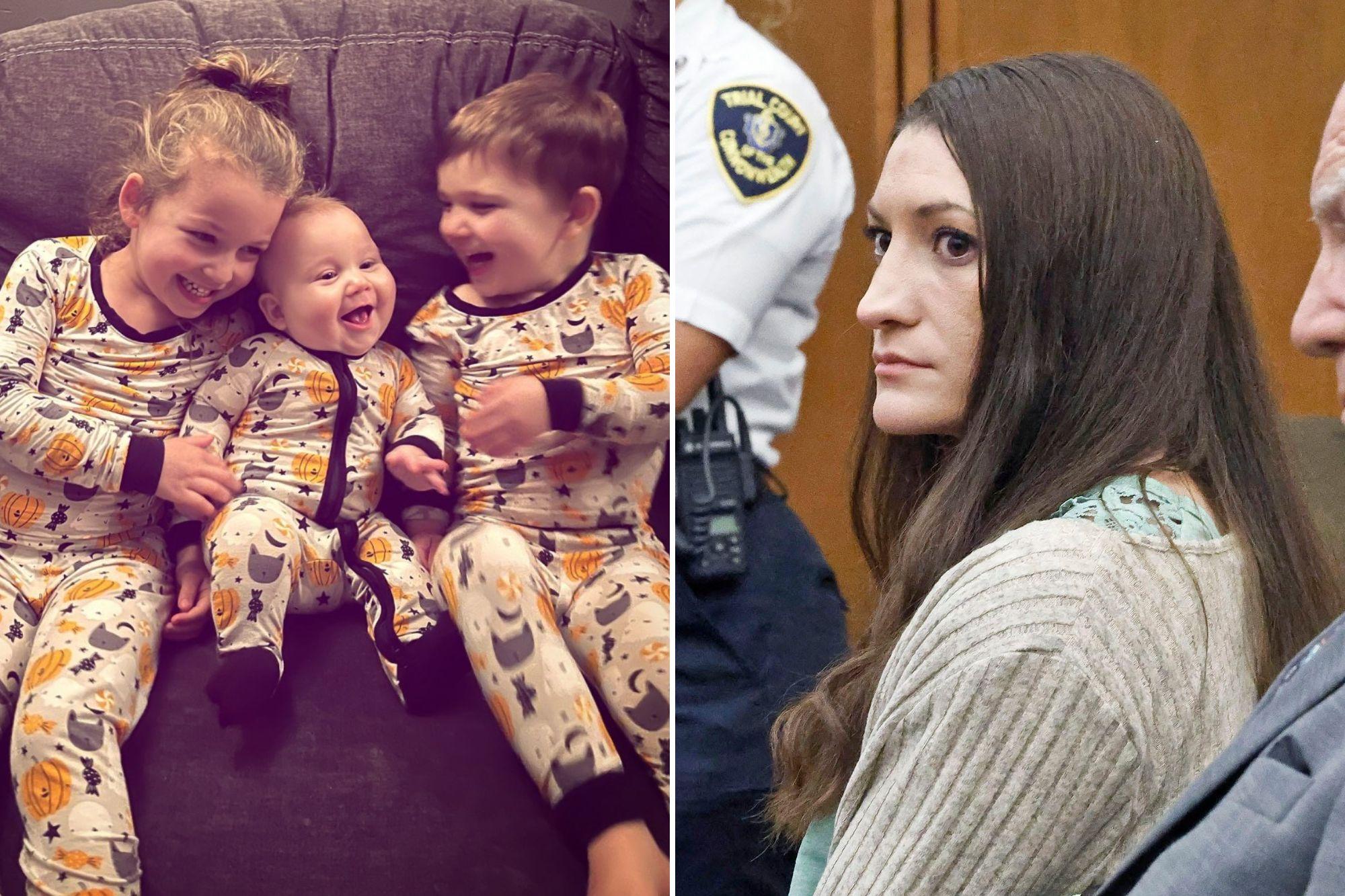
Lindsay Clancy looks at jurors as Judge Sullivan asks them to start deliberations for a sixth day on Sept. 3, 2026. USA TODAY Network via Reuters Connect See more of our coverage in your search results.
Add The New York Post on Google After six days of deliberations and multiple notes to the judge about a deadlock, the jury in the Lindsay Clancy trial appears to be poised for a mistrial.
One headline read, “Lindsay Clancy’s attorney says Clancy would not be able to ‘emotionally handle’ another trial.”
No similar headlines ran about her ex-husband and the father of her children, Patrick Clancy.
Her three murdered children, age five and under, are forever unavailable for comment.
What’s astounding about the complexity of this case is just how simple it is.
Lindsay Clancy has pleaded not guilty not because she claims she is not the perpetrator of the heinous crime, but because she was rendered incapacitated by postpartum psychosis.
The question before the jury isn’t simply whether Clancy was mentally ill: It’s well documented that she was struggling profoundly in the months before the killings.
The question the jury is grappling with is whether her mental state left her incapable of understanding the wrongfulness of what she was doing, and unable to control her actions.
And on that question, the defense did not make a convincing case.
Start with Clancy’s actions on the day she killed her children.
The evidence presented at trial points not to an uncontrollable eruption of psychosis, but to careful planning and purposeful behavior.
Clancy calculated how long it would take her husband to pick up dinner, added a stop at CVS to his errand, and thereby created a window in which she would be alone with their three children long enough to harm them.
She then brutally strangled each of them with exercise bands.
When Patrick called home while he was out, Clancy answered the phone and spoke to him so calmly that he didn’t suspect anything was amiss.
Prosecutors argued that the call must have occurred while the killings were underway.
This is a woman capable of thinking about time, distance and opportunity; of engineering her husband’s absence; and of interacting with him while carrying out the acts she had arranged the opportunity to commit.
It does, however, seriously complicate the argument that she was so consumed by psychosis that she could neither understand nor control what she was doing.
The doctors and mental-health professionals who actually treated Clancy before the killings documented a deeply troubled woman.
She suffered from depression, anxiety, insomnia, intrusive thoughts and suicidal ideation.
She sought help and received extensive psychiatric treatment and medication — but was never diagnosed with psychosis.
What was undocumented in her medical records was the command hallucinations that would later become central to her defense.
She reportedly only experienced those hallucinations one time.
In his instructions to the jury, the judge in the case explained that the trial was complicated due to the amount of the expert testimony and evidence put in front of the jury.
Lindsay Clancy’s children Cora Clancy, Callan Clancy and Dawson Clancy (left to right) are shown in an undated photograph. Instagram/@heardwithlove But the quantity of evidence does not erase the fact that for such a complex case, it is actually quite simple.
Lindsay Clancy murdered her children, and in another time, before TikTok detectives and sleuths made this their cause célèbre, she would have been convicted in a day.
Now, the prosecution is tasked with the prospect of starting over, trying to find a dozen people in the state who have not formed an opinion on the case.
It would be difficult to accomplish that feat with a jury pool consisting of every American.
What’s perhaps even more depressing than the prospect of retrying the entire case is the fact that it will be difficult to find jurors, especially women, who do not feel innate sympathy for a murderer — so much so that they would excuse her actions or reach for implausible theories on the events of that day that do not match with the reality.
The TikTok-ification of our culture and our national discourse has benefited at least one person.
Unfortunately for Americans, that individual is a child killer.
Bethany Mandel writes and podcasts at The Mom Wars.