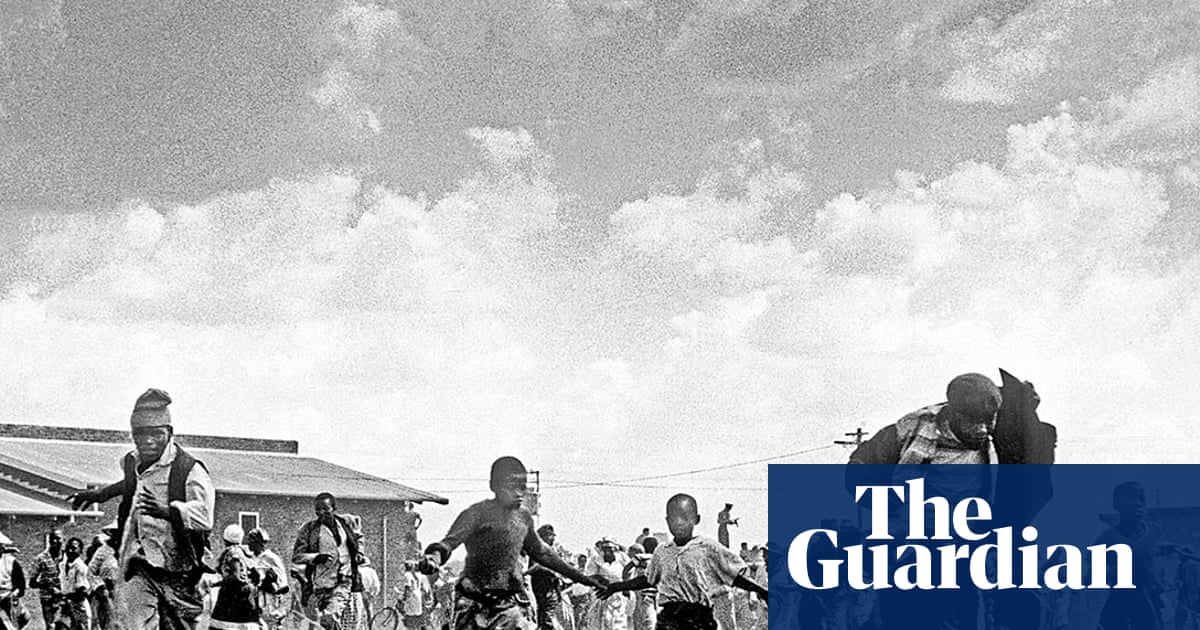
Protesters flee after police opened fire on a peaceful crowd in Sharpeville on 21 March 1960. At least 91 people were killed and 238 injured. Photograph: Ian Berry/c/o Atlas GalleryView image in fullscreenProtesters flee after police opened fire on a peaceful crowd in Sharpeville on 21 March 1960. At least 91 people were killed and 238 injured. Photograph: Ian Berry/c/o Atlas GalleryVictims sue South African government over 1961 Sharpeville massacre that left 91 deadClaim relating to infamous apartheid-era shooting of protesters part of wave of litigation for apartheid-era crimes
The day dawned brightly on 21 March 1960, as residents of the South African township of Sharpeville gathered to protest against pass laws, which forced “Black, Indian and Coloured” South Africans to carry documents at all times specifying where they were allowed to be.
Abraham Mofokeng joined the march, one of dozens organised nationwide by the Pan Africanist Congress (PAC), a breakaway group from the African National Congress. “The weather was very nice, the sun was out. You could not have suspected that the day would go so horribly,” said Mofokeng, who was then a 20-year-old factory worker.
View image in fullscreenAbraham Mofokeng, who was shot in the foot and back while protesting against South Africa’s apartheid pass laws during the Sharpeville massacre on 21 March 1960. Photograph: Rachel Savage/The GuardianMofokeng, now 86, was among the thousands gathered peacefully outside the police station in Sharpeville, which is about 40 miles south of Johannesburg in a heavily industrialised region known as the Vaal Triangle.
The crowd was singing, he said, when officers opened fire without warning. At least 91 people were killed and 238 injured, in what became known as the Sharpeville massacre.
As Mofokeng fled, a bullet grazed the inside of his right foot, ripping his shoe off. A woman fell to the ground before him; he jumped over her and kept running. Only later, when he noticed blood running down his legs, did he realise he had been shot in the back, where a bullet remains lodged in his spine.
Mofokeng is among three claimants suing the South Africa government, in a case filed on Thursday, for compensation for the massacre. If the case is successful, dozens more could file claims.
The case is part of a wave of litigation demanding justice for apartheid-era crimes, amid widespread disillusionment with ANC-led governments that have failed to rectify South Africa’s huge racial inequality and poverty since the end of apartheid over three decades ago.
View image in fullscreenDead and wounded South Africans lie outside the Sharpeville police station. Photograph: PN2In January 2025, 25 survivors and relatives of victims of apartheid state violence sued South Africa’s government for failing to prosecute cases referred to it by the post-apartheid Truth and Reconciliation Commission. That May, the president, Cyril Ramaphosa, announced a judicial inquiry into potential political interference, which is still ongoing.
Spokespeople for South Africa’s justice department did not respond to a request for comment on the Sharpeville compensation case.
In the immediate aftermath of the Sharpeville massacre, police claimed that protesters had been throwing rocks at them. “I don’t know how many we shot,” said Colonel J Pienaar, the local police commander, according to a story published by the Guardian the following day. “It all started when hordes of natives surrounded the police station. My car was struck with a stone. If they do these things they must learn their lesson the hard way.”
In July 1961, in response to victims filing compensation claims, the white minority regime passed a law indemnifying the government and anyone acting under its authority for any actions taken “in good faith for the prevention or suppression of internal disorder, the maintenance or restoration of good order, public safety or essential services, or the preservation of life or property”.
View image in fullscreenMembers of a choir perform during the commemorations of the massacre, at the Phelindaba cemetery in Sharpeville, on 21 March 2026. Photograph: Marco Longari/AFP/Getty ImagesThe law, which was made effective retrospectively from the date of the massacre, is still in force today. The claimants’ legal team is arguing that the law is unconstitutional.
The claimants are hoping to get compensation of about 500,000 rand (£23,000), said Daniel Leader, a partner with UK law firm Leigh Day, which is advising the South African legal team, led by Lawyers For Human Rights, an NGO.
Mafokeng was awarded 30,000 rand as a one-off payment, after the TRC concluded in 2003. The TRC had recommended annual reparations payments of around 20,000 rand for six years.
“We continued to suffer,” said Mofokeng, who still lives in Sharpeville. “Especially now … I am struggling and my health is not up to standard.”
View image in fullscreenPaulina Mathinye, whose father Samson was killed by police in the Sharpeville massacre Photograph: Rachel Savage/The GuardianThe other two test claimants were children when their fathers were killed in the massacre. Paulina Mathinye was five when her father Samson was shot. “Every time he came back from work, I would be so happy to see him that I would run to him, and then he would pick me up,” she said.
Mathinye didn’t initially understand what had happened that day in 1960. “I kept on asking my mum: ‘Mummy, why are you crying?’”
Mathinye’s mother struggled to raise her five children on a domestic worker’s wages and Mathinye, who had wanted to train as a teacher but couldn’t afford the bursary, had to leave education at 17 to find work.
Mathinye, who is now 71, said she hoped for compensation that would make up for some of what she lost when her father died. “Some of my friends are teachers, some of them are nurses, and I’m staying in the same house that my father did,” she said.
Sharpeville’s problems didn’t begin with the massacre in 1960, but with the dispossession of Black South Africans from productive land, their forced removals to townships and their exclusion from the economy, said Vincent Thamae, a PAC member who supports the massacre victims and their families.
“When people talk about compensation now,” he said, “compensation is a concept to them that includes all the land that they lost, the economy that they were taken out of and even how they have been treated in the new democracy.”