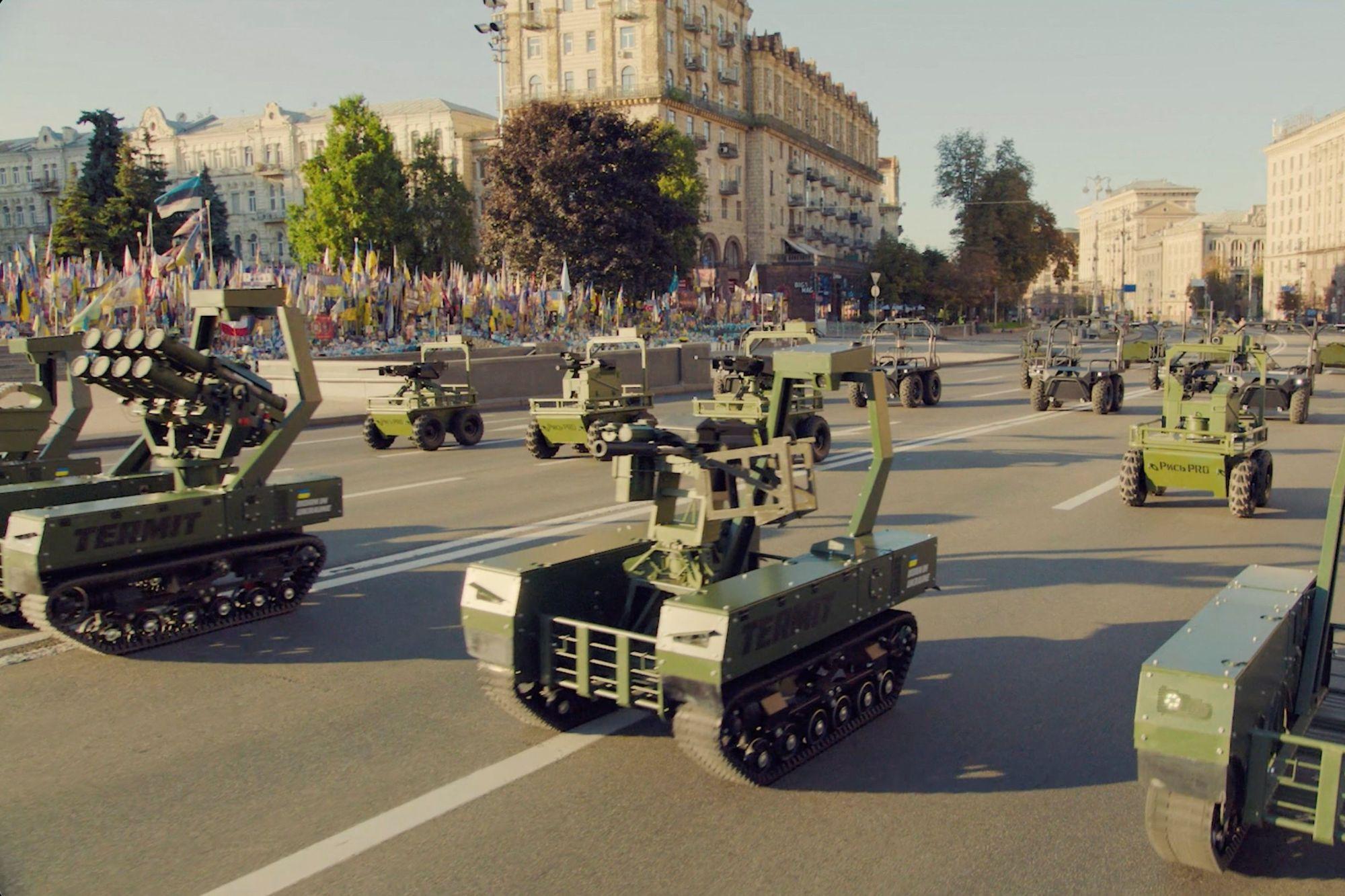
Unmanned ground vehicles participating in a military parade for Ukraine's Independence Day in Kyiv on Aug. 24, 2026. Ukrainian Presidential Press Service/Handout via REUTERS See more of our coverage in your search results.
Add The New York Post on Google Events on opposite sides of the Atlantic last month revealed radically different approaches to the future of warfare — and one nation is taking a wrong turn.
Days after the US Army announced plans to disband its only experimental Unmanned Assault Battalion, Ukraine staged the world’s first all-robot, no-human military parade.
The 600-member American drone battalion, part of the 173rd Airborne Brigade based in Germany, had been tasked with developing US drone warfare tactics, drawing lessons from Ukraine and sharing its findings with the rest of the Army.
This month, however, the battalion will return to its former role as an airborne infantry unit.
The backtrack came on the heels of a new strategic roadmap from Gen. Christopher LaNeve, the Army’s acting chief of staff, promoting the back-to-basics approach advocated by Defense Secretary Pete Hegseth.
In his report “The Army Azimuth,” issued Aug. 19, LaNeve stressed “a strong grounding in warrior ethos, individual Soldier readiness, and small unit tactical skills” — while downplaying the importance of technology.
A week later, the Marine Corps released its own strategy document, “Ground Combat Element 2040,” which acknowledged drone warfare but asserted, “The future force remains fundamentally human-centric, grounded in the willpower, discipline and adaptability of the individual Marine.”
Meanwhile, the Drone Dominance Program Hegseth launched last year is having trouble delivering — only about 60% of the 22,000 first-person-view attack drones ordered by the Pentagon have arrived on time.
That’s a weak start: Ukraine produces more than that number of FPVs every week.
On Aug. 24 Kyiv strutted its robot stuff in its first-ever uncrewed military parade, to celebrate its Independence Day.
The line of wheeled and tracked vehicles included at least six different types, all developed and produced in Ukraine — reconnaissance vehicles, mine-clearing types, logistics and resupply buggies and casualty-evacuation robots.
There were combat robots, too, including TerMIT with machine guns and grenade launchers, Simba with anti-tank missiles, and Ratel carrying kamikaze explosive charges.
While ground robots have taken longer than aerial drones for Ukraine to develop, they’re now appearing on the battlefield in significant numbers, with production this year in the tens of thousands.
Ukraine plans to replace up to 30% of frontline infantry with machines by the end of the year, and a steadily increasing proportion after that.
Nobody doubts the “warrior ethos” of the Ukrainian army, which has fought for four years against a much larger and better equipped invading force.
But Kyiv is determined to do all it can to keep humans out of danger and reduce casualties.
It seems like an anachronism to insist, as Hegseth appears to be doing, that high physical fitness standards and a ban on beards are more important than the efficient use of technology.
What makes the point even sharper is that the US Army’s Unmanned Assault Battalion is going back to its airborne role — and airborne assault is something of a moot point in 2026.
In Ukraine, helicopters have been forced to stay well back from the front lines, with choppers mainly lobbing salvoes of rockets in inaccurate, long-range indirect attacks rather than engaging enemy forces directly.
The Russians’ single heliborne assault — an attempt to take Hostomel airport outside Kyiv early in the war — failed spectacularly, with many casualties and the loss of several helicopters, and has not been repeated.
But Ukraine has reinvented heliborne assault — with robots.
In July, a Russian video showed a Ukrainian heavy-lift multicopter transporting a small ground robot into battle, a clearly risky maneuver that, if successful, can deliver a ground attack force rapidly behind enemy lines.
And, unlike a traditional heliborne assault, both the robot and the drone copter carrying it are expendable.
Commanders don’t even need to worry about picking up the robots afterward — and casualties will be replaced with the next robot shipment.
Large, well-funded US forces, backed by the world’s most powerful technological base, are reverting to a traditional approach focused on discipline, endurance and human factors.
Ukraine, working with limited means, is accelerating toward an uncrewed future — and getting humans away from the fight.
Given the accessible, budget-friendly drones and robots they are developing, we may expect this technology to proliferate fast.
The United States may never have to fight an invasion force as Ukraine is doing.
It’s almost certain, though, that any future US military action will involve opponents well supplied with drones and robots.
And while one side may lose a lot of machines, in the “human-centric” force the casualties will involve flesh and blood.
A military parade of robots looks nothing like what America is used to.
But when you consider which combatants will actually be taking bullets in America’s next conflict, putting fewer humans and more robots out there makes a lot of sense.
David Hambling is the author of “Swarm Troopers: How Small Drones Will Conquer the World.”