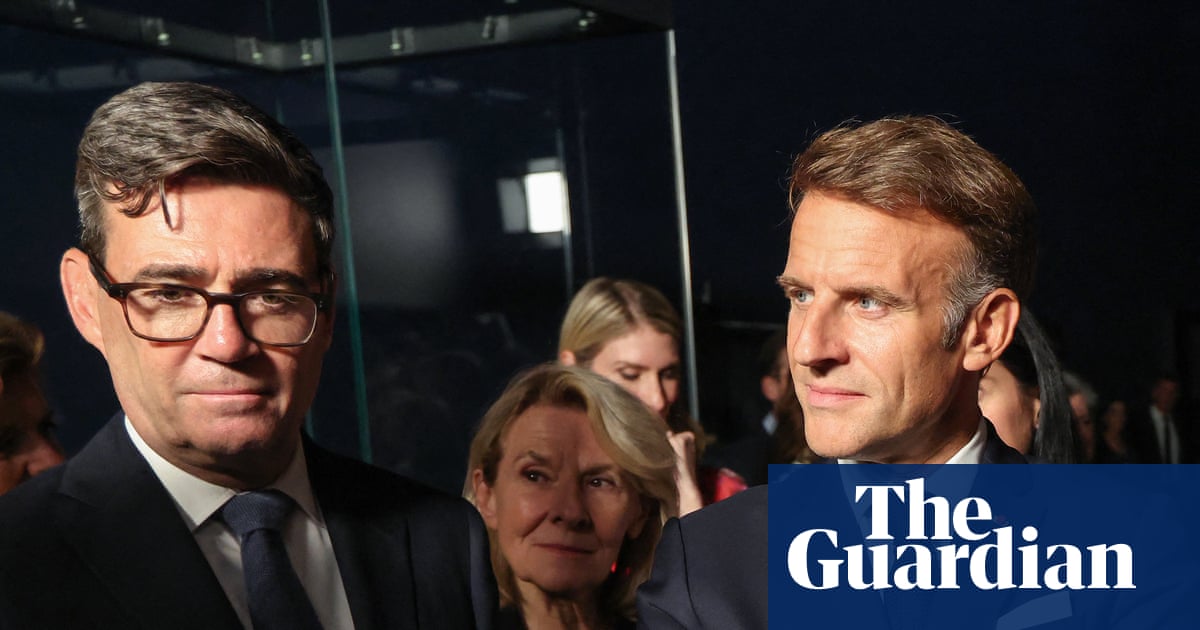
Andy Burnham and Emmanuel Macron at a preview event for the Bayeux tapestry exhibition at the British Museum. Photograph: Ludovic Marin/AFP/Getty ImagesView image in fullscreenAndy Burnham and Emmanuel Macron at a preview event for the Bayeux tapestry exhibition at the British Museum. Photograph: Ludovic Marin/AFP/Getty ImagesAndy Burnham targets migrant crisis ahead of Macron’s visit to No 10PM will aim to centre talks with French president on key foreign policy issues such as Iran, smuggling gangs and EU relations
Andy Burnham will begin the process of courting European leaders when he welcomes Emmanuel Macron as the first foreign head of state to visit him in Downing Street.
The prime minister will meet the French president at No 10 on Thursday as he looks to make inroads on a number of foreign policy objectives, including curbing irregular migration and sealing a new deal with the EU.
The meeting marks one of Burnham’s first forays into foreign policy, having previously promised to remain mostly focused on domestic issues, and comes weeks before a crunch EU summit that could shape much of his future economic strategy.
Read moreBurnham said in a statement on Wednesday: “The progress we have seen this summer [in bringing down the number of small boat crossings] shows what can be achieved when the UK and France work together.
“But I am clear that we cannot be complacent. Smuggling gangs are constantly adapting their tactics, and the UK and France need to respond quickly and stay one step ahead of the criminals facilitating the dangerous crossings.
“The small boats crisis is a shared European challenge, and no country can solve it alone. Working with France and our international partners, we will restore order and control to our borders and prevent smugglers exploiting vulnerable migrants.”
While Burnham has talked almost exclusively about domestic issues such as the cost of living since becoming prime minister, he is quickly finding himself having to deal with international crises as well.
Last month he met the Ukrainian president, Volodymyr Zelenskyy, to help celebrate the country’s independence day, when he announced he would declassify sensitive military information to allow Ukraine to build more cruise missiles.
On Thursday he will discuss migration, EU relations, Ukraine and the war in Iran with Macron.
The two leaders will announce additional resources for French police to help stop small boats being launched from the country’s north coast and larger “mega-dinghies” departing from the west.
Downing Street said on Wednesday that the number of French officers dealing with small boat crossings in northern France would soon rise to nearly 1,050 officers – up by roughly a quarter in four months.
The teams will include a specialist 75-person team to seize equipment and arrest smugglers on land. A separate intelligence unit will be expanded from 18 to 30, while another 45 officers will be deployed to the west coast.
Irregular migration has fallen down the political agenda in recent weeks thanks to a drop in the number of small boat crossings.
This week, Burnham said the drop in numbers to a seven-year low was a result of efforts by his predecessor Keir Starmer to tackle smuggling gangs – though experts say external factors such as an improvement in Syria’s security situation have also played a role.
The prime minister will also use the meeting to press Macron to support his efforts to renegotiate Britain’s treaty with the EU.
Brussels postponed a planned summit from July to allow the new prime minister time to review tentative agreements made by Starmer, with a new one expected in early November.
European countries have been pushing hard for Britain to agree a new youth mobility scheme and to allow their students to pay home fees at British universities – both concessions that Starmer was ready to make, according to recent reports.
However, Burnham may take a tougher line on the number of young people he is willing to admit as part of the scheme, having promised to pass all government policies through a “Makerfield test” to measure them against the views of his constituents.
In return, Britain wants new agreements to ease trade in electricity and agricultural products, which officials hope will give a timely boost to the UK economy.
The prime minister told the Guardian last year he wanted the UK to rejoin the EU, but has since said this would not be something he would actively pursue as prime minister.