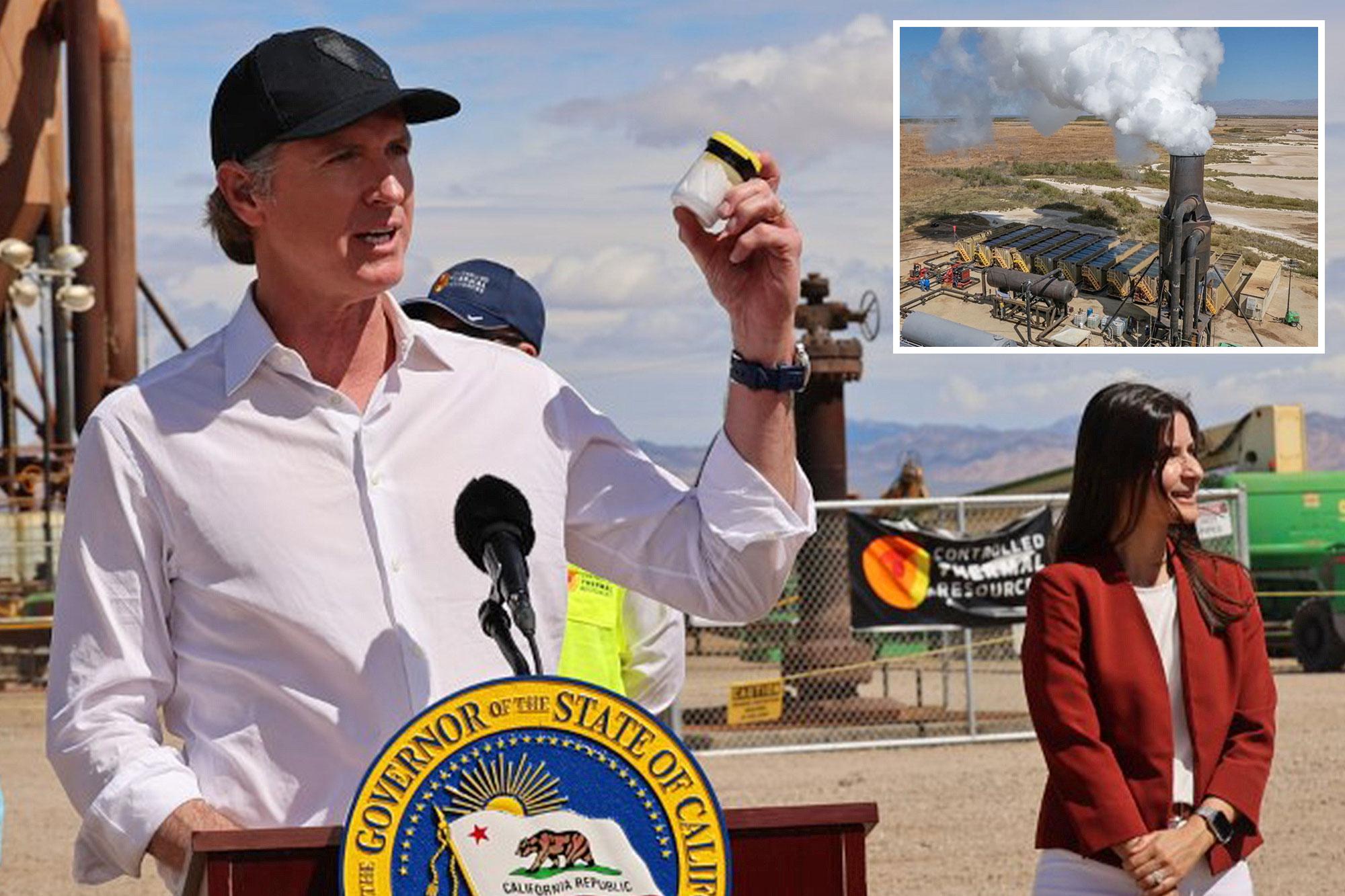
Add The California Post on Google An ambitious project to unlock Southern California’s vast lithium resources appears to have stalled, as promises by Gov. Gavin Newsom and other politicians to create “Lithium Valley” to help the state’s climate goals run into a gauntlet of red tape.
The state government and the mining industry have long eyed the Salton Sea — a toxic, shrinking lake in Imperial County — for its estimated $500 billion worth of untapped lithium, a mineral required for electric car batteries, smart phones and many electronics.
Nicknamed the “Saudi Arabia of lithium,” the Salton Sea region could even provide enough of the mineral to meet all of America’s future demand and more than one-third of global demand, according to some experts.
But the main project to take advantage of that potential — named Hell’s Kitchen by the company Controlled Thermal Resources — has been stalled for years by environmental lawsuits, Calmatters reported.
“It will be done in accordance with all of the rules and regulations of the state of California, which are not as easy as other states and other regions of the world,” Imperial County Supervisor Ryan Kelley told the outlet.
In 2023, the governor visited the Salton Sea area to tout the Hell’s Kitchen project — portraying the future mining as not only an economic boon but also a way for California to combat carbon emissions.
“California is poised to become the world’s largest source of batteries, and it couldn’t come at a more crucial moment in our efforts to move away from fossil fuels,” Newsom said during his visit.
Since then, however, environmental advocates have been getting in the way.
Comite Civico del Valle, a social justice organization, and Earthworks, a mining watchdog group, sued Controlled Thermal Resources in 2024 over alleged neglect in its environmental impact report related to air quality, water use and more. They contend that the project will hurt those resources.
An appellate court ruled this August in favor of the environmentalists, sending the environmental review back to the company and county officials after years of legal back-and-forth.
“When companies come into a community to make a profit, they need to respect the people who live there,” Jared Naimark, the Western Mining Senior Manager at Earthworks, said to Inewsource. “One way to show that respect is to follow the law from the start instead of cutting corners.”
The legal setback means that the lithium projects have yet to start full operation. A spokesperson for Controlled Thermal Resources declined to comment on the ongoing litigation.
The state energy commission told CalMatters that the promises of a “Lithium Valley” are still underway.
“Though efforts to develop the resources have been slower than anticipated – largely due to global lithium markets and prices – progress is being made, with developers securing funding to advance projects,” the agency said.
Both the county and company are reviewing legal options after the appellate ruling. Meanwhile, the delays meant that those gearing up for an industry boom have to wait longer.
For instance, San Diego State University opened an $80 million STEM facility in Imperial County to train workers for the lithium industry — if that eventually exists.
“Unless progress in Lithium Valley accelerates rapidly, these students will graduate into an empty local job market,” Adela de la Torre, the president of San Diego State University, said in an op-ed.
“Each new lawsuit, policy and delay pushes the realization of Lithium Valley’s promise further over the horizon.”