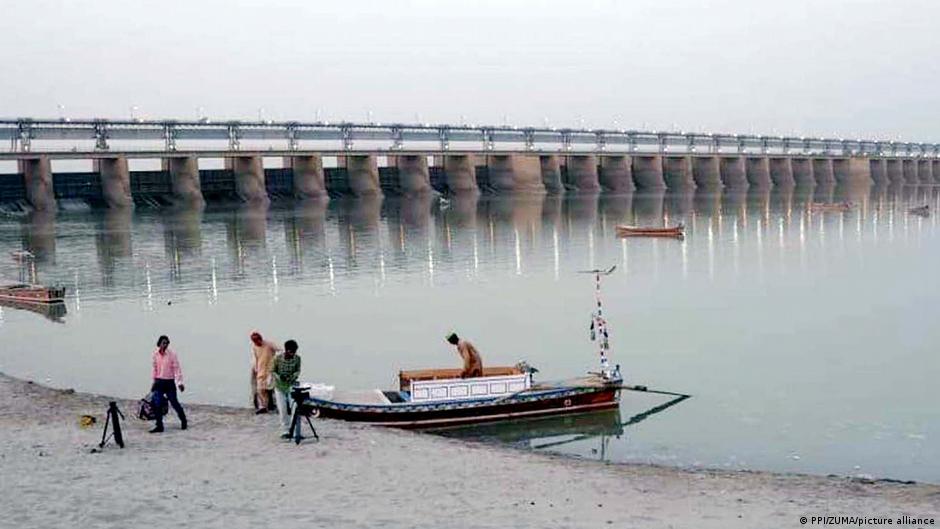
https://p.dw.com/p/5KRJhThe 1960 Indus Waters Treaty governs the use of water from six rivers flowing through India and Pakistan [FILE: May 29, 2021]Image: PPI/ZUMA/picture allianceAdvertisementThe Indus Waters Treaty is facing a fresh dispute after India rejected a Hague-based Court of Arbitration ruling that the 1960 agreement remains in force.
Pakistan has welcomed the decision and says India remains bound by the treaty.
India's Ministry of External Affairs described the tribunal as a "so-called Court of Arbitration" that was "illegally constituted."
It said the body had been established by the World Bank in breach of the treaty and that India "categorically rejects its so-called award, just as it has firmly rejected all prior pronouncements by this illegally constituted body."
"The Court of Arbitration has no jurisdiction whatsoever to pronounce on India's sovereign decisions," the ministry said.
The Indus Waters Treaty, brokered by the World Bank, governs the use of water from six rivers flowing through India and Pakistan.
The agreement largely gives India rights over three eastern rivers while Pakistan has rights over the western Indus, Jhelum and Chenab. India is allowed to use the western rivers for specified purposes including certain hydroelectric projects.
India, Pakistan could be ready to talk 1 year after standoffTo view this video please enable JavaScript, and consider upgrading to a web browser that supports HTML5 video
The treaty had endured wars and prolonged periods of intense hostility between the two nuclear-armed neighbors.
But India placed the treaty in abeyance in April 2025 as part of a package of diplomatic and economic measures announced after a deadly attack in India-administered Kashmir killed 26 people, mostly tourists.
New Delhi accused Islamabad of backing the attack. Pakistan denied the charges.
Millions of people in Pakistan depend on the Indus, Jhelum and Chenab rivers for drinking water, farming and daily life.
The rivers are particularly important to Punjab and Sindh provinces, whose agriculture is central to the country's food supply and rural economy.
After India's move to suspend the treaty, Pakistan approached the court in The Hague over the status of the accord.
Pakistani officials have repeatedly warned that any attempt to deny the country its share of the waters of rivers flowing across the border would be treated as an act of war.
Ajay Bisaria, a former Indian high commissioner to Pakistan, said India had challenged the treaty on both political and legal grounds.
"Politically, abeyance hands India a new point of leverage, one more lever to press Pakistan into changing its behavior on cross-border terrorism," Bisaria told DW.
He also pointed to India's earlier requests to renegotiate the treaty, citing climate change, new dam-building technology and the deterioration of relations between the two countries.
India chose to put the treaty in abeyance rather than formally abrogate it. Bisaria said the Hague ruling would not change that course.
"The tribunal will not alter this trajectory," he said. "India's course on the Indus Waters Treaty is set. The treaty will not be revived in its present form."
A 'frozen conflict': India-Pakistan tensions persistTo view this video please enable JavaScript, and consider upgrading to a web browser that supports HTML5 video
Deputy Prime Minister and Foreign Minister Ishaq Dar said the ruling "decisively rejects" India's attempt to place the treaty in abeyance and reaffirmed that it remains "fully in force and binding on both parties."
"The Award vindicates Pakistan's consistent position that a binding international treaty cannot be unilaterally suspended or set aside," Dar said in a post on X.
He added that India must comply with its obligations under the treaty and with binding decisions arising from its dispute settlement mechanisms.
Ayesha Siddiqa, a Pakistani political scientist and defense analyst, said the ruling may be difficult to implement if India refuses to accept it.
"The arbitration court's ruling may not be implementable because the court doesn't have the force to do so," Siddiqa told DW.
But she said the decision gave Pakistan an advantage as a lower riparian state.
"It does give Pakistan a moral edge," said Siddiqa, a senior fellow in the Department of War Studies at King's College London.
She also questioned what India's rejection of the ruling could mean for its international position, particularly given that India has accepted international legal decisions in other disputes.
"This is not just an issue of pure military power but an international standing where India will not be able to justify its position to the world any longer," she said.
Shanthie Mariet D'Souza, a South Asia analyst and founder of the Mantraya think tank, said the ruling did not materially change India's position.
"The Permanent Court of Arbitration is an administrative body, not a conventional sovereign court with enforcement capabilities," D'Souza told DW.
"In this particular case, India chose not to participate in the proceedings. This allows it not to recognize the tribunal's rulings. Therefore, it has no enforceable constraint on India and nothing changes materially for New Delhi," she said.
India and Pakistan have disagreed for years over the interpretation of the treaty, particularly over Indian hydropower projects on rivers allocated primarily to Pakistan.
Uttam Kumar Sinha, a senior fellow at the Manohar Parrikar Institute for Defence Studies and author of "Trial by Water," said India is now no longer merely contesting the interpretation of the treaty, but rather "contesting the authority of the treaty's dispute-settlement mechanism itself."
New Delhi maintains that the tribunal was improperly constituted and that its decisions have no legal effect on India.
Sinha describes the emerging contest as "lawfare," with Pakistan likely to use the ruling in international forums and frame the dispute around treaty obligations and international law.
India threatens to dry out Pakistan To view this video please enable JavaScript, and consider upgrading to a web browser that supports HTML5 video
The practical implications will also depend on what India does with its infrastructure on the western rivers.
D'Souza said the treaty's abeyance gave India more political and psychological leverage than an immediate ability to alter the flow of the rivers.
"To effectively stop or significantly alter the flows of the Indus, Jhelum and Chenab rivers, substantial infrastructure like dams, canals and large storage systems would be required, and such structures do not currently exist," said D'Souza.
"Furthermore, geographical and technical constraints limit India's capacity to block these rivers."
"India cannot simply 'turn off' the western rivers," he said.
Large storage and diversion projects would take years or decades, require substantial investment and involve difficult construction in the mountainous Himalayan region, as well as environmental and domestic approvals.
"There is a significant gap between India's potential strategic freedom on the western rivers and its actual physical capacity to change water flows," Sinha said.