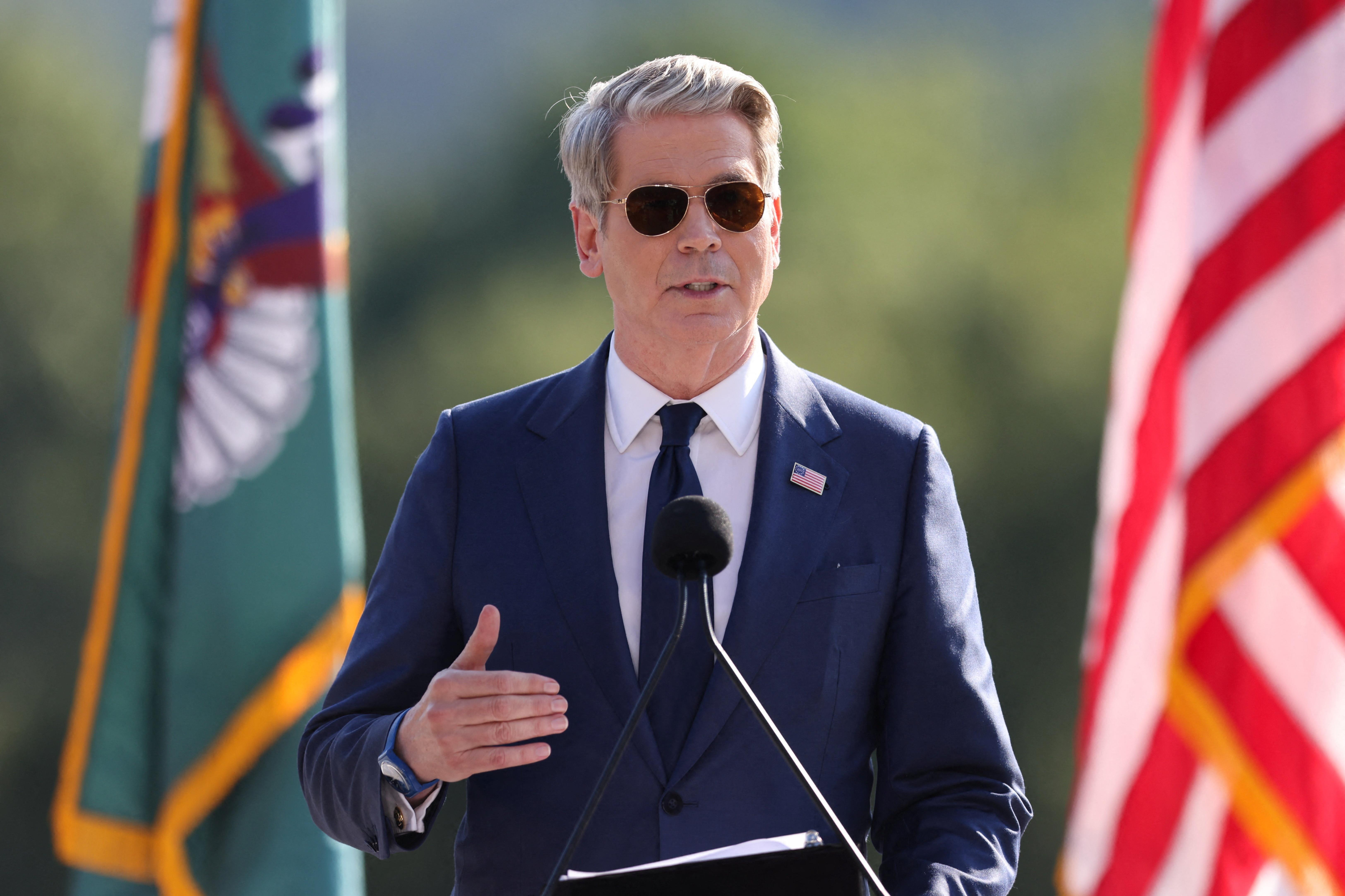
Treasury Secretary Scott Bessent recognized Masar Badil as an arm of the Popular Front for the Liberation of Palestine, a designated terrorist organization. REUTERS See more of our coverage in your search results.
Add The New York Post on Google When the US Treasury Department sanctioned the transnational organization Masar Badil last week, Washington took a much-needed step toward thwarting terrorist activity and recruitment here in the homeland.
The pro-Palestine group was recognized as an arm of the Popular Front for the Liberation of Palestine, a designated terrorist organization.
Yet Treasury’s designation stops there — without naming a single one of Masar Badil’s domestic affiliates.
Those affiliates, associated with college campuses in Minnesota, Oregon and Washington state, have been vocal advocates for armed resistance against “colonialism” — and in recent months their calls for “resistance” have escalated into violence and intimidation.
One of the most active is Students United for Palestinian Equality and Return at the University of Washington, which until recently was a formally registered student organization.
Masar Badil itself has listed SUPER-UW among its “frameworks and militant networks,” and the student group’s evolution over the past three years reveals just how deep a foothold the network has gained inside the US.
SUPER-UW’s rapid development from rhetoric to violence began with Hamas’ Oct. 7 terrorist attack, which killed UW alumnus Hayim Katsman along with 45 other American citizens.
SUPER-UW immediately cheered the killing of civilians and venerated those responsible, later inviting UW students to a an event celebrating the slaughter “as not only a victory for the resistance, but a scientific necessity.”
In September 2024, SUPER-UW encouraged followers to learn about “defending the Palestinian resistance” in a workshop organized by Samidoun-Seattle — the local arm of Samidoun, a Treasury- designated “sham charity” that raises funds for the PFLP.
When Oct. 7 architect Yahya Sinwar was killed weeks later, SUPER-UW called him “our martyr leader” and pledged to carry “their struggle forward, until Palestine is free from the river to the sea.”
That progression culminated in May 2025 when 33 SUPER-UW protesters, most of them university students, occupied UW’s newly constructed engineering building in a chaotic anti-Israel protest.
They demanded that the university cut ties with Boeing — which had contributed $10 million toward the building’s construction — due to its defense contracts with the US military and the Israeli Defense Forces.
They vandalized walls, shattered glass and set fire to dumpsters, causing approximately $1 million in damages.
UW quietly severed ties with SUPER-UW that same month, though the university didn’t publicly announce it until this July.
Yet despite the ban, SUPER-UW still uses the “UW” tag in its name and identifies itself as part of the university across its social media and in activist mobilizations throughout greater Seattle, including an Oct. 7 K-12 school walkout last fall.
Last month, SUPER-UW’s three years of escalating rhetoric culminated in an act of targeted intimidation.
When the Jewish Federation of Greater Seattle announced an Aug. 20 book-tour appearance by Ira Kohler, an Oct. 7 first responder, SUPER-UW responded with threats.
The group posted a picture of Kohler beneath an inverted red triangle — a symbol used by Hamas to mark military targets — and urged “comrades” to protest the event and “prove that THESE G3NOCIDERS ARE NOT WELCOME IN SEATTLE!!”
When the Seattle synagogue set to host Kohler changed the venue due to security concerns, SUPER-UW published the new address as well, framing the move as proof that “cowardly z1ionists” feared “the masses of Seattlites.”
“These zionists continue to cower and run,” the group posted when Kohler’s appearance was finally moved to an undisclosed location. “They should be scared!”
Masar Badil does not operate alone: At its March 2026 conference in Brazil, messages from Hamas and Hezbollah officials were relayed to attendees.
At that same conference, Masar Badil acknowledged it had received “political and organizational reports” from SUPER-UW.
Its Seattle network extends through Bissan Barghouti, a member of Masar Badil’s executive committee who has spoken at several UW demonstrations and has met with Iran’s Mission to the United Nations.
And the links run deep: Two of the SUPER-UW members arrested for storming the UW building, Jessica Schutz and Kimaya Mahajan, are active members of Tariq El-Tahrir, Masar Badil’s youth wing.
The escalation we’ve seen at the University of Washington should not be dismissed as yet another example of leftist campus protest.
When our colleges turn a blind eye to groups that transform terrorists into heroes and openly celebrate violence, we have taken a dangerous turn.
SUPER-UW’s story is a warning that universities, students and the public must recognize this progression — before the line between political activism and political violence disappears entirely.
Samantha Wampold is a researcher for the Program on Extremism at The George Washington University.