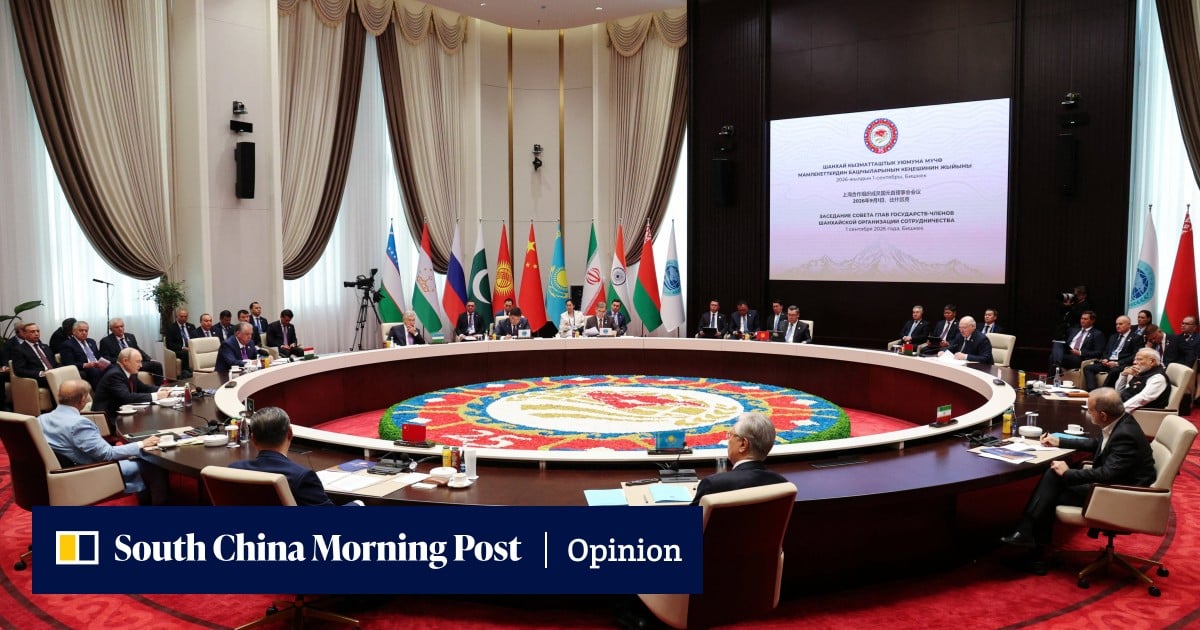
The SCO’s significance is practical: it gives those who do not want their future defined in Washington a forum to coordinate and hedge
3-MIN READ3-MINAdriel KasontaAdriel Kasonta is a London-based political risk consultant and lawyer, and a graduate of London School of Economics and Political Science (LSE). Published: 4:30pm, 2 Sep 2026The Shanghai Cooperation Organisation (SCO) was born 25 years ago as a modest mechanism for managing borders between China, Russia and four Central Asian states. At its anniversary summit in Bishkek this week, it looks more consequential – and harder for the United States to dismiss.The timing is important. Russia’s invasion of Ukraine remains unresolved, while the war between Iran and the US has turned the Persian Gulf into another theatre of strategic competition, with energy markets again exposed to disruption around the Strait of Hormuz. The SCO now brings together China, Russia, India, Iran, Pakistan, most of the Central Asian republics and Belarus, alongside partners including Turkey and multiple Gulf states.
Its 10 full members represent more than 3.4 billion people and roughly a quarter of global GDP. However, its growing importance is not simply a matter of size.
Calling the SCO an anti-American alliance is a mistake. Its members have different interests. India and China remain strategic competitors; India and Pakistan have long-standing tensions; and Central Asian governments want room to manoeuvre between Moscow, Beijing, Ankara, Brussels and Washington. Turkey remains a North Atlantic Treaty Organization (Nato) member while pursuing a larger Eurasian role.