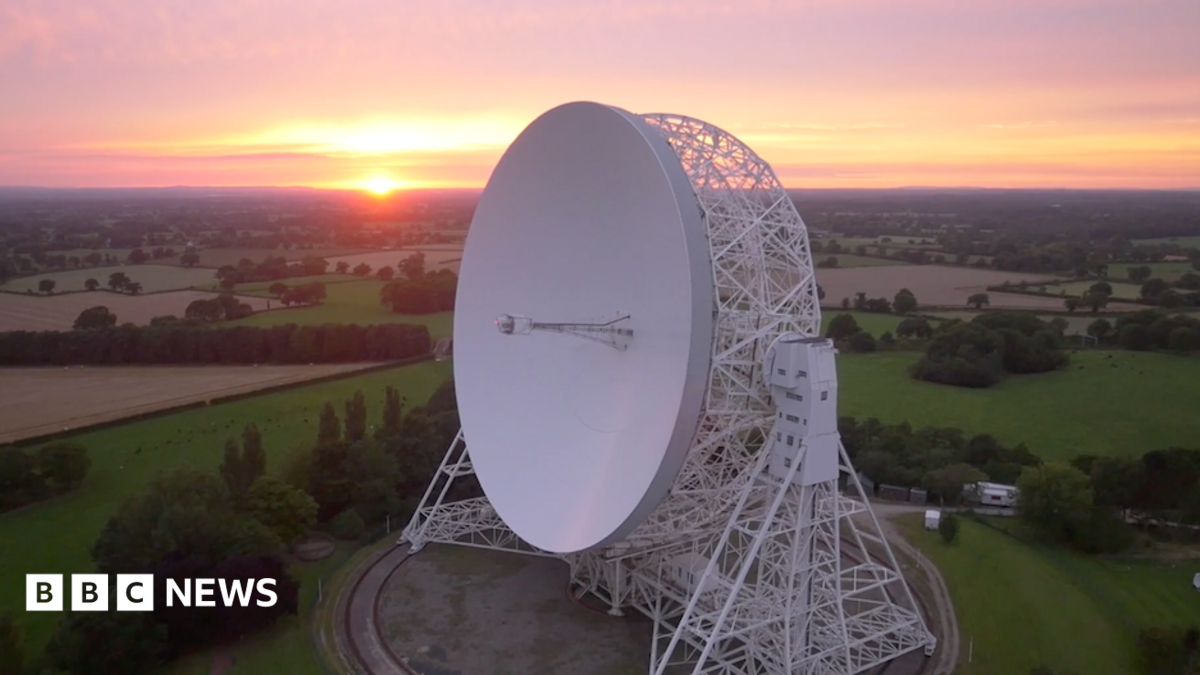
Image source, Jodrell Bank/Manchester UniversityImage caption, Jodrell Bank has lost its funding and is under threat of closure
Prime Minister Andy Burnham has vowed to save the UK's largest telescope at the Jodrell Bank Observatory.
The Lovell telescope, which has stood in Cheshire since 1957, is the world's third-largest steerable radio telescope.
But in July this year, UK Research and Innovation (UKRI) said the site would not be prioritised for further funding after its current agreement ended in March 2028.
Burnham said: "Every one of my generation went on a school trip to Jodrell Bank, and there is no way that we can see its demise, and it won't happen under my government."
UKRI said its decision for the site was "the result of a comprehensive, evidence-based prioritisation process".
The Prime Minister spoke of his determination to save the site after being asked a question about its future in the House of Commons.
Congleton MP Sarah Russell, whose constituency includes the Jodrell Bank site, said it "is facing a significant problem in the medium term because of funding cuts".
She called on Burnham and No 10 North to work alongside her and Macclesfield MP Tim Roca to address the issue.
Burnham said: "I know there are changes that have been made in relation to research funding, but Jodrell Bank is a heritage asset for the country, as well as a research asset."
He said he would set up the meeting she requested, adding: "There must be a way to save Jodrell Bank, and I give a commitment today, at this despatch box, we will find it."
Image source, PA MediaImage caption, Speaking in the House of Commons earlier, Prime Minister Andy Burnham said "there must be a way to save Jodrell Bank"
The Jodrell Bank site was first established in 1945 and pioneered radio astronomy and the study of galaxies beyond our own.
The site has also been immortalised in popular science fiction productions from the Hitchhiker's Guide to the Galaxy to Doctor Who.
Scientists have described the UKRI's decision as "heartbreaking" and "scientifically misguided".
More than 150 public figures have signed a letter calling for the government to reverse its decision and "find funding immediately to save Jodrell Bank".
Signatories include astronaut Tim Peake, musicians Sir Brian May, Johnny Marr and Jarvis Cocker, the bands New Order, Elbow and Doves and comedian Dara Ó Briain.
Scotland's Astronomer Royal Prof Catherine Heymans, physicists Prof Jim Al-Khalili and Prof Brian Cox, and Judy Spence, the daughter of the site's founder Sir Bernard Lovell, have also signed it.
All scientific observations at Jodrell are expected to cease on the 1 April 2028 unless alternative funding can be found.
The Lovell Telescope has a diameter of 250ft (76.2m) and is part of the e-Merlin array, a network of telescopes up and down the country that is operated by the University of Manchester from the site.
Jodrell Bank had a pioneering role in the development of radio astronomy.
Its work in tracking spacecraft in the early space race, and its research into quasars, pulsars and gravitational lenses, is also part of its outstanding scientific heritage.
The site has evidence of every stage of the history of radio astronomy, from its emergence as a new science in the 1940s through to the present day.
The Jodrell Bank Centre for Engagement is regarded as a separate entity and is currently not thought to be at risk as a result of the cuts.
Contact formContact formRead more stories from Cheshire on the BBC, watch BBC North West Tonight on BBC iPlayer and follow BBC North West on X, external. You can also send story ideas via Whatsapp to 0808 100 2230.
What is Jodrell Bank Observatory and what does it do?
Jodrell Bank cuts 'a disappointing gamble'
UK's iconic Jodrell Bank telescope faces axe in science cuts