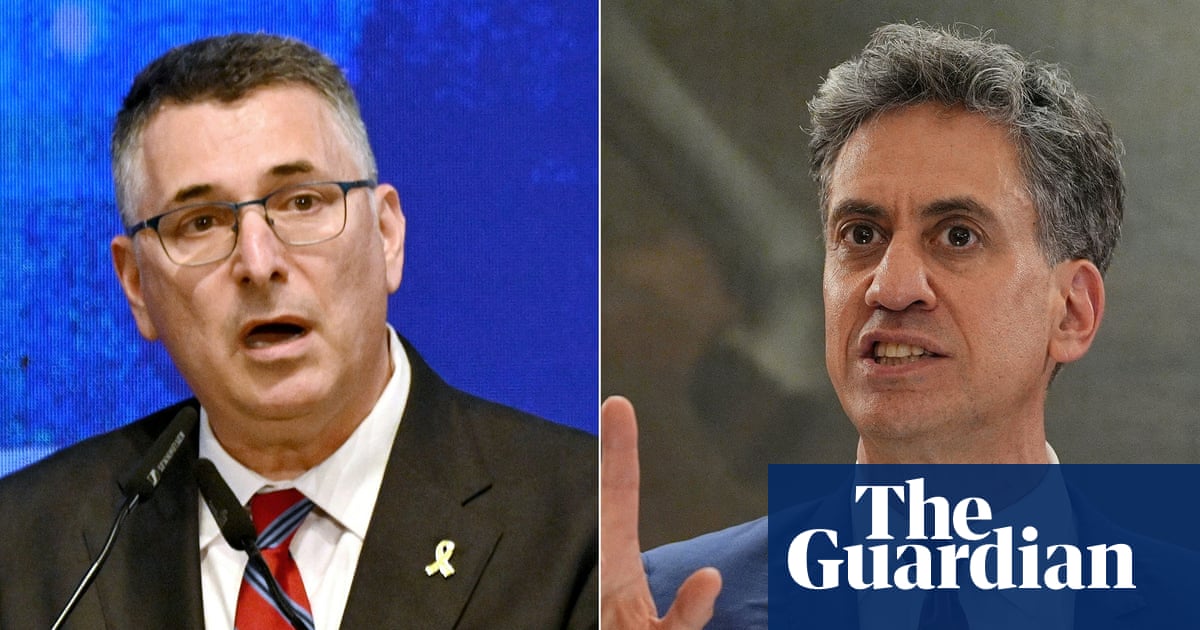
Ed Miliband has promised to stop UK involvement in settlement projects in the West Bank despite a warning of repercussions from Israel’s foreign minister, Gideon Sa’ar, left. Photograph: Debbie Hill/Yui Mok/AFP/Getty ImagesView image in fullscreenEd Miliband has promised to stop UK involvement in settlement projects in the West Bank despite a warning of repercussions from Israel’s foreign minister, Gideon Sa’ar, left. Photograph: Debbie Hill/Yui Mok/AFP/Getty ImagesEd Miliband promises ‘comprehensive reset’ of UK policy toward IsraelForeign secretary tells MPs he will try to stop illegal settlements carving up the West Bank
Ed Miliband has promised to “reset” Britain’s policy on Israel, saying he will try to stop British companies helping build settlements in the West Bank.
Speaking to the Commons for the first time as foreign secretary, Miliband said he would set out measures to prevent UK involvement in projects such as the illegal E1 plan, which critics say would split the West Bank in half.
Tuesday’s comments came after Israel issued tenders for around a third of the 3,400 homes planned for the project. Miliband called the settlement “the crossing of a red line”.
He said: “It cuts through the heart of the West Bank and risks making a Palestinian state unviable. This government will not acquiesce in the destruction of the two-state solution. We will act, and I will set out a comprehensive set of measures in the coming weeks.
“I want a comprehensive reset of our approach on these issues because it is necessary, it is high time.”
Ministers have been under pressure for weeks to place tighter sanctions on Israel, specifically in relation to the E1 plan.
Last month, Israel invited companies to bid for contracts to build 1,200 homes for the project between East Jerusalem and the settlement of Ma’ale Adumim.
View image in fullscreenMa’ale Adumim in the E1 area of the occupied West Bank, where the Israeli government plans to build thousands of homes. Photograph: Debbie Hill/UPI/ShutterstockA group of former British diplomats called on the government in May to threaten action against any companies bidding to build any illegal settlement “designed to divide the West Bank in two and destroy Palestine’s viability”. They warned that E1 was part of Israel’s “systemic West Bank annexation”.
Other governments have condemned the project. The German chancellor, Friedrich Merz – usually one of Israel’s staunchest defenders – called it a “big mistake”.
The UK joined a group of 20 other countries, including France, Germany and Italy, as well as the European Union, to issue a joint statement calling E1 “unacceptable”.
The statement said: “The E1 settlement will undermine the prospect of the two-state solution by driving a wedge through the West Bank and harming the territorial contiguity of the Palestinian territories.”
Miliband said: “We need to look, and we are looking indeed, at our wider economic relationship with the occupied territories and the different tools we have to tackle it.
“I want to be very clear: we do not want British companies financing, constructing, or advertising new settlements. The work we are now undertaking is how we can stop that. And as I say, I’ll have more to say soon.”
Ministers are under pressure to go further and ban trade in goods and services with people or organisations linked to illegal settlements.
James Naish, the Labour MP for Rushcliffe in Nottinghamshire, said: “Does the foreign secretary accept that this pace of expansion shows that current UK measures are failing to change Israeli government behaviour, and that a trade ban is now the necessary next step?”
Stephen Doughty, a Foreign Office minister, indicated this could be included in the government’s measures. He said: “We have absolutely condemned the settler violence, the settler terrorism that we have seen, absolutely our condemnation of the proposals for E1 and all illegal settlements, and indeed we have joined other countries around the world in condemning this proposal and been very, very clear with the government of Israel that this must stop.
“The prime minister has been very clear that we need to do more, including looking at further sanctions, both those involved in the violence in Gaza, but also looking at measures to ban trade in goods with illegal settlements.”
The Israeli embassy to London responded by referring to previous comments by Gideon Sa’ar, Israel’s foreign minister, who said: “If Britain acts against the state of Israel, the state of Israel will act against Britain. We have the tools. The period is over when people act against the state of Israel and the state of Israel doesn’t respond.”