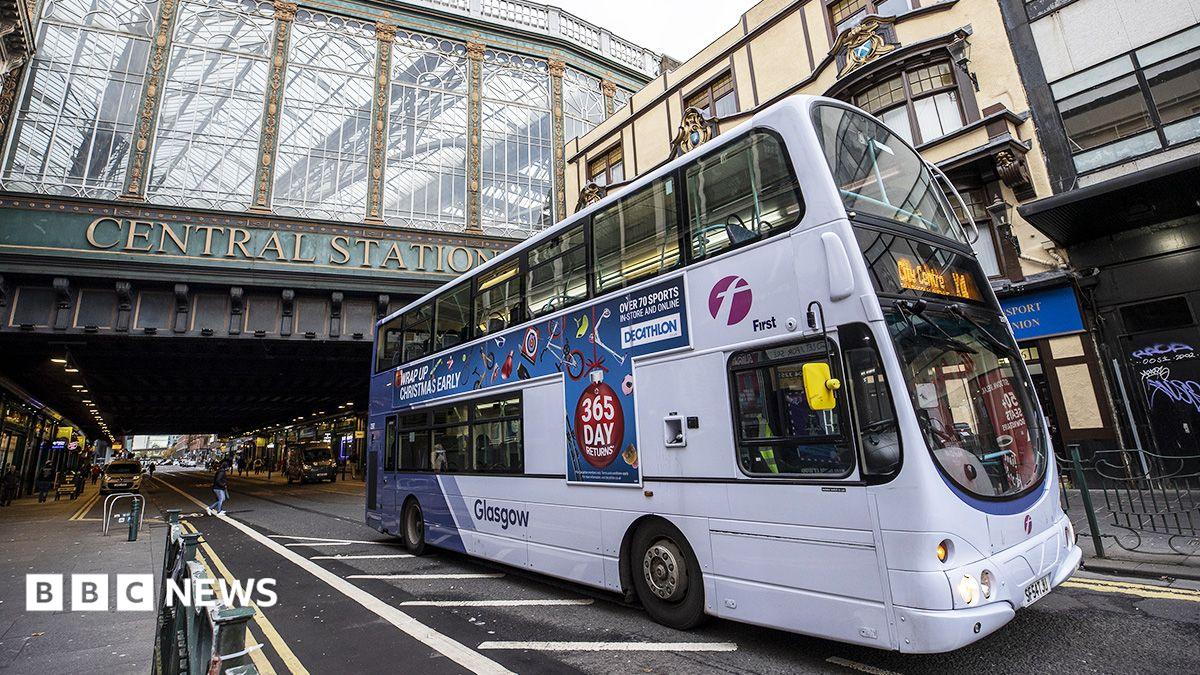
Image source, Getty ImagesImage caption, The bus fare cap will cover journeys in Glasgow, Renfrewshire, Ayrshire, Dunbartonshire, Lanarkshire and Inverclyde
Bus fares in the west of Scotland will be capped at £2, First Minister John Swinney has announced.
The move takes effect from Monday morning for journeys in Glasgow, Renfrewshire, Ayrshire, Dunbartonshire, Lanarkshire and Inverclyde.
In his programme for government, Swinney also confirmed plans to cut Scotland's health boards from 14 to two in what he said was the "most significant structural reform in the NHS in the era of devolution".
He vowed that by 2031, no patient will wait longer than 26 weeks for the treatment they need - an apparent downgrade on a promise in 2011 that patients should not wait longer than 12 weeks for inpatient or day-case treatment after diagnosis.
This is the first programme for government in the seventh session of the Scottish Parliament and outlines the government's policy and legislative goals.
The bus fare announcement is part of an SNP manifesto pledge to cut the cost of bus travel to £2 per single fare for every journey in the country by the end of this parliamentary term.
A cap is already in place in the Highlands and islands. Swinney did not say when it will be extended to the rest of Scotland.
Swinney to cut Scottish health boards from 14 to two and roll out £2 bus fare cap
Swinney's 100-day push gives way to bigger battles ahead
Work began on this proposal last November and splits the country into east and west, with the chief executives of NHS Greater Glasgow and Clyde and NHS Lothian taking the lead.
It is unclear whether this new structure will result in financial savings by cutting senior roles or streamlining departments.
The trade union Unite branded the plan to cut health boards a "slash and burn programme for the NHS".
Union general secretary Sharon Graham said the measures would "inevitably result in swingeing cuts and thousands of job losses across the public sector", as she warned that workers "will not be the collateral damage for the Scottish government's failings".
Other key announcements include the introduction of a misogyny bill - a proposal which was dropped in May last year as the government said it did not have time to draft the legislation to reflect the Supreme Court judgement on the definition of a woman before the Holyrood election.
Swinney said he would give the "personal leadership required to tackle the epidemic of male violence against women and girls" and announced a public health campaign to challenge misogynistic attitudes in boys and young men.
Swinney said his plans intended to deliver "real, lasting improvements to people's lives".
He said: "By rewiring a system of services designed for the last century, we will simplify and reshape organisations on which everyone relies and ensure every pound of investment achieves maximum impact.
"As we do so, we will build on the most generous cost of living package anywhere in the UK while continuing to tackle inequality, poverty and division.
"This is a programme for government to deliver a fairer, healthier and more prosperous nation."
Scottish Labour's acting leader Jackie Baillie said she was not sure that two mainland health boards would be sufficient and called for a specific board covering the Highlands and north east.
She said the SNP's attitude towards the health service is to "promise the world but "deliver nothing but failure", adding that Scotland's patients "deserve so much better".
Reform UK Scotland leader Malcolm Offord describes Swinney's pledges as the "same old empty promises, rebranded".
He criticised plans including GP walk-in clinics, food price caps and the "welcome to school" bag for primary one pupils as "gimmicks", not "reforms".
The Scottish Greens were critical of the bus fares plan for not going far enough and the NHS reforms, saying scrapping regional health boards would cause significant concern among patients and staff.
The party's health spokesperson Kayleigh Kinross-O'Neill called for reassurances that there would be no compulsory redundancies of NHS staff, while co-leader Gillian Mackay said that free bus travel should have been expanded to everyone.
Scottish Conservative leader Russell Findlay said his party had been arguing that Scotland's public sector was "bloated and inefficient" but said he had little faith in the government's ability to deliver reforms.
He said: "Just look at the mess they have made of Police Scotland which lurches from one crisis to another, or the millions they squandered on their abandoned National Care Service."