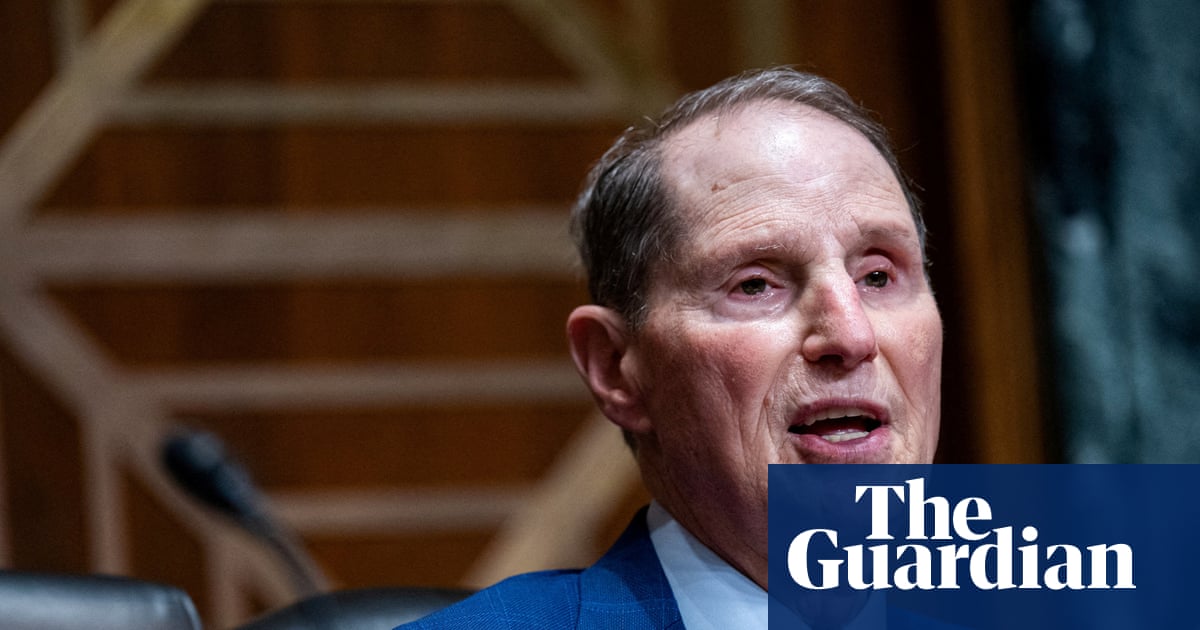
Ron Wyden on Capitol Hill in Washington DC on 22 July. Photograph: Annabelle Gordon/ReutersView image in fullscreenRon Wyden on Capitol Hill in Washington DC on 22 July. Photograph: Annabelle Gordon/ReutersUS lawmakers demand investigation into Trump administration’s secret surveillance of AmericansExclusive: Two congressmembers respond to revelations of government snooping on journalists, non-profits and unions
Two congressional Democrats asked a government watchdog Tuesday to investigate the Trump administration’s use of an obscure law to secretly collect records on journalists, non-profits and unions without judicial oversight.
The request from the senator Ron Wyden of Oregon and the representative Pramila Jayapal of Washington seen by the Guardian comes amid mounting scrutiny over the way the Department of Homeland Security (DHS) recently used its power to issue administrative summonses related to customs matters to make extraordinary unilateral demands for information. They sent their request to the government accountability office (GAO), the nonpartisan congressional watchdog.
The Guardian reported this week that Homeland Security Investigations (HSI), the investigative arm of DHS, has used the summonses to secretly obtain six months’ worth of telephone records for Georgia Fort, a Minneapolis journalist. In one particularly stunning episode, it issued an administrative summons to Google requesting information on the YouTube accounts of Fort and Don Lemon after a judge had twice rejected a search warrant application for the information, telling the government Fort and Lemon needed to have a chance to contest the request.
HSI sought the records after federal prosecutors charged Fort and Lemon with civil rights crimes in connection with a protest at a Saint Paul, Minnestoa, church in January that they were covering. Both have pleaded not guilty.
DHS has used administrative summonses to successfully obtain financial information on labor unions and Venmo transactions for a non-profit group. DHS has also issued a slew of administrative subpoenas to tech giants like Meta, X and Reddit to try to unmask anonymous DHS critics.
Wyden and Jayapal asked the GAO to investigate the way that DHS was using the summonses outside of customs matters. It also asked the GAO to investigate language in each summons requesting that the recipients of the summons not notify the user of its existence because it would “impede the investigation and thereby interfere with the enforcement of federal law”. Privacy experts say that language is not legally binding and the companies can ignore it.
“Crucially, the recipients of these subpoenas – often third-party companies and service providers – maintain a First Amendment right to notify their customers of the demand, allowing the actual targets of the subpoenas the opportunity to assert their own legal rights or challenge the demand in court,” they added. “We request an audit of HSI’s use of non-disclosure language in immigration subpoenas and customs summonses, as well as the circumstances under which HSI has used customs summonses unrelated to import violations or customs duties.” A GAO spokesperson confirmed the office received the request and was examining it.
Wyden and Jayapal also raised concerns about how the Department of Justice and the US Drug Enforcement Administration have used language in subpoenas that pressure companies into keeping a request subpoena private when, in many cases, the law does not prevent notifying the customer about the inquiry.
“Although large technology firms with sophisticated counsel sometimes ignore these extra-legal requests, many other businesses in heavily-regulated sectors – such as telecommunications, pharmaceuticals, automotive manufacturing, and banking – often comply out of fear of regulatory retaliation,” they wrote. “Indeed, companies like AT&T and CVS have explicitly cited these extra-legal government demands to Congress to justify their failure to notify customers when their private records are turned over to the government.”
Wyden and Jayapal also asked the GAO to identify any changes the DHS made to its policies around administrative summonses after a 2017 DHS inspector general report found they were being used improperly.
Wyden and Jayapal additionally asked the judicial conference, the group that oversees policies for the federal courts, to amend the template for a grand jury or trial subpoena to make it clear that recipients are allowed to disclose their existence unless there is a court order prohibiting that.
“These steps will help ensure that agencies do not abuse their subpoena authorities at the expense of privacy and free speech rights,” they wrote.