While Bangladesh is weighing the risks of joining the Mecca mutual defense alliance, experts warn that any move to join the pact could complicate relations with neighboring India.
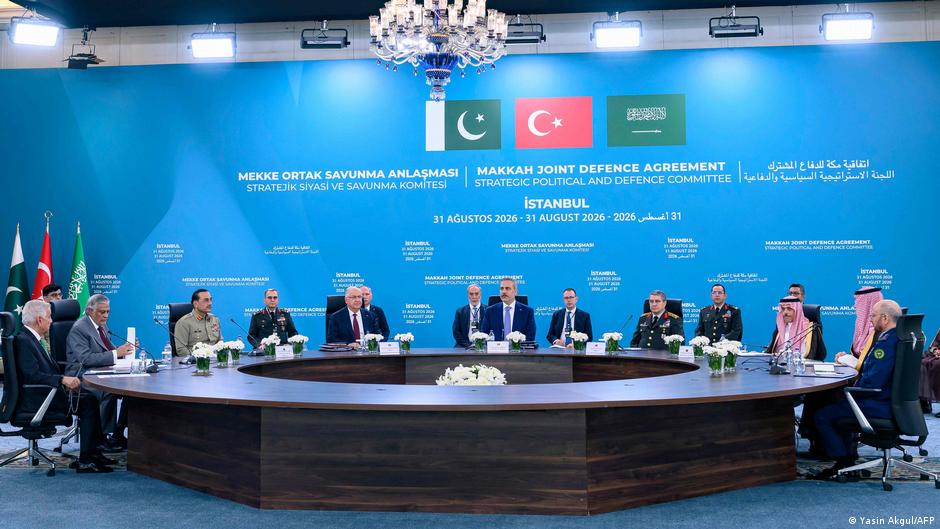
https://p.dw.com/p/5Jr4qThe Mecca Joint Defense Agreement, signed by Saudi Arabia, Turkey and Pakistan, stipulates that an armed attack against any of the three would be regarded as an attack on allImage: Yasin Akgul/AFPAdvertisementThere has been widespread speculation about Bangladesh joining the Mecca pact — a mutual defense deal struck last month by Saudi Arabia, Turkey and Pakistan. But the South Asian country says it has yet to receive an invitation.
The "Mecca Joint Defense Agreement," signed in early August, is intended to strengthen collective deterrence against any act of aggression and stipulates that an armed attack against any of the three would be regarded as an attack on all.
Some analysts believe the pact has changed the geopolitical landscape of the Middle East and South Asia.
"Although it is a collective defense understanding, from a strategic perspective it is primarily an initiative to maintain the regional balance of power and advance the respective interests of the participating states," Navine Murshid, professor in the Department of Political Science and Sociology at North South University in Dhaka, told DW.
South Asia projects boost China's presence in India's sphereTo view this video please enable JavaScript, and consider upgrading to a web browser that supports HTML5 video
Any move by Bangladesh to join the pact, however, could complicate its foreign relations, particularly with neighboring India.
The two countries share a 4,096-kilometer-long (2,545 miles) land border, and strong cultural and economic ties.
India, a fierce rival of Pakistan, sheltered many Bangladeshi refugees and supported Bangladesh militarily during its bloody independence war against Islamabad in 1971.
However, ties between New Delhi and Dhaka have become increasingly contentious since a deadly student-led uprising in 2024 toppled then Prime Minister Sheikh Hasina, who is considered a close ally of the Indian government.
Hasina, who is now living in exile in India, has since been convicted in absentia for crimes against humanity during the uprising. The former premier, however, denied the charges.
Bangladesh's current government, headed by the center-right Bangladesh Nationalist Party (BNP), views the Mecca agreement positively.
"We view this pact positively," Foreign Minister Khalilur Rahman said in response to a question in parliament last week.
But he underlined that the question of Bangladesh joining the pact, or considering membership, had not yet arisen, as that would depend on the intentions of its current members.
"If they express an intention to include Bangladesh in the pact, we will certainly consider it positively," Rahman added.
In response to a question about Bangladeshi officials' remarks, India said the Mecca pact has implications for its national security and that it is closely monitoring developments surrounding the agreement.
"We continue to follow all developments that have a bearing on India's security and take all necessary steps to safeguard it," Randhir Jaiswal, spokesperson for India's Ministry of External Affairs, told reporters in New Delhi last week.
Can Pakistan still help end the US-Iran war?To view this video please enable JavaScript, and consider upgrading to a web browser that supports HTML5 video
Analysts say Dhaka needs to consider its interests carefully before making any move to join the joint defense pact.
"The scope for direct conventional interstate war or military conflict in South Asia is limited. Therefore, the primary role of such an agreement is not confined to conducting border wars," Murshid said.
"In international relations, its significance lies mainly in strengthening bargaining power and maintaining one's position against the influence of other regional countries," the expert added.
Murshid underscored that Pakistan's interest in bringing Bangladesh closer through this agreement "is driven by geographical and political considerations."
"For India, the security of the Siliguri Corridor and its eastern frontier are important considerations. If Pakistan's defense-related influence in Bangladesh were to increase, New Delhi could view this as a development capable of affecting the regional balance of relationships."
Murshid believes that in such circumstances, Bangladesh needs to clearly define what it would and would not do by joining this alliance.
"In particular, a clear position would be necessary regarding Bangladesh's role if a military conflict were to arise between India and Pakistan. Taking Pakistan's side during such a conflict could create political and diplomatic pressures for Dhaka that may exceed Bangladesh's capacity to manage," she stressed.
Dhaka-based former diplomat M Humayun Kabir sees no reason for Bangladesh to join the pact. He thinks the country should maintain its position of not joining any such pact.
"Bangladesh has not joined any military alliance over the past 50 to 55 years. As far as I am concerned, I believe that position remains unchanged to this day," he told DW.
"They are talking about a regional security arrangement, but the region in question concerns Pakistan and the Middle East. We are not part of that region or geographical area. Bangladesh is located in the eastern part of South Asia. Therefore, there is no direct geographical rationale for Bangladesh to participate in such a military alliance," Kabir added.
Pakistan bets on fighter jet exports to boost its economyTo view this video please enable JavaScript, and consider upgrading to a web browser that supports HTML5 video
Murshid stressed that Bangladesh needs sustainable development of its own defense infrastructure and security systems.
She believes becoming part of an international security agreement could help modernize Dhaka's defense capabilities and facilitate access to military technology.
"The text of the agreement does not directly mention trade, labor markets, or economic relations. However, it is natural for economic elements to become linked with a security framework, a phenomenon known in international relations as issue linkage," she told DW.
However, Kabir, the former diplomat, fears joining the pact could limit his country's geopolitical options. He instead suggests pursuing a balancing approach.
"We contribute to peacekeeping missions around the world under the auspices of the United Nations, and that is important to us. Our economy is interconnected with many different countries in various ways, which is also important. Our workforce is present in countries across the world, and that, too, is an important consideration," he told DW.
"Therefore, before making any decision on this issue, we must take into account the many different dimensions and forms of our national interests."