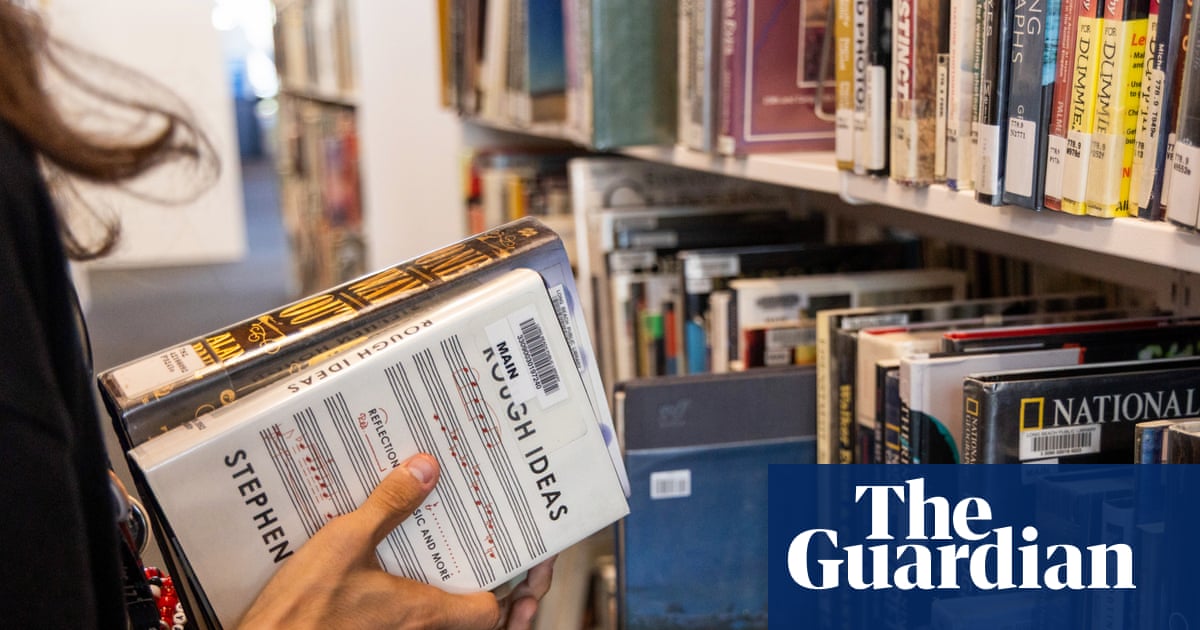
A library in Long Beach, California. Photograph: Juliana Yamada/Los Angeles Times/Getty ImagesView image in fullscreenA library in Long Beach, California. Photograph: Juliana Yamada/Los Angeles Times/Getty ImagesUS public libraries at ‘breaking point’ amid ideological attacks, report findsPEN America study details verbal and physical threats to librarians, funding cuts and proliferation of book bans
Public libraries in the US are “at breaking point” because of an onslaught of political interference, harassment and ideological censorship, a new report published on Tuesday said.
Book bans, cancelled story hours, attacks on librarians, funding cuts and the undoing of libraries’ independent governance are examined by the free expression advocacy group PEN America in its study called Out of Circulation: Expanding Censorship in Public Libraries.
“Public libraries can be a foundational democratic institution only if they can speak to everyone and only if librarians’ curation decisions can occur free from partisan pressure or restriction,” the report, compiled by PEN America’s Freedom to Read Project, said.
“However, ongoing political and public pressures are challenging these very principles. Public libraries nationwide are reaching a breaking point.”
The 16-page document relates countless episodes and incidents across the US to support its assertion. They include verbal and physical attacks on librarians, disproportionate targeting of literature featuring LGBTQ+ people, a proliferation of bans on books dealing with gender identity and sexuality, and instances of politically appointed officials installed to override the policies of democratically elected library boards.
In one prominent example, the conservative activist and former collegiate swimmer Riley Gaines was last year appointed to a library board in Sumter county, Tennessee, which repeatedly voted down a proposal by its chair to remove material she deemed “inappropriate or sexually-explicit, including anything with transgender themes”.
Gaines, an anti-transgender voice who has taken rightwing positions on other issues, including supporting Donald Trump’s often violent immigration crackdown, immediately used social media to brand such books “filth”, and to denounce her new colleagues for “ignoring” Tennessee’s ban on state funding for “woke gender ideology”.
The report points to an Idaho law passed in March that allows city councils to hire and fire library directors, discretion previously granted to appointed library boards; and efforts in Alabama that would have allowed local governments to remove library board members at will, and without cause.
Another trend highlighted by the PEN America report is attacks on drag shows at, or promoted by public libraries. It chronicles bomb threats, protests and a physical assault on a librarian that caused the cancellation of events or story times at libraries in New York, Massachusetts and Nevada.
The group said it had also tracked almost 23,000 book bans in school libraries since 2021, and an expansion to the point where 51% of all book bans attempted nationwide, documented by the American Library Association, came in public libraries.
Among the materials banned, in a ruling later overturned by a Texas appeals court, were so-called “butt and fart” books objected to by some parents for their depictions of the human body and, in one case, a description of puberty.
Despite the court’s ruling that public schools and libraries could not ban books just because they disagreed with their content, a branch head librarian in Llano county, Suzette Baker, was fired for insubordination when she refused to remove books on a list handed to her by her boss.
Kasey Meehan, PEN America’s Freedom to Read director, said such “censorship” efforts reflected a growing, politically driven trend to control what is available to readers, and the ideas that are allowed to be represented.
“Local libraries nationwide have long been safe havens for the freedom to read and finding joy and comfort in books,” she said.
“Increasingly, they are censorship battlegrounds. When libraries become targets, communities suffer. The consequences extend to authors whose books are taken off shelves and readers who are denied access to stories and information.”
PEN America said it had followed “how a movement to censor wide-ranging literature in public schools, especially stories with LGBTQ+ characters and characters of color, has evolved over the past five years, snowballing from coordinated attacks led by groups like Moms for Liberty to state and federal legislation that curtails the right to read”.
Philomena Polefrone, senior manager of the Freedom to Read project, said: “The same arguments that have inflamed censorship in schools are also eroding public libraries. These attacks rob library users of vital public services, access to books, and an affirmation that they have a place in their community.
“But wherever we see efforts to destabilize these vital public institutions, we also see communities organizing to protect their right to read, standing alongside their public librarians, and resisting funding threats from politically motivated decision-makers.”
Evidence of a backlash came in Florida’s primary elections this month, when numerous Moms for Liberty candidates lost seats or failed to win their races, and the conservative group lost its majority on the Sarasota school board.