Add The New York Post on Google On a visit to NASA’s Johnson Space Center in Houston last week, President Trump promised American astronauts would establish a permanent presence on the Moon before pushing forward to Mars.
“Our nation will conquer … this vast frontier that we have before us … We will explore it, we will tame it, and we will win it,” he said of America’s present “golden age” of space exploration.
But researchers thinking of truly big ideas say we’ll never get there with today’s inefficient chemical rocket technology. And they point to an important breakthrough.
“We’re really pushing for permanent infrastructure, like a bridge replacing ferries to cross a river,” Pete Swan, president of the International Space Elevator Consortium (ISEC), a nonprofit research and advocacy hub, told The Post.
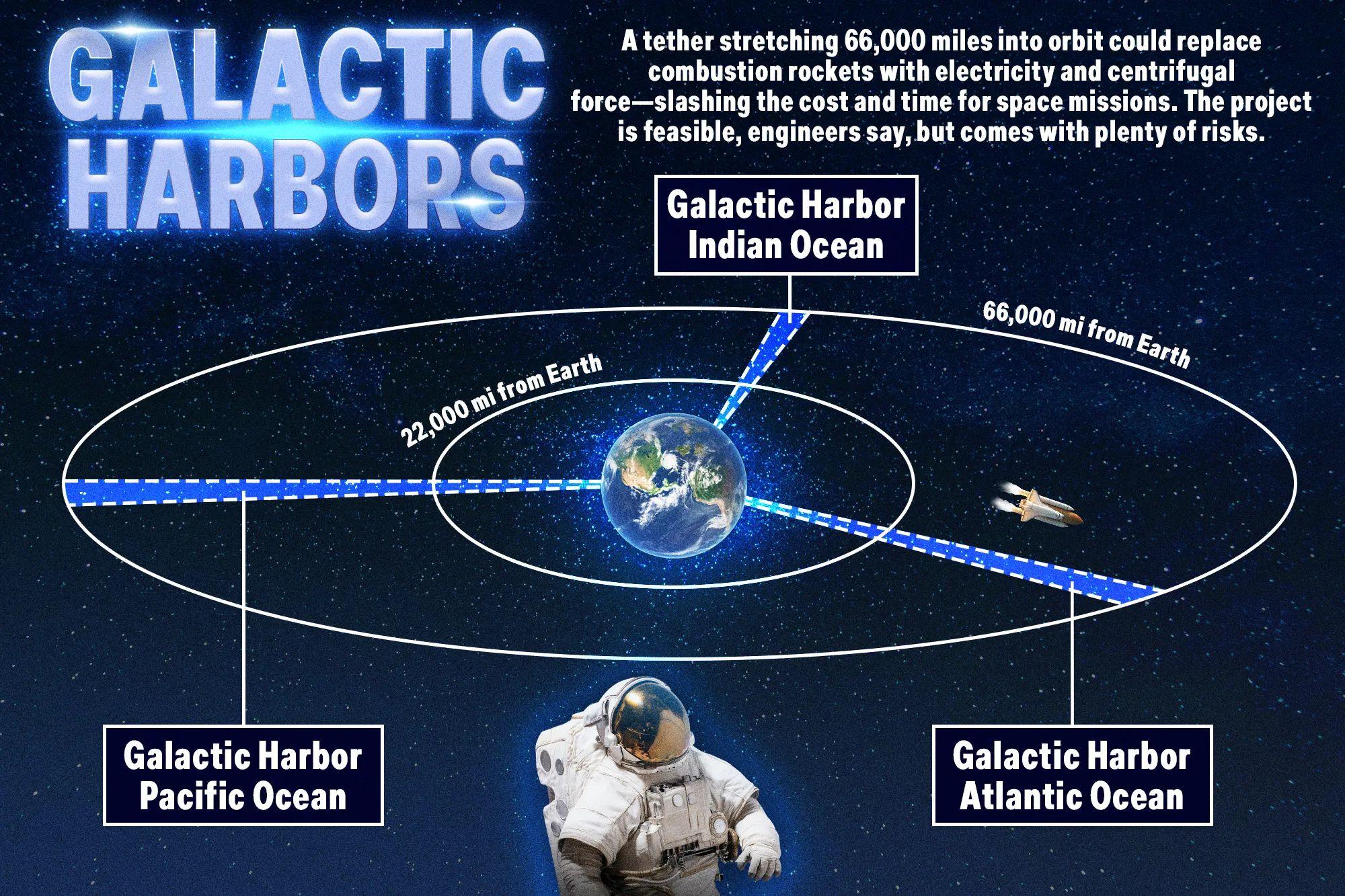
It’s a simple yet mind-bending concept: an ultra-strong electrified cable running from a point on the ground at Earth’s equator, extended out beyond geostationary orbit (GEO), where a counterweight will float in space keeping it taut. Vessels then climb the cable to deliver goods, people and machines, passing through the atmosphere and into space.
“The beauty is that raising it with electricity saves our atmosphere from pollution, it doesn’t leave any debris along the way and it will be routine, daily, inexpensive, safe. It’s gonna be a bridge to space.”
Crazy as it sounds, the engineering checks out, according to researchers who spoke to The Post.
However, the bottleneck to the space elevator idea has always been the tether material, because it must be scalable, 100 times stronger than steel, exceptionally lightweight and capable of efficient spooling in order to get the whole thing in place.
Next month, the ISEC is set to announce they have their most promising candidate yet—a two-dimensional material called polycrystalline graphene, already widely used in the consumer electronics industry.
Graphene is basically just one unbroken crystal of ordinary pencil lead atoms, long thought to be an ideal candidate for such a project, the researchers said. Polycrystalline refers to a patchwork process that makes the molecule more scalable.
“It looks like we found the material,” said Swan. “We’re a heck of a lot further along than we were six months ago. Technology doesn’t go on a linear line, it grows.
“Every once in a while, somebody makes a discovery and all of a sudden the capabilities go from linear to really huge jumps in capability. That’s what’s happening in our tether material arena.
“[Polycrystalline graphene] is so flippin’ strong. They’re taking it and making it into bulletproof vests, one layer can stop a .38 bullet from a pistol.”
Stargazers have dreamed up ladders to space for well over a century with the idea popularized by famed British sci-fi writer Arthur C. Clarke in his 1979 novel “The Fountains of Paradise,” where the mega structures he envisioned were called “orbital towers.”
Clarke — author of “2001: A Space Odyssey” — put in the effort to finely detail the real world engineering such a feat would require and famously remarked that a space elevator would be built “about fifty years after everybody stops laughing.”
Swan likes to remind naysayers that in 1969, following the moon landing, the New York Times issued a formal apology for a decades-old editorial that mocked an engineer who suggested rockets would one day take men to the moon.
Each strand of tether would actually be a single molecule—one atom thick, one meter wide and 100,000 kilometers (62,000 miles) long—stretching from an “Earthport” on the surface, which will have to be located at the equator, up to an “apex anchor” spaceport well beyond GEO.
A single tether, or leg, is 20,000 stacked sheets of this molecule, as the ISEC sees it. The colossal cable would be nearly invisible, said Swan, but reflective, like a mirror, with ground-based spectators catching an occasional thin, long glint of reflected sunlight slicing down from heaven.
The ISEC report notes engineers in South Korea have managed to manufacture a 1,000-meter long, half-meter wide polycrystalline graphene molecule, which can be produced at a rate of about two meters per minute.
Damage to the tether from space junk whizzing around low Earth orbit remains a top concern, said Swan, which is why he proposes something like five tethers per elevator, for backups and other uses, as well as a no-fly zone for satellites around it.
The plan is for cargo vessels, called climbers, to crawl skyward using the tether until they reach GEO, which occurs at 22,000 miles above Earth. The journey to the top would take about two weeks, said Swan.
After GEO—the gravitational sweet spot where Earth’s gravity equals the exact inward force needed to match Earth’s rotation—climbers no longer need electricity for propulsion. The centrifugal force of the rotating Earth takes over, hurling cargo along the remaining 40,000 miles of tether before flinging it out into space at 16,000 miles an hour— 4.4 miles a second—according to ISEC’s calculations.
That means materiel could be sent from the top of the tether to the moon in as little as 14 hours, a journey that presently takes three days from earth.
Trips to Mars could be cut down to just 61 to 120 days, depending on the planetary positions at launch time, said Swan. The fastest route to the Red Planet takes seven months today, with a launch window which only happens every 26 months.
“You could have daily launches to Mars,” claimed Swan.
However, a functioning space elevator, is still a long way off.
“It’s not a sure thing,” pointed out space economics professor Armen Papazian, at the American University in Dubai.
“Even if one were to start building a space elevator tomorrow, assuming they find the risk capital to do so, it will take a decade or two to complete, assuming everything goes smoothly.”
From Moon villages to Martian cities to asteroid mining, space enthusiasts have long felt rockets are never going to fully cut it.
The “tyranny” of the rocket equation, as one NASA researcher put it in a 2012 paper, is that in order to reach the speed needed to escape Earth’s gravity, rockets must be 85–95 percent propellant. Cargo is typically just 2–4 percent of liftoff mass.
The ISEC has put forth a cheeky $15 billion price tag to build the world’s first fully robotic space elevator. They say it would be a steal, if feasible. The recent Artemis launch that sent humans back to the moon for the first time since 1972 clocked in at $4 billion. But the entire ongoing, multi-decade Artemis program is expected to cost over $200 billion by 2030, according to the NASA Office of Inspector General.
“I believe the first ten years of the space elevator will be a logistics mission, just moving stuff up. Once we get past that and the moon starts getting its settlements and Mars needs more, we’ll start having two-way, bringing stuff down. After 15 or 20 years we could do people.”
The nonprofit claims a space elevator will be able to deliver 30,000 metric tons of cargo into space per year from the get-go. That would be a staggering annual haul, more than the combined weight of every object ever sent into space since 1957. However, it remains a hard sell to most.
“By the time a project like that starts generating cash flow for investors it could be two and a half, three decades,” Papazian, author of “The Space Value of Money: Rethinking Finance Beyond Risk and Time” told The Post. “[Investors] are looking for a return … hopefully while they’re still alive,” he added, adding public money is also subject to ever-changing political whims and debt constraints.