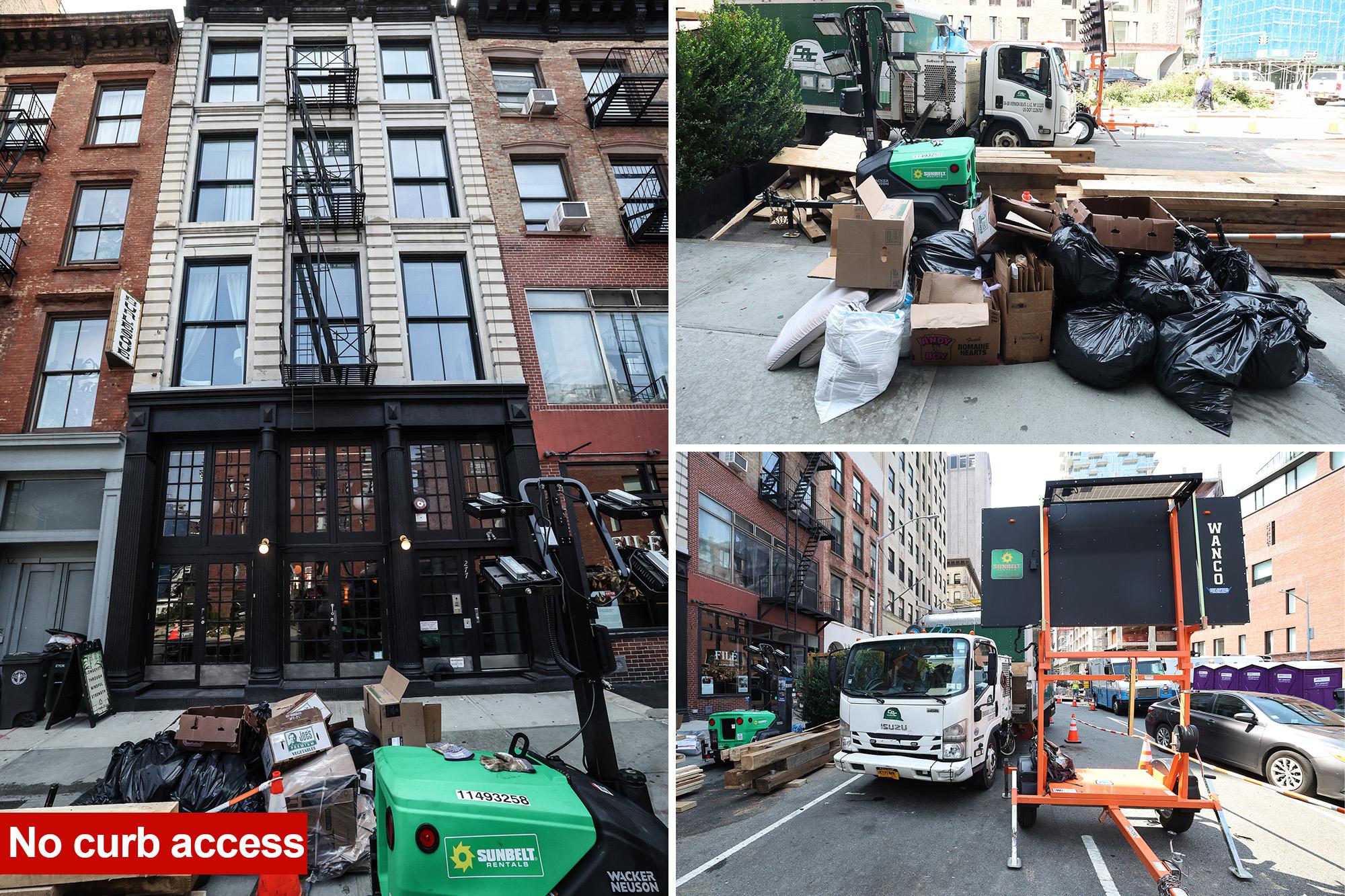
Add The New York Post on Google A clash over trash is playing out in Tribeca — where plenty of small buildings have no choice but to set out their garbage in plastic bags rather than bulky bins.
In such small buildings, there is simply no space for the sanitation department’s required bins, which consume far more space than bags alone.
Regardless, late last year the sanitation department slapped landlord Robert Moskowitz with three “receptacle violation” tickets — for using garbage bags rather than the requisite “rigid receptacles with tight fitting lids.”
Moskowitz paid $150 for those three counts of “failure to containerize.” His efforts to fight the tickets failed, and he is now suing the city’s sanitation department, DSNY.
It is both “physically and legally impossible to comply” with the bin requirement, wrote his lawyer, Nicole Waknine, in papers filed last week in Manhattan Supreme Court.
“We have no objection to the use of trash cans,” she told The Post. “Our issue is a practical one. The goal is to push the city to implement a waiver program for building owners who have tried in good faith to comply and truly can’t comply.”
With no yard or storage space, there is simply no place to put the bins, except for a building’s entryway, where people would need to shimmy past. Even if there were space, the fire code prohibits the storage of rubbish in lobbies.
Nor is there space for another allowed option, a fenced-in storage area within 3 feet of the building, which would block the doors.
Moskowitz — whose company, Only Properties, owns about a dozen small downtown buildings — was issued tickets for three historic Tribeca properties. All are small walkups, with lofty rental residences atop narrow ground-floor commercial spaces, and open directly onto the sidewalk.
Large buildings and massive skyscrapers are in a very different situation, with plenty of space and resources to handle garbage, Moskowitz said in a statement to The Post.
“The law places a disproportionate burden on [small buildings], forcing us to purchase only DSNY-approved trash cans and to create storage space out of thin air.”
The current situation is “an example of a ‘one size fits all’ rule really failing,” Waknine said.
About two years ago, as part of its war on rats, the city required buildings to containerize their trash, specifying certain requirements for the bins used.
(As of Sept. 8, the sanitation department will start fining small buildings, defined as having one to nine residential units, that do not use the specific official NYC bins, which are available at Home Depot.)
“This is not a matter of storing a small waste bin in the residential lobby,” the complaint reads, “but rather having enough space for storage of the amount of garbage that accumulates within the entire building over a 72-hour period,” which the law requires.
The buildings in question have trash picked up three times a week.
At 277 Church St., one of the ticketed buildings, the commercial tenant is the French restaurant Faux, scheduled to open next month by George McNally, son of legendary restaurateur Keith McNally. The restaurant will occupy both the ground-floor and basement levels.
One obvious problem: The building’s residential lobby is 50 inches wide, and storing two 45-gallon bins would consume no fewer than 45.2 inches.
“Residential tenants cannot safely enter and exit the building with only 5 inches of space,” Waknine wrote.
Even if the bins were slightly smaller, “regardless of size, we are completely prohibited from storing bins in the lobby,” she told The Post. The buildings also don’t have space for recycling or compost bins, but they have not been ticketed for those failures.
Building residents put their own garbage out, with the super organizing it to be sure it is neatly and correctly bagged.
Moskowitz lost an appeal because “no evidence was presented to indicate whether Respondent made aby [sic] effort to place refuse out for collection in a rigid container” and also “failed to prove that the containers could not be stored in other areas, including the commercial space,” the hearing officer wrote.
Waknine was incredulous. “The court is making decisions that are not addressing reality,” she told The Post.
“The notion that a restaurant would want large garbage cans stored on site and would accept the building’s residential tenants going in and out to dispose of their garbage when they are not required to under their lease agreement is preposterous,” Waknine wrote in court papers.
What’s more, “is the hearing officer arguing that Respondent should have proven it cannot store these garbage cans within one of the residential apartments? There is no court in New York State that would compel a residential tenant to submit to the public storage of garbage in its home.”
At 31 Walker St., the Mexican restaurant Añejo TriBeCa uses a hatch for deliveries, and there is also signage outside for the building’s sprinkler system. Neither can be blocked.
At that building, approved trash bins in the lobby would leave residents squeezing past with only 22 inches of clearance. If stored behind the stairwell, the bins would block the freight elevator.
Interior storage space is also missing at 92 Reade St., where the ground floor is occupied by Heyday Skincare. “There, we were directed to build a fenced-in enclosure,” Waknine told The Post.
But there is no place to do so without obstructing doors or setting the enclosure in the middle of the sidewalk, thereby impeding pedestrian flow in a busy commercial area, where the sidewalk width on the block is just 9.1 feet.
The City Council has recognized the absurdity of the bin requirement, and is considering a bill that would exempt some small buildings that don’t have adequate bin space.
“I’ve heard from deli owners, barbers and landlords who have no alley, no yard, no storage space — but are still getting fined for not having a place to put these bins,” the bill’s sponsor, Councilmember Frank Morano of Staten Island, told SI Live last October. “That’s not good government; that’s bureaucracy gone wild.”
Sanitation spokesman Joshua Goodman declined to comment on pending litigation, but emphasized that using bins instead of bags “actually works” as far as cleaner streets and fewer rats.
“Looking at enforcement data, these three buildings appear to have been caught not using a bin about 80 times since the rules went into effect,” Goodman wrote in a statement to The Post. “That’s 80 nights with an all-you-can-eat rat buffet outside the buildings.”
Since the start of 2025, DSNY has issued about 170,000 summonses for failure to use a bin, and 30,000 written warnings, he told The Post.
He further insisted that DSNY does have a process for buildings to apply for exemptions. One form is for “extremely rare cases” where using a bin would pose “a public safety risk to pedestrians.” Another form is for property owners who have a disability making the use of a bin impossible.
“We do not appear to have a record of these property owners applying for an exemption or reaching out for assistance,” Goodman said, adding that DSNY is “very proud to be such an accessible and responsive agency.”
Those forms are irrelevant, Waknine said. “Our issue is a practical question of how small building owners can realistically store cans between collection days — not an argument that putting trash cans out on collection days will pose a threat to public safety.”