Ukraine says it can share its expertise to help protect Gulf states under attack from Iranian drones. What does it expect in return?
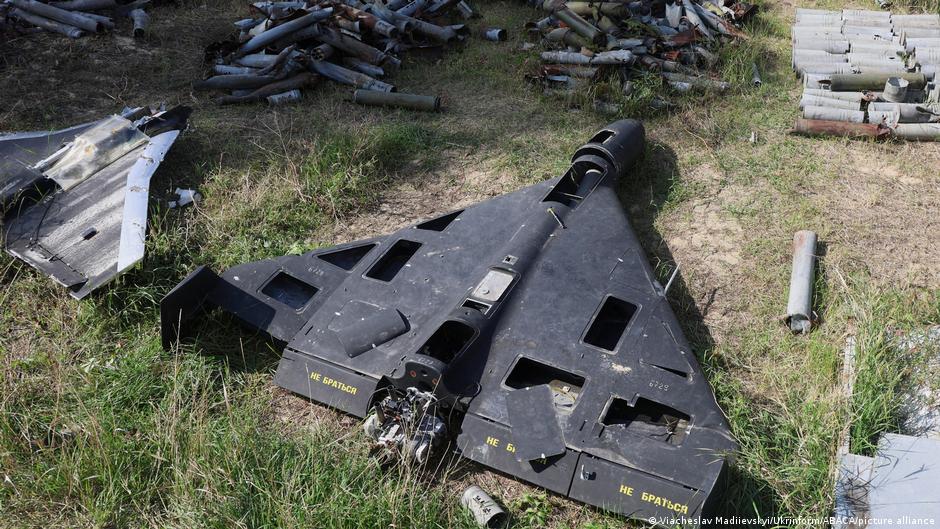
https://p.dw.com/p/59xWtIranian-designed Shahed drones (of which fragments can be seen here) are used extensively by Russia to attack UkraineImage: Viacheslav Madiievskyi/Ukrinform/ABACA/picture allianceAdvertisementUkraine has declared its willingness to support Middle Eastern countries protect themselves from Iranian drones, which are often used to strike infrastructure and military targets. President Volodymyr Zelenskyy said his country has a great deal of drone defense experience and is willing to share these insights.
Kyiv is already in talks with the US, European states and countries neighboring Iran, Zelenskyy said on his Telegram channel. He did, however, add a condition for his country's help, telling US news outlet Bloomberg that "leaders of the Middle East have great relations with Russians, they can ask Russia to implement a month-long ceasefire." Once such a ceasefire comes into force, Ukraine would send its best drone defense operators to the Middle East, he added. "We can help Israel in the same way."
Ukrainian Foreign Minister Andrii Sybiha made a similar point in an interview with Reuters. He said the Ukrainian armed forces would fend off 90% of Iranian Shahed drones, most of them with domestically produced interceptor drones. "We won't be able to send all our forces, but we will definitely be able to send some if it is guaranteed that there will be no Russian attacks on our country," Sybiha said.
Arab states have long ignored the nature of the Russian-Ukrainian war and failed to recognize that Russia is an important Iranian ally, helping improve its drone technology, says Oleksandr Chara of the Ukrainian security think tank Center for Defense Strategies (CDS). Their thinking changed when Iranian drones, fitted with some Russian components, began striking targets in the Gulf region, he adds.
According to Chara, Kyiv can offer expertise in downing Iranian drones as well as well-trained operational personnel. After all, Ukraine intercepts hundreds of drones every night and is very experienced doing so. He says for wealthy Gulf countries, drone defense is primarily an economic question.
"Shooting down a $30,000 [€25,824] drone with a missile that costs at least $100,000, or tens of millions in the case of a Patriot system, becomes a hopeless endeavor. So given the threat posed by Iran, it is logical to invest in Ukrainian defense capabilities," Chara says.
He envisions three possible scenarios for Ukrainian cooperation with Gulf states. One would entail Ukraine deploying experienced forces with interceptor drones to begin protecting facilities at once. A second scenario would involve training drone pilots in Arab countries and Ukraine, which would strengthen military ties. A third option would see Arab capital flowing into the Ukrainian defense industry to mass produce interceptor drones for both parties.
Ukraine is considering handing over some aspects of interceptor drone production to the Gulf states, President Zelenskyy told journalists on March 3. In return, Kyiv hopes to receive American PAC-3 missiles for the Patriot system, which it needs to bolster Ukraine's air defense systems, the president said.
On March 5, the Financial Times reported that the Pentagon and at least one Gulf state government were in talks about buying Ukrainian-made interceptor drones, according to an unnamed Ukrainian industry representative cited in the publication.
The Gulf states have enormous financial resources at their disposal and can afford any kind of equipment, according to Ukrainian military expert and Defense Express editor-in-chief Oleh Katkov. What they lack, he says, is data and battle-tested algorithms. "The value lies solely in the fact that we can help build a suitable air defense system based on our own experience," Katkov told DW. "This is an extraordinary amount of [useful] information. Outside of Ukraine, no one has any data on how many mobile fire units are deployed, how much ammunition is required and which equipment actually works and which does not."
President Zelenskyy apparently wants to capitalize on Ukraine's military experience. He wants those benefitting from Ukrainian know-how to stop helping Russia circumvent sanctions and instead increase the pressure on Russia to end its war on Ukraine.
Strait of Hormuz, the world's most critical oil chokepointTo view this video please enable JavaScript, and consider upgrading to a web browser that supports HTML5 video
Oleksandr Chara calls this a "classic win-win situation." He says Middle Eastern countries could benefit from Ukraine's experience in the fight against Iranian drones and Ukraine could build a "Middle East coalition" against Russia.
Saudi Arabiacould drastically reduce oil prices in the shortest possible time, Chara says. "Lowering the price to between $20 or $30 dollars would immediately undermine Russia, which is already selling its oil at a discount."
Yet Oleh Katkov does not believe Ukraine will quickly benefit from cooperating with Middle Eastern countries. While talks about drone defense go beyond purely technical discussions, with quick decisions expected on shooting down Iranian drones, Katkov says political decisions are rarely made quickly.