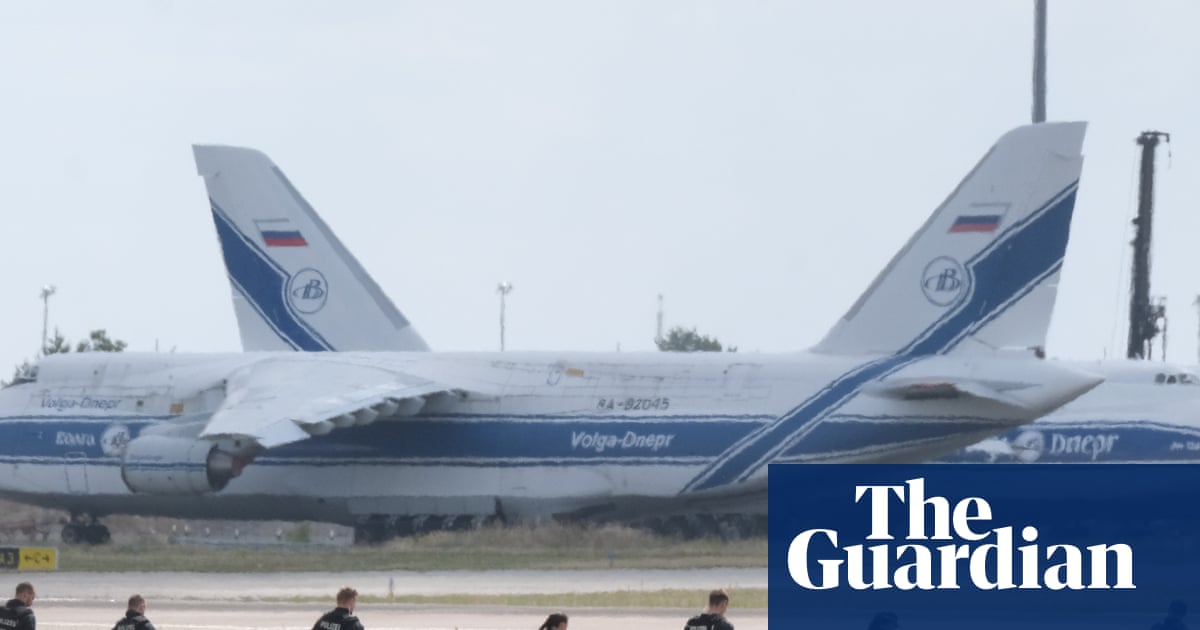
Police officers at Leipzig airport search for a drone that may be connected to a suspected attack on 7 August. Photograph: Sebastian Willnow/DPA/APView image in fullscreenPolice officers at Leipzig airport search for a drone that may be connected to a suspected attack on 7 August. Photograph: Sebastian Willnow/DPA/APGermany poised to identify suspect in Leipzig drone attack on Ukrainian planeBerlin expected to outline response to incident this month widely speculated to have been coordinated by Russia
The German government is imminently expected to announce who it believes was behind a suspected drone attack on a Ukrainian cargo plane earlier this month and to outline its response to the incident in coordination with its European and Nato partners.
The chancellor, Friedrich Merz, told the public broadcaster ARD in an interview on Sunday evening: “We are in the process of concluding the investigations; we have reached a broad agreement within the federal government on how we will respond, and we will make this clear in the coming days. It won’t take much longer.”
The government has so far declined to say officially who it thinks was behind the attempted attack at Leipzig/Halle airport on 4 August. There has been widespread speculation that it was coordinated by Moscow.
A drone containing explosives was discovered near a Ukrainian Antonov cargo aircraft used to transport military supplies. The drone was apparently intended to land on the wings of the aircraft, which was filled with kerosene, but the explosive device did not detonate, according to a report last week referencing the investigation.
About 20 minutes after the discovery of the first drone, a second drone possibly collided with a DHL cargo plane, which had to abort its landing manoeuvre and was diverted.
Days later, a third drone was found in a field in a municipality that directly borders the western edge of Leipzig airport. Forensic technicians from the federal criminal police office found residues of a substance that initial assessments indicated could have been the highly explosive substance hexogen.
This explosive also failed to detonate but according to media reports, the investigators’ report stated: “The perpetrators may have had a far larger attack in mind than previously known to the public.”
Read moreMerz indicated that the information the government was due to release was being closely communicated with Berlin’s partners, and any response would also be carried out in cooperation with them.
“It will be a response from Germany, but our partners in the European Union and Nato will not be taken by surprise,” he said.
It has been speculated in Berlin that meetings this week of EU defence and foreign affairs ministers in Wicklow, Ireland, could be used to make the announcement.
Last week Merz stopped short of naming a suspect but said: “They will pay for this.” He underscored the necessity for a decisive response due to the lengths he said those behind the Leipzig plot and other acts of sabotage had been prepared to go.
“Attackers are increasingly ruthlessly accepting even serious property damage, and even injuries and deaths,” he said.
The daily Die Welt and the news website Politico have reported, citing sources, that the government will blame Russia for the attack and that its retaliatory measures are likely to include a new, extensive package of sanctions coordinated with Brussels to hinder it financially, as well as more forceful measures against Russia’s shadow fleet, the Russian ships illegally transporting oil.
The closure of Russian House, an institution representing Russia’s cultural interests that has a large presence in the centre of Berlin, is also said to be on the cards. In return, Russia would be expected to close Germany’s cultural body in Russia, the Goethe Institute.
The political dimensions of the government’s response are potentially considerable owing to the timing. A heated election campaign in eastern German states culminates in a vote this Sunday in which the anti-immigrant, populist AfD is expected to do well. The debate over relations with Russia and whether and how Germany should continue to support Ukraine are playing an important role in the campaign.
The AfD’s foreign policy spokesperson, Markus Frohnmaier, said he believed “without a doubt” Germany faced hybrid threats but said he would not speculate over who was behind them, calling on the government to “first establish transparency and provide information about the current state of knowledge”.