Analysts say economic desperation and fraudulent recruitment schemes are funneling Cameroonian youth into the Russian military — with deadly consequences. Does the Cameroonian government need to act more decisively?
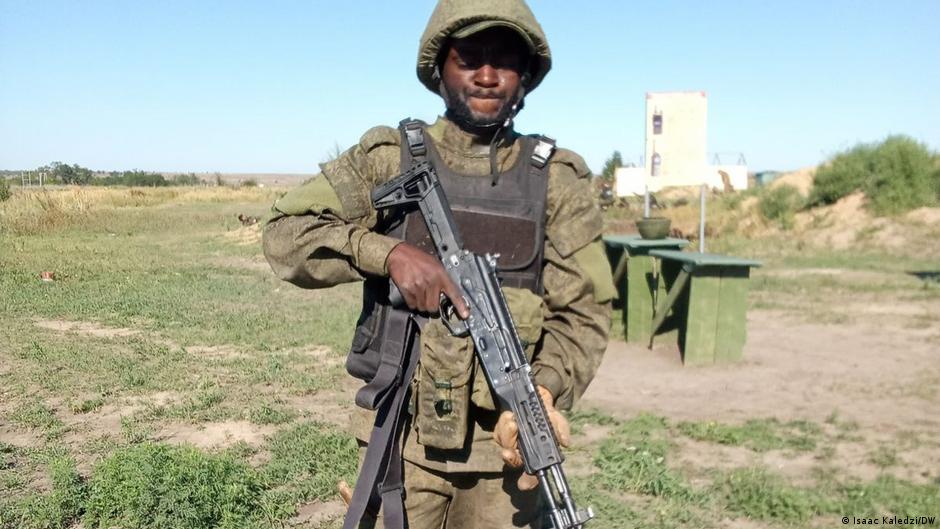
https://p.dw.com/p/5JQsqYoung men across Africa are being tricked into leaving their home countries to fight in Russia's warImage: Isaac Kaledzi/DWAdvertisementCameroon has emerged as one of the leading sources of African recruits for the Russian military, with young men lured by false promises of jobs and fast-tracked Russian citizenship, only to find themselves on the front lines of the war in Ukraine.
Ukrainian officials say that nearly 3,000 citizens from various African countries are known to have fought — or were still fighting — for Russia as of May this year; Cameroon, Ghana, Egypt, Kenya and Uganda were identified as major source countries.
In April, the Cameroonian government confirmed that Russia had reported the deaths of 16 Cameroonian nationals, seven of whom died in military action in Ukraine.
The actual death toll is likely higher, according to DW correspondent Dorcas Ekupe, reporting from Bamenda in northwestern Cameroon.
"When you look at other publications and see what is happening — even seeing families who are grieving their loved ones — the number is really much higher than what the government had earlier said," Ekupe told DW's AfricaLink program.
She described two forces causing this worrying phenomenon: economic desperation and deliberate deception.
Many recruits, she said, travel to Russia believing they have secured jobs in construction or as security guards, or that they are participating in study programs.
"Once in Russia, they then end up on the battlefield," Ekupe said.
African recruits fighting in Ukraine: Where's the AU?To view this video please enable JavaScript, and consider upgrading to a web browser that supports HTML5 video
Russia's perceived appeal meanwhile is also being amplified by highly structured influence campaigns:
Banjo Herman, a lecturer and political analyst at the University of Bamenda, pointed to the key role of the the Russian paramilitary Wagner Group as well as its successor, the Africa Corps, as Moscow's primary instrument for expanding its presence and reputation across Africa.
He also cited Russian government programs such as the "African Initiative" and "Alabuga," which present themselves as cultural or educational exchange schemes but have been linked to military recruitment.
"On the surface, sometimes it looks like cultural outreach," Banjo said. "Sometimes Cameroonians are lured thinking it is for work, not necessarily knowing what is beneath the surface," adding that offers of Russian nationality within six months are also a particularly powerful draw.
France has previously described the African Initiative as a front administered by Russian intelligence services, designed to spread propaganda.
Banjo stresses, however, that the economic situation of the recruits is typically the main motivator.
"Imagine that you are a carpenter in Cameroon who cannot even earn 100,000 CFA francs (€150; $175) a month, but somebody is promising you 3 million CFA francs to come and work," he explains. "It is very attractive."
Meanwhile, he also highlighted the fact that not all Cameroonians in Russia are the victims of deception: Some have lived there for years, were absorbed into the military over time, and are, by all accounts, doing reasonably well.
Yet the promise of financial reward combined with the prospect of gaining Russian citizenship explains why even people aware of the risks continue to accept recruitment offers to fight in Ukraine, he believes.
Ekupe corroborated this, noting a prevailing attitude of fatalism among some youth: "Sometimes people say, 'If I die, I die,'" and agree to join Russian forces.
Africans pay high human cost fighting for Russia in UkraineTo view this video please enable JavaScript, and consider upgrading to a web browser that supports HTML5 video
Families left behind meanwhile are forced to bear the cost in silence: Ekupe described cases in which mothers only learned of their sons' deaths years after the fact — in one instance, when a fellow soldier called home to report that a 35-year-old Cameroonian had been killed in combat.
She added that many families have received no financial compensation from the Cameroonian government, and that some of the men who died had left behind their pregnant wives as well as their children.
Contact between recruits and their families is often severed abruptly.
"When they get there and discover it was not as promised, it is really difficult to inform their family," Ekupe said. "Sometimes they have to take time to adjust to the new environment and the situation, in which they find themselves."
On the question of legal responsibility, Banjo noted that international law does not, in principle, prohibit a foreign national from voluntarily enlisting in another state's armed forces.
Legal liability arises, however, when recruitment involves fraud, coercion, trafficking or mercenary activity.
Banjo cited Article 47 of the Additional Protocol to the Geneva Conventions, which defines a mercenary as someone who agrees to take direct part in hostilities with private financial gain as their main motivation.
Under current frameworks, the responsibility for the death of a foreign fighter in another country's war rests largely with the individual and their family, not the recruiting state.
Cameroon's government has stated publicly that it does not deploy troops abroad outside international mandates, and has warned citizens against joining foreign conflicts.
Analysts are nevertheless calling on the Cameroonian government, and African governments more broadly, to pursue a three-pronged response to stop more people from risking their lives in Russia.
This approach would include economic reforms to create opportunities and reduce the conditions that make deceptive recruitment attractive; direct diplomatic engagement with Russia to hold recruitment networks accountable; and a public awareness campaign that issues clear, proactive public warnings to citizens about the dangers of following such schemes.
Ghana meanwhile has already formally raised the issue with Russia, demanding an end to the recruitment of its nationals.
However in Cameroon's case, there might be another major hurdle in the country's longstanding military ties with Russia, which President Paul Biya moved to renew in 2014 and 2015.
Banjo also said the absence of an official Cameroonian policy response to date reflects, at least in part, the government's awareness that the recruitment is carried out by private actors — limiting the state's formal grounds and opportunities for intervention.
"For the government to stop this," Banjo said, "it has to go back to its governance policy and have a policy that is inclusive, transparent, and in which people can find opportunities within the system."
This article contains material generated by artificial intelligence (AI) from the AfricaLink podcast.
Cameroon's youth caught in Russia's war recruitment driveTo play this audio please enable JavaScript, and consider upgrading to a web browser that supports HTML5 audio