A year after Gen Z-led protests swept Prime Minister Balendra "Balen" Shah to power, deadly floods are testing his government's ability to manage a national crisis.
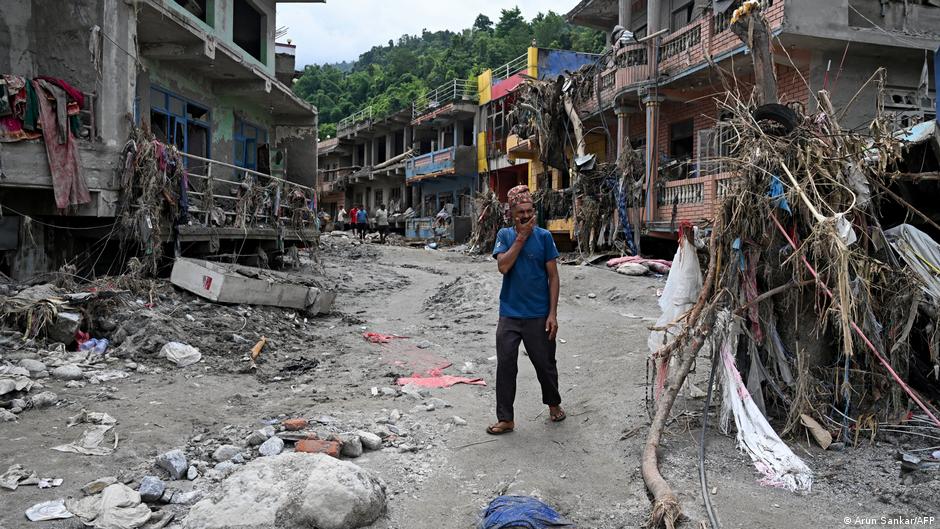
https://p.dw.com/p/5JgkFRescue efforts continue to aid the tens of thousands impacted by the devastating floods, with roads smashed and bridges destroyedImage: Arun Sankar/AFPAdvertisementNepal's Prime Minister Balendra Shah, an ex-rapper popularly known as "Balen," is facing the enormous task of rebuilding communities and critical infrastructure following last week's deadly flash floods.
The floods, carrying rock, ice, mud and debris, swept through areas near the Chinese border, ravaging entire towns and damaging hydropower plants.
More than 900 people have been killed and nearly 4,800 remain missing, authorities said Monday, as rescue efforts entered a sixth day.
The devastating floods struck the Himalayan nation just days before the anniversary of the Gen-Z-led anti-corruption protests of September 8-9 last year that toppled the previous government and swept Shah to power.
Now, the 36-year-old prime minister and his largely inexperienced cabinet face their first major national crisis, in what is shaping up to be the country's worst disaster in a decade.
Rescuers, including Chinese and Indian experts, believe hundreds of workers are trapped in tunnels at hydropower sites under construction that were buried in mud by the catastrophic flooding.
Sushila Giri was waiting for news of her son, Sishir, a Kathmandu University student completing an internship at one of the hydropower projects.
"I came to know that my son, along with others, was at the quarter of the hydro project when the disaster happened," she told DW. "Please help me find his whereabouts."
Gen Z activist Raksha Bam expressed concern about delays in rescuing workers trapped at hydropower projects and urged the government to seek specialized assistance from the international community.
Across affected districts, family members gathered in hospitals and temporary aid centers hoping for news of missing loved ones.
Indra Adhikari lost her home and paddy fields in the floods, while four of her relatives remain missing. She said rescue and relief efforts appeared concentrated in areas accessible by road and where media were present, particularly along one side of the Trishuli River.
"Most of those who have come to Trishuli Bazar are not rescuers but onlookers," she told DW. "Remote settlements farther upstream and across the river remain difficult to reach."
The administration itself has acknowledged that it was not fully prepared for a disaster of such scale, which is the deadliest for Nepal since a 2015 earthquake killed thousands and injured many more.
"On the very first day, we got a bit confused as to how to deal with the crisis," Minister for Information and Communication Bikram Timilsina told DW after visiting the flood-hit area. "[From the] second day onwards, we have been putting all our efforts into swift search, rescue and relief works."
Security agencies have received praise for their response, particularly their efforts to reach people in inaccessible areas via helicopters. But the disaster has also exposed questions about the government's crisis-management capacity and its relationship with Nepal's provincial and local governments.
"Given the scale of devastation, the government's efforts and promptness to deal with the crisis are commendable," Madhu Raman Acharya, a former foreign secretary of Nepal, told DW. "The preliminary search and rescue efforts, especially coordination among security agencies, are commendable."
Govinda Pokharel, a former chief executive officer of the National Reconstruction Authority, which oversaw post-earthquake reconstruction, however, has a different take.
He said that the federal government had attempted to manage the crisis largely on its own, without adequately involving local and provincial governments. This is particularly significant because Shah's ruling Rastriya Swatantra Party has no presence in local or provincial governments.
Pokharel also questioned whether the government's lack of experience had affected its ability to gauge the scale of the response required.
"Our neighboring countries like China and India were willing to lend help for rescue, especially for tunnel-rescue from the very outset," he told DW, adding that the government failed to decide in time whether to allow them to deploy, costing three crucial days.
Nepal starts mass burials of hundreds of flood victimsTo view this video please enable JavaScript, and consider upgrading to a web browser that supports HTML5 video
Nepal initially maintained that its own rescue teams were capable of handling the operation.
But by Friday, Foreign Minister Shishir Khanal told the media that the government had decided to seek international expertise, including from China and India, for tunnel rescues, DNA testing and forensic examinations.
The shift highlighted one of the central challenges facing the new administration: whether the government can act quickly and effectively during a rapidly evolving national emergency.
Pokharel said the government's decision to raise substantial funds domestically for disaster relief demonstrated public confidence.
"One good thing is that the government is collecting a huge sum of public money domestically on the Prime Minister's Disaster Relief Fund," he said. "It shows the public trust in the government that doesn't misuse its funds collected in the name of relief."
By Saturday, over 5 billion Nepali rupees ($34.7 million, €29.9 million) had been collected in a government-run disaster relief fund for flood victims, according to the Office of the Prime Minister and Council of Ministers.
Prabha Bogati, deputy mayor of Bidur Municipality in Nuwakot, said local authorities had limited scope to act during the crisis because the federal government adopted a centralized "one-door" approach, requiring relief activities to be coordinated through a single command structure.
"In previous crises, local communities and volunteers used to be mobilized in search, rescue and relief efforts," she told DW.
Bogati added that helicopter rescues have been effective, but local stakeholders have not been brought into the response and have not been allowed to recover bodies or perform final rites.
Government spokesperson and Education Minister Sasmit Pokharel defended the administration's response, saying all available resources were being mobilized for rescue, relief and rehabilitation.
"In the first phase, our priority was to save citizens' lives by using the available human resources and means," Pokharel told reporters. "A process has also been initiated to better organize the mobilization of volunteers."
In Nepal, families cling to hope as thousands still missingTo view this video please enable JavaScript, and consider upgrading to a web browser that supports HTML5 video