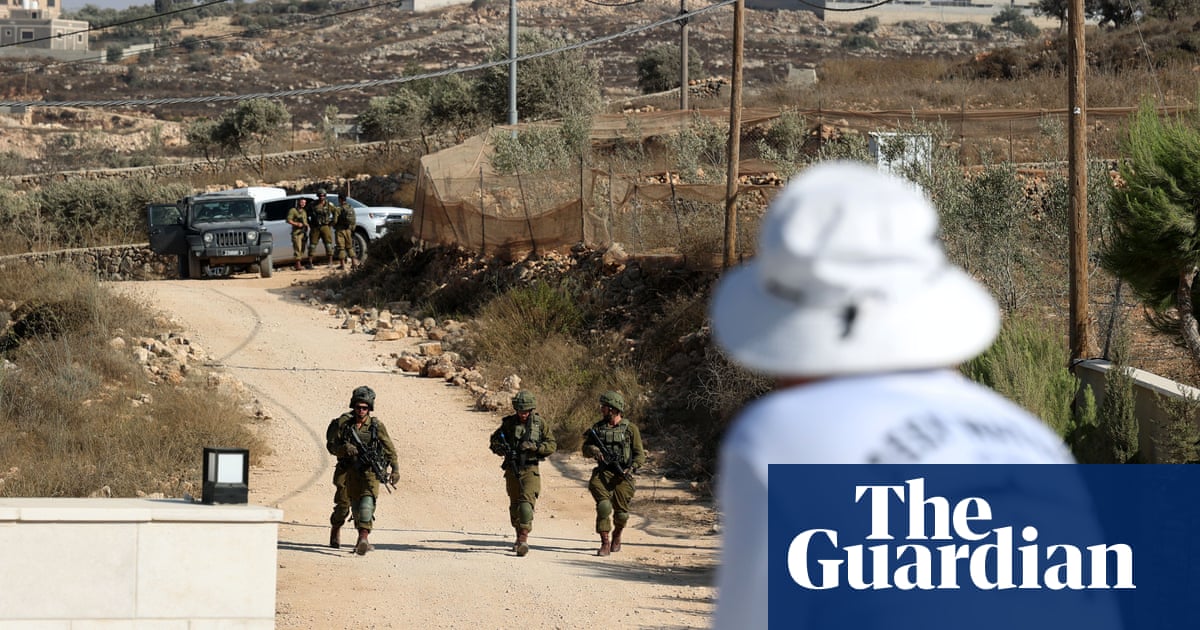
Loui Ridi looks on as Palestinian residents are confined in their homes in the village of Qusra, south of Nablus in the West Bank, on 20 August 2026. Photograph: Anadolu/Getty ImagesView image in fullscreenLoui Ridi looks on as Palestinian residents are confined in their homes in the village of Qusra, south of Nablus in the West Bank, on 20 August 2026. Photograph: Anadolu/Getty ImagesIn a town in the heart of the US, Israeli settler violence in West Bank hits close to homeWar on Gaza and violence in West Bank is playing out in the streets of Toledo, Ohio, where the Arab American community has flourished
From his office outside Toledo, Ohio, Thamin Tim Ridi opens his phone to livestream the scene outside the besieged house of his brother, Loui, thousands of miles away in the occupied West Bank.
This month, with his property at risk of being destroyed by Israeli settlers, Loui traveled from Ohio to his ancestral home in Qusra, south of Nablus, where his mother and other family members have been living in constant fear of attack.
In Qusra, settlers have besieged a number of Palestinian properties and homes, preventing members of the Ridi family from leaving, as their food and water supplies dwindled. The US ambassador to Israel, Mike Huckabee, took to X on 13 August to describe the settlers’ actions as those of “terrorists”.
While the Trump administration has offered broad support to Israel and its illegal settlement building over the years, recent comments from JD Vance, the vice-president, and Donald Trump himself indicate a change of tone.
Read moreRegardless, for Loui’s extended family in Ohio, it’s created a world of concern.
“This building has been taken by settlers; that one up there by the soldiers,” Ridi said, pointing at the outline of buildings further up the hill from his brother’s home that are barely visible on his phone.
“I’m extremely worried about them,” he said, his eyes clued to the security camera footage that’s coming through his phone.
One of the first things Loui did upon arriving at his home in Qusra, said Ridi, was plant an American flag on his property.
For decades, the war in the Middle East had been a distant headline, something that appeared briefly on the evening news, for residents of Toledo in north-west Ohio. But decades of migration to small cities in the American heartland, combined with the war on Gaza and recent rise in settler violence against Palestinians in the occupied West Bank, are bringing the conflict into the streets and homes of places such as Toledo.
Last October, five people were arrested in downtown Toledo for protesting outside the office of Jon Husted, an Ohio Republican senator, who at the time had voted to send aid to Israel.
“There’s been demonstrations, petitions and the city council passed a resolution calling for a ceasefire not long after October 7 [2023]. There’s a palpable difference of opinion regarding what Israel is doing and that the US is funding it,” said Mike Ferner, a US navy veteran and one of those arrested in Toledo. Ferner said he began speaking out against America’s support for Israel after the war on Gaza began.
“It just comes to a point where you have to ask: is this what I want my country paying for?”
Israel’s military assault has largely destroyed the Gaza Strip and killed more than 76,000 people while being condemned by a United Nations body as a genocide. It has prompted Ferner to travel to New York City and organize a 40-day fast in front of the United Nations building last year.
“We made our point as best we could that this is something dreadful and the US has got no business participating in it,” he says.
Ferner’s position is illustrative of a widening gap between American public opinion and the US government’s support for Israel.
While Americans broadly supported Israel in the past, a Pew Research Center poll released in April found that six in 10 participants had an unfavorable view of the country – an increase of 7% in just a year.
The reason is partly explained by mounting anger with the actions of pro-Israel groups such as American Israel Public Affairs Committee (Aipac), which have spent billions of dollars over a period of decades helping to elect American politicians who are supportive of Israel. This year, many of its high-profile candidates have been defeated in primary elections, despite an outlay of tens of millions of dollars.
Arab American communities have grown particularly in the midwest, where job opportunities and a comparatively affordable cost of living have attracted many immigrants to start out.
Aside from English and Spanish, Arabic is the most popular primary language spoken in Ohio. Drawn to the region’s growing manufacturing industry in the early 20th century, Toledo once had its own “Little Syria” district, located in the Old North End neighborhood.
“Since the late 1800s, people would come here, work at Cooper Tire and then retire back in Lebanon; my great-grandparents did that, everyone did it,” says Nabil Shaheen, who as a child emigrated from Lebanon with his mother, brother and sister in 1979, and also worked in manufacturing.
“There are at least 300 families from Sultan Yacub [Shaheen’s village in Lebanon] here. We even have a Sultan Yacub club, which for every occasion we meet there.”
Today, he and his family run a sign manufacturing company west of downtown Toledo.
“This used to be a church, then it was empty, and we came in. There’s a variety of [Arab American] businesses that are contributing to the city of Toledo,” he says from his office, which has wall-to-wall paraphernalia of the Cincinnati Bengals NFL team.
Today, many Arab Americans in the area have moved to suburban Sylvania west of Toledo, where eastern Orthodox churches, a mosque and an Islamic school have opened in recent decades. In these communities, away from the conflict, dialogue between Arab and Jewish Americans has flourished.
“As a Jewish community, we believe deeply in the importance of a shared society: one grounded in respect for diversity, the dignity and rights of every individual,” says Roy Büchler of the Jewish Federation of Greater Toledo.
“Loui [Ridi] and his brother have built successful businesses, created jobs, paid taxes, supported numerous philanthropic causes, and worked to build bridges among people of different backgrounds throughout our community.”
However, the federation declined to comment on the settler violence.
Founded in 1999, the Ridi family’s chain of supermarkets, car washes and gas stations stretch out across north-west Ohio, Michigan and Indiana after several of the brothers came to the US to attend university during the 1990s.
The company, which employs hundreds of people, forms the cornerstone of Toledo’s bustling Palestinian American community and donates hundreds of thousands of dollars every year to charities and nonprofits.
Ridi said he typically visits Qusra three times a year, taking his children, but the war on Gaza and violence in the occupied West Bank have made that harder in recent years.
“I was so surprised by [US ambassador] Huckabee’s comments, calling the settlers Israeli terrorists,” he said. “Maybe something is changing.”