4-MIN READ4-MINAdvertising partnerPublished: 12:00am, 31 Aug 2026[The content of this article has been produced by our advertising partner.]
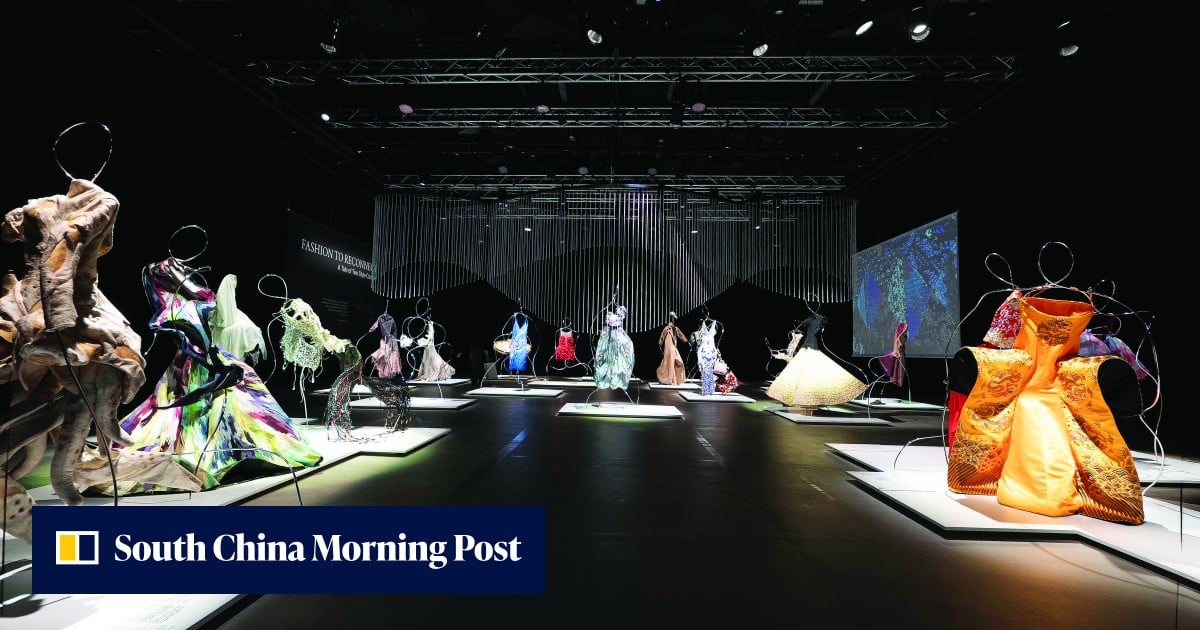
When policymakers talk about sustainable development and better governance, the conversation usually centres on regulation, compliance and economic reform. Rarely does it begin with a runway. Yet in late 2025, Fashion to Reconnect: A Tale of Two Style Capitals showed how cultural innovation—through fashion—can become a powerful driver of systemic change.
Organised by the College of Liberal Arts and Social Sciences (CLASS) at City University of Hong Kong (CityUHK), in partnership with Fondazione Pistoletto Cittadellarte and Camera Nazionale della Moda Italiana, funded by the Cultural and Creative Industries Development Agency of the Hong Kong SAR and supported by the Consulate General of Italy in Hong Kong, the initiative brought together 9 Hong Kong designers and 16 Italian designers. The cross-cultural exhibition drew inspiration from Michelangelo Pistoletto’s Third Paradise.
But beyond the garments and installations, the project functioned as a living laboratory for governance and sustainability—pairing symbolic expression with measurable impact.
“At first it may look like it’s simply a fashion event,” says Professor Esterina NERVINO, Associate Professor at the Department of English (EN) at CityUHK and Project Coordinator. “Actually, it combines fashion, sustainability and art … and was designed to promote sustainability on a large scale, because fashion is part of everybody’s life.”
That universality is key. Fashion touches individuals across all demographics, making it a natural entry point into broader conversations about consumption, responsibility and community. For Nervino, however, cultural innovation must go beyond inspiration—it must also be measurable.
Measuring What Matters
Unlike many cultural initiatives, Fashion to Reconnect embedded accountability at its core. The team developed an impact index to evaluate cultural events across five levels: individual, community, city, institution and economic development. Fashion to Reconnect was the first event to be assessed through the index.
“These five layers are essential to understanding the return on investment when running these kinds of events,” Nervino explains.More than 1,700 participants were surveyed to assess shifts in sustainability awareness and perceptions of Hong Kong’s creative identity. The findings will be published in an upcoming publication and the methodology in a white paper that will be made available to the public.
“I think the ability to measure impact is crucial,” Nervino says. “How do we know it’s working?”
In an era of heightened scrutiny around ESG claims and public spending, frameworks like this elevate cultural initiatives into the realm of governance infrastructure. “It’s not marketing,” she adds. “It’s communication so others can adopt and build on it.”
Equally important, cultural innovation must be tangible and visible. Professor Dorian HO, Adjunct Professor at the Department of Media and Communication (COM) at CityUHK, project consultant and exhibiting designer, emphasises this point:
“Fashion is one of the most direct ways to communicate values,” he says. “People may not read a policy paper, but they understand what they wear.”
The sustainability philosophy was reflected throughout the event: minimal printed materials, no plastic bottles at receptions, and active student involvement across departments. Secondary school students recreated the Third Paradise symbol in a flash mob linked to the Sustainable Development Goals—turning spectators into participants.
“I think the most beautiful thing that happened is that we were able to activate the whole city,” Nervino recalls.
If Nervino brings measurement to cultural innovation, Ho brings narrative power. His centrepiece, Dragon Glow, reimagines a vintage imperial dragon robe—once the exclusive reserve of emperors—as a contemporary evening gown.
“In the past, only the emperor could wear this,” Ho explains. “People see it as very masculine. Then suddenly, it becomes something feminine, while preserving the original embroidery and golden dragon.”
The transformation is aesthetic, cultural and political. Historically, wearing imperial dragon motifs without permission could result in punishment. By reinterpreting the robe as modern couture, Ho symbolically redistributes power.
“Fashion allows us to respect tradition while also questioning hierarchy,” he says.
The piece is also an act of upcycling, extending the life of an existing garment rather than creating something new. Yet Ho is pragmatic about its limitations. “Upcycling is not always practical,” he admits. “It works at a small scale, but it’s difficult to apply in mass production.”
Instead, he sees sustainability as requiring systemic innovation. “There’s a lot of work being done in developing new materials such as bamboo, coffee-based textiles, recycled plastics,” he says. “Designers, manufacturers, and policymakers need to collaborate.”
For Ho, sustainability also includes preserving craftsmanship. “I deeply admire embroidery,” he explains. “Many younger designers no longer learn these techniques. Through my work, I want to encourage appreciation for this art.”
Here, sustainability extends beyond the environment to include cultural continuity—preserving knowledge, skills and identity across generations.
Both professors argue that sustainability is reshaping the very meaning of luxury today. “Luxury is a concept that evolves with time and context,” Nervino observes. “In the past, it was centred on product and brand. Today, it is increasingly centred on people.”
Ho sees this shift reflected in consumer behaviour. “A garment is no longer just something to consume,” he adds. “It becomes a precious object—something that can be inherited. Sustainability itself has become a new form of exclusivity.”
In this framing, true luxury is no longer defined by excess, but by responsibility.
An Ecosystem of Giving Back
At its core, Fashion to Reconnect demonstrates how cultural innovation can strengthen governance when it operates as an ecosystem. “I think ‘ecosystem’ is the right word,” agrees Nervino. “It’s not enough to create a sustainable design if the overall experience isn’t sustainable.”
From student engagement to public installations, the project blurred boundaries between academia, industry, government and the wider community.
For Ho, the vision is both artistic and civic. “Fashion should be an elegant bridge—connecting past and future, tradition and innovation, humanity and nature,” he says.
The exhibition ultimately suggests that governance and policy do not always have to be technical or bureaucratic. Sometimes, they can be cultural, stitched together through creativity, accountability and shared responsibility.